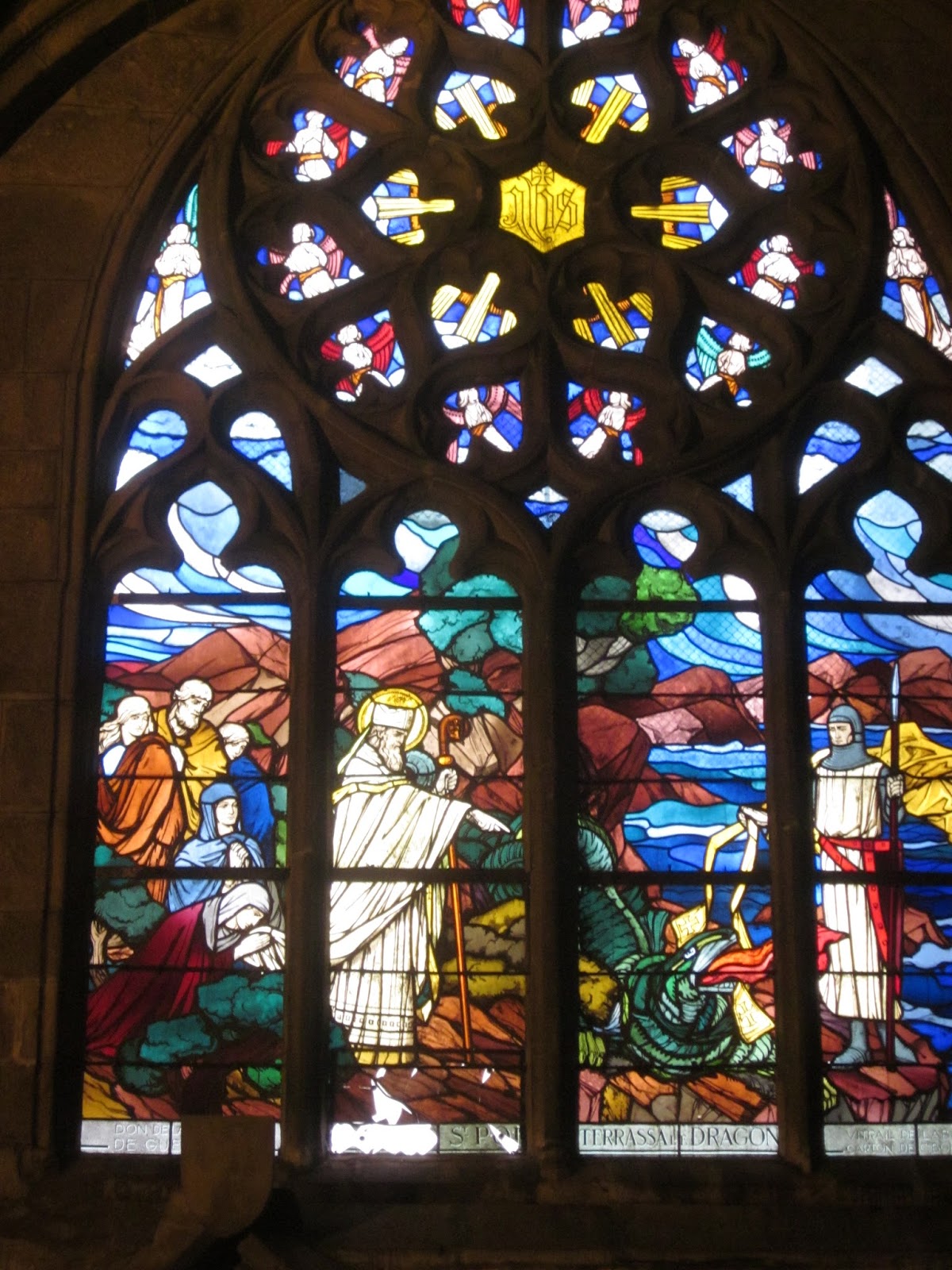
I have been tracing the scenes of St Pol's journey in eastern Léon, looking at the landscape and likely changes over the intervening centuries. Indication in the earliest Vita has the saint moving by land possibly along former Roman roads towards his destination of what is today St-Pol-de-Léon, where his cathedral stands. There he arrived in the wooded valley of Gourveau, and struck the ground with his staff to produce the source which still feeds an enormous stone lavoir by the road leading down to Pempoul from the town centre.
He met a pig-man of the local lord who offered to conduct St-Pol to his master. First they arrived at the almost deserted oppidum which was to become his mainland settlement. Here he finds a wild pig with its young, swarms of bees, a bear and a rampant bull. The event has distinct echoes of Aeneas' arrival in Latium in Vergil's Aeneid, a work that was my constant companion for more than twenty years. In Book 7, Latinus tells of the omen of a swarm of bees in a special laurel tree, interpreted by the soothsayer as the arrival of strangers who will take over. In Book 8, Father Tiber gives Aeneas a sign that he has reached his destined place: he will find a huge sow and her litter of thirty beneath the oak trees. Wrmonoc, the monk at Landevennec abbey who wrote St Pol's first Vita in 884, must have been familiar with the classical text, and adopted its foundation symbolism. Pol's subsequent blessing of the boundaries (earth-and-ditch defences) with water and salt also has a distinctly pre-Christian tang.
St-Pol tamed the pig and domesticated the bees in hives. The savage inhabitants fared less well: the bear ran off and lost itself in a deep ravine, while Pol faced down the rampant bull. One can't help a sneaking suspicion that it was the same one he had remonstrated with at Lampaul-Ploudalmezeau, one who could not resist following his holy opponent across Léon for another ticking off. A taurine stalker is just another potent enhancement factor for the saint.
There is another tradition of St Pol, on the north coast of Finistère, perhaps indicating a separate journey at another time. But it does include his arrival at the Pointe de Beg Pol (the point of the point of Pol!) by the current Phare de Pontusval in a stone boat. When locals attempted to drag this item by oxen, the beasts stopped definitively on top of a nearby knoll and the stone remained there. Today the little chapel of St-Pol stands on the spot in a rather special setting among boulders.
Monday, March 20, 2017
Thursday, February 23, 2017
St Pol and the dragon
The
iconography of St Pol (Sant Paol in Breton), one of the founding saints of Brittany , shows the saint with a dragon
beneath his feet. The reference is to an event on the Ile de Batz, in the area
where he came to settle permanently, witnessed today by the nearby mainland town
of St-Pol-de-Léon with its cathedral commemorating St
Pol as the first bishop in the early 6th century.
St Pol
began his religious career in Wales , studying at the prestigious
monastery of Llanwit Major. From a noble family, he was marked by his piety
from an early age, although the evidence for his later life suggests the uneasy
mixture of asceticism and missionary zeal not uncommon in the early Breton
saints. After a sojourn with King Mark in Cornwall , where he was refused a bronze bell
to take to his new land, St Pol sailed across the Channel to confront the pagan
population of western Brittany with the steady truth of
Christianity.
This
focused purpose is suggested by his first landfall on Ouessant, a remote island
in the Atlantic off the north-west shore of Brittany . Here there was a well-established
pagan cult centre, a group of priestesses that St Pol is said to have forced
from one end of the island to the other. A cross on the cliffs marked his first
landfall, with a nearby stone bearing the imprint of his knees at prayer. The
name of the only sizeable settlement on Ouessant today is Lampaul – the holy
place of St Pol.
Further
place-names reflect the saint’s traditional journey eastwards across what is now
Léon, the northern part of Finistère: Lampaul-Plouarzel, Lampaul-Ploudalmezeau,
the chapel of Prat-Paol, Lampaul-Guimiliau and finally St-Pol-de-Léon. Here St
Pol is said to have had a positive interview with local count Withur (who may
have been a relation), and received land on the Ile de Batz, just off Roscoff.
Here he founded a monastery on the site of what later became a chapel to
St-Anne, still visible in ruins on the island now.
The Ile de
Batz was terrorised by a marauding dragon and the inhabitants approached St Pol
for help. He is said to have called the beast out of its lair, placed his
bishop’s stole around its neck, led it to the western edge of the island and
commanded the dragon to hurl itself into the sea. It obeyed. The place today is
called Toull ar Zarpant, Serpent’s Hole, and a striking rock formation marks
the bay where this remarkable event took place.
In the
village church, a medieval bishop’s stole is displayed in a glass case, echoing
the most memorable feature of the story, a wild beast led like a tame dog to
its death. The fabric has been tested and is very early, possibly 8th
century, alas too late for St Pol himself who died near the end of the 6th
century at the great age of 102.
He had
wanted to continue a quiet monastic life on the Ile de Batz, but was tricked
into becoming a bishop by Withur who sent him to Clovis in Paris with a note requesting his episcopal
consecration. Thereafter he cleared more wild beasts from the Celtic site of
Occismor and founded what later became the cathedral and town of
St-Pol-de-Léon. Official life was not congenial to St Pol who made several
thwarted attempts to retire to the Ile de Batz before he was finally allowed to
live out the rest of his long life in peace there.
The dragon
story overrides all other tales of St Pol’s miracle-working, such as healing
the blind and commanding the sea to respect a boundary he had set, the powers
that set him apart from other Christians in his group of settlers. It is surely
the detail of that wild monster behaving like a family pet that sticks in the
memory and makes the story curious. Another interesting detail, often
overlooked, is that the saint took a companion with him for this feat, a
certain knight from Cléder. The implication of a knight is of course a warrior
with a sword, which sounds suspiciously like an insurance policy or back-up
plan. Did St Pol want a witness? Or perhaps a muscle-man if things did not turn
out to his advantage. Did the islanders turn out to watch a potentially
thrilling contest or cower in their huts until the danger was past? An observed
miracle and a reported one are markedly different things.
If the
dragon, so vividly described in the Latin text of an early Vita of St
Pol, written by Wrmonoc, a monk at Landévennec in 884, symbolized pagan
religion, the worship of natural forces and elemental powers, it was perhaps
apt that it met its end on the western shore, a direction associated with death
and the Isles of the Blessed in Celtic mythology, here where the sea stretches
emptily and endlessly into the far distance. The bay is crammed with rocks of
all sizes today, dominated by the vaguely beast-shaped pile of giant stones at
a point exposed fully at low tide. The sea of course has resurrective potential
in pagan mythology, so the beast may not have been reluctant after all, and
needed little bidding to opt not for destruction but regeneration, and a
welcome release from the irritating goodness of Christian saints.
Tuesday, February 14, 2017
Dull and cold
Spent the weekend in St Brieuc and the environs. I fear I shall never like this dull town with its tortuous traffic arrangements, incohesive centre and claustrophobic streets, despite a scattering of handsome half-timbered houses. The cathedral, built with defence in mind, has a dour and forbidding exterior, hardly enlivened by the gloom inside, the unadorned walls punctuated by bishops' tombs. Certainly the building was badly used at the time of the Revolution, but the interior still seems inhabited by the miasma of an unholy trinity: defeat, loss and martyrdom.
The Bay of St Brieuc is an open relief after many attempts to leave the town are thwarted by poor signage and roadworks further confusing an already baffling one-way system. The tourist office had provided me with maps for my visit to the bay area. Unfortunately, these did not include minor roads so finesse of direction was tricky. It's a long time since I explored this area for the Footprint Brittany guidebook, but I had various goals in mind, thinking about the new book and old pathways. I drove along a road based on the Roman route towards Corseul, capital of the Coriosolites in Celtic times, before branching off along a beautiful curvy split route with trees on both sides and between the carriageways, to the small bourg of Hillion with its appealing Romanesque church,
I then walked the coast path beyond the look-out point at the Maison de le Baie. It's a weekend of high tides and this bay is famous for one of the longest recoils in the world, when the sea retreats for up to 7km. It was out for me, so there was plenty of bird-life on the exposed bed, including a flock of Tadornes de Belon. I'm fond of this chunky bird whose peculiar markings make it look unfinished, a work in progress.
Moving inland and onto the high ground in the commune of Yffiniac, I found the Fontaine des Sept Saints beside the little chapel of St Laurent, tucked unobtrusively into the hilside beside a huge racecourse. In this case it is seven healing saints, not the founding saints of Brittany, nor the sleeping saints of Vieux-Marché. It just goes to show the insecurity of the historical evidence for the Tro Breiz pilgrimage. References to the the Seven Saints exist in various documents, but which seven is far from clear. Here it is Guenolé, Jacut, Lubin, Tugdual (Tudwal), Méen, Cadoc and Armel, each patron of their own speciality disease, from rabies to eczema.
Last stop was Ploufragan to search for three ill-signed neolithic monuments. After two, the bitter wind got the better of me and I headed home. The highlight of my weekend was without doubt having the swimming pool at the beautiful appartments where I stayed (Domitys Le Griffon d'Or in St Brieuc) all to myself on two occasions.
The Bay of St Brieuc is an open relief after many attempts to leave the town are thwarted by poor signage and roadworks further confusing an already baffling one-way system. The tourist office had provided me with maps for my visit to the bay area. Unfortunately, these did not include minor roads so finesse of direction was tricky. It's a long time since I explored this area for the Footprint Brittany guidebook, but I had various goals in mind, thinking about the new book and old pathways. I drove along a road based on the Roman route towards Corseul, capital of the Coriosolites in Celtic times, before branching off along a beautiful curvy split route with trees on both sides and between the carriageways, to the small bourg of Hillion with its appealing Romanesque church,
I then walked the coast path beyond the look-out point at the Maison de le Baie. It's a weekend of high tides and this bay is famous for one of the longest recoils in the world, when the sea retreats for up to 7km. It was out for me, so there was plenty of bird-life on the exposed bed, including a flock of Tadornes de Belon. I'm fond of this chunky bird whose peculiar markings make it look unfinished, a work in progress.
Moving inland and onto the high ground in the commune of Yffiniac, I found the Fontaine des Sept Saints beside the little chapel of St Laurent, tucked unobtrusively into the hilside beside a huge racecourse. In this case it is seven healing saints, not the founding saints of Brittany, nor the sleeping saints of Vieux-Marché. It just goes to show the insecurity of the historical evidence for the Tro Breiz pilgrimage. References to the the Seven Saints exist in various documents, but which seven is far from clear. Here it is Guenolé, Jacut, Lubin, Tugdual (Tudwal), Méen, Cadoc and Armel, each patron of their own speciality disease, from rabies to eczema.
Last stop was Ploufragan to search for three ill-signed neolithic monuments. After two, the bitter wind got the better of me and I headed home. The highlight of my weekend was without doubt having the swimming pool at the beautiful appartments where I stayed (Domitys Le Griffon d'Or in St Brieuc) all to myself on two occasions.
Sunday, February 05, 2017
February
I wrote a long post at the end of January about what a frustrating month it had been and then could not get access to my blog to post it! February has begun with the same pattern of set-backs and obstacles, although the weather has changed from the beautiful freezing sunny weather so perfect for walking to storms, hailstorms and persistent rain. I have spent a lot of time doing translation (Arthurian research by Christophe Deceneux) and waiting for translation pieces booked but never appearing and thus storing up further frustration for this month. I have been let down in a most dishonourable way by a contractor who was to do major work at my house (and I've been waiting five months for his services already. Still, my father always told me never to trust an Englishman ;-)).
Two articles have been written, two interviews given and a very successful launch of my new book enjoyed, but all I really want to do now is have clear time to get on with the next. Finally the French translation of Spirit of Place is done and at the printer, well in time for the February 19th launch, but getting it done has been a very rough ride.
Both my lap-tops are malfunctioning, the elder through exhaustion and the baby, initally my pride and joy, for no reason capable of analysis. It has been nothing but trouble from the set-up and I tend to do no more than leave it alone in its smart new case and make notes on scruffy bits of paper. Things can only get better. This week I am teaching a course about the Tro Breiz to lovely people in a lovely place and having a session with my lovely personal trainer, and maybe an island trip, so nothing to complain about at all... I am also incredibly pleased by and grateful for all the really wonderful comments on the new book. The theme has clearly struck many a personal echo.
Two articles have been written, two interviews given and a very successful launch of my new book enjoyed, but all I really want to do now is have clear time to get on with the next. Finally the French translation of Spirit of Place is done and at the printer, well in time for the February 19th launch, but getting it done has been a very rough ride.
Both my lap-tops are malfunctioning, the elder through exhaustion and the baby, initally my pride and joy, for no reason capable of analysis. It has been nothing but trouble from the set-up and I tend to do no more than leave it alone in its smart new case and make notes on scruffy bits of paper. Things can only get better. This week I am teaching a course about the Tro Breiz to lovely people in a lovely place and having a session with my lovely personal trainer, and maybe an island trip, so nothing to complain about at all... I am also incredibly pleased by and grateful for all the really wonderful comments on the new book. The theme has clearly struck many a personal echo.
Wednesday, January 04, 2017
New book
My new book is out (in English) next week, with a launch at The Bookshop, Huelgoat, on the 14th and 15th January, 2.30-4pm. The French translation will have its first airing at the Salon du Livre, Le Cloitre St Thegonnec in February.
This book looks at the character and personality of certain ‘little
landscapes’ in western Brittany, considering
what sets them apart from their surroundings. Some, like the extraordinary
megalithic cairn at Barnenez are well-known, others like the Chaos de Mardoul
are well off the beaten track. Emotional links with place are also explored, as
well as general themes of relating to the environment and the possibility of seeing
into nature beyond accepted notions of beauty and cultural filters. Topics
include the nature of ruins, sacred geography and the sense of belonging to the
land. ‘Place writing’ and personal connection combine to express some
fundamentals of intimacy with landscape.
Eleven doorways, eleven passages and eleven burial chambers: a terrace
of dead neighbours, a defunct community echoing the values and social
continuity of its creators. It is also an abiding memorial, although those
responsible could scarcely have anticipated the endurance of their project. The
cairn of Barnenez changed the colour of the landscape.
Sunday, January 01, 2017
2017
HAPPY NEW YEAR from St Pol de Léon to all friends and followers. My new book Spirit of Place in Finistère is out in English on January 14th, with French edition following in February. Thanks for all the support over the last year. Concentrating now on the Tro Breiz and a new fiction project.
Friday, December 30, 2016
Being outside
Being outside. Those words have defined my life for good and ill. They
reflect my preference for place over people and the resulting separateness. As
a child it was a physical longing, more than that, a necessity to be out of
doors, away from the cage that family life often formed. The sense of
liberation and free choice is intimately connected for me with open space, with
air and sky. I have come to see my definition and sense of identity in a
connection with landscape. Place before people, expansion before confinement. I
don’t function well within physical limits.
Looking back, my life is speckled with moments of profound
identification with my environment, and the course of my own career and
development has been an irresistible, if wavy, line drawing me along the
pathway of freedom and belonging. The journey began in Gloucestershire, found
meaning in leaving that manicured terrain far behind, was inspired by the
Brecon Beacons, and matured in the south Wales of my parental
roots. It floundered in the relentless urbanity of London and revived in the
relenting rurality of Somerset. There I began
to understand the nature of spiritual pilgrimage and the value of landscape in
life. My wayfaring has been equally fired by the Tatra mountains of southern Poland and the misty
sweep of Exmoor,before being finally fixed in the
granite of Brittany, where the
moment of arrival was an awakening.
Here's to being outside in 2017...
Monday, December 12, 2016
Walking
Walking is our most natural pace. The moderate
speed allows us to gain the greatest appreciation of what we pass. Early man
needed to assess signs and sounds of danger and to spy out sources of food and
water, all of which required a level of examination of the terrain he passed
through that can only be achieved by pacing or striding. Jogging and running,
cycling and horseback riding separate us from the detail of landscape by speed
or height. By those methods we notice less: screeds of bluebells but not the
first violets; a beautiful old stone wall but not the little heads of stoats
peeping out of the cracks; a fish jumping from the river but not the tracks of
otters on the bank. The detail needs time and deliberate searching by eye, and
it’s the detail that raises the level of experience and a sense of connection
with the other inhabitants of the earth as well as nature’s manifests.
The same is true of walking in an urban
environment. We need our senses to be alert but also our movement to be slow
enough to separate a blur of buildings or a flash of green space. Driving
through a town in a car or riding a bike requires attention to be focused on
the travel itself for safety. Stopping and starting may provide moments of
observation but these are hardly leisured and the flow of traffic usually dictates
the pace of passage. It’s possible to admire a street of medieval half-timbered
houses, to get a sense of historic atmosphere through glimpses of architecture,
but you have to walk to access the minutiae of decorative art. You also have to
walk to appreciate fully the development of settlement patterns, the
relationship between older and newer elements, the changing demands of society
in an urban environment.
The complexity of landscape we have created can
only be appreciated through the simplest of movements.
Saturday, November 05, 2016
Association des Ecrivains bretons
| Parish Close at St-Thegonnec |
The AGM was run by our President, Michel Priziac, a tireless worker for the interests of writers and a prolific author himself, place-names and the historical associations of places being two of his specialities. He has done a great deal to promote the association and encourage writers to make the best of their talents in recent years. Other members of the committee also give their time freely to perform the many administrative and organizational tasks required to keep a large association not only ticking over, but constantly exploring new avenues of interest to members.
After lunch and more feedback on the year's events, prizes, awards, future plans, etc. we drove the short distance to St Thegonnec for a guided tour of the famous Parish Close. I bring many groups and individuals here myself, so it was rather enjoyable to visit without responsiblity and to benefit from Anne Guillou's exceptional local knowledge.
I could not stay for drinks with the mayor, kindly offered to the Association by the commune - or rather the new commune, as St Thegonnec has just amalgamated with Loc-Eguiner-St-Thegonnec. I came away once again with an invigorating sense of the extraordinary vitality of associations in Brittany and the passionate commitment to heritage and tradition so prevalent here, as well as the pleasure of meeting up once more with fellow-writer-friends.
| Anne Guillou's guided tour |
Sunday, October 16, 2016
TRO BREIZ – a last long walk
| Dol-de-Bretagne |
I am thinking of walking
the Tro Breiz next year. It would need to be in stages, as the entire route
tops 600km and would definitely be my last long distance walk. Let’s see how my
fitness stands at the end of 2016 before the big decision.
The Tro Breiz pilgrimage
connects the seven cathedrals associated with the seven founding saints of Brittany: ‘founding' because they
represented the initial wave of proselytising Christianity which took hold of Brittany in the 5th and 6th centuries.
Indeed this was the time when Brittany itself came into being in an
embryonic state, as migrants from the British Isles arrived to start new lives, mingling their language
with that of the indigenous population.
The name Brittany of course means 'little Britain'. Five of the seven saints were
probably of Welsh origin, only two being natives of the Armorican peninsula
(Amorica was the Roman name for NW France), perhaps sons of immigrant parents.
The cathedrals later associated with the seven – and in order of the route I’ll
maybe take - are St-Pol-de-Léon (St Pol), Tréguier (St Tugdual), St Brieuc (St
Brieuc), St Malo (St Malo), Dol-de-Bretagne (St Samson), Vannes (St Patern) and
Quimper (St Corentin).
| Quimper |
There is evidence that
this ‘Breton journey’ was a genuine medieval pilgrimage route, an undertaking
of serious commitment to be achieved once in a lifetime to be that much more
secure of a heavenly future. Although the actual paths are mostly lost, old
Roman roads, still major highways in later periods, certainly formed important
links: for example, we know that a pilgrim from Morlaix took the 'Roman road
nearest the shore' on his way to Dol. Another Roman road connecting Vannes and Quimper must also have been part of the
chain.
There are many place-names containing
references to pilgrims (although these may just as likely refer to those on the
Compostela trail), such as Le Champ du Pèlerins and La Fontaine-aux-Pèlerins.
Some see an allusion to the 'Green route of Hope'(= salvation, by completing
this journey) in names like Le Chemin-Vert and Les-Croix-Vertes. The study of
toponyms is so often not a conclusive investigation.
Another approach to establishing the ancient
ways involves looking at where pilgrims would have stayed along their route.
Abbeys and establishments of the Knights of St-John, such as that at La
Feuillée, made natural stopping-places for travellers anxious about security.
And certain chapels and fontaines along routes between the great
cathedrals are known to have been focal points for spiritual travellers on the
Tro Breiz: for example, La Trinité near Melgven.
I have often written and publicly spoken about these saints, I know the seven
cathedrals well and have walked many miles of the paths used for the
contemporary version of the Tro Breiz, recreated by the hard work and
dedication of an association based in St-Pol-de-Léon. But the idea of one last great
big walk with ancient connections, full of modern logistics, drenched in beautiful
Breton coast and country, doubtless spiritually uplifting even to an old
animist like me is almost irresistible, despite the inevitable physical trial
it will also provide.
| Tréguier |
Sunday, September 25, 2016
Away and home
| Coming home |
Since then I have been working, and having fun, as a guide to American tour operator, Mindie Burgoyne, (www.thinplacestour.com) and her husband Dan. We have packed the last two days with visiting natural wonders in the forest, megaliths on the moors and elsewhere, and churches demonstrating the complexity of religion in Brittany, where paganism is never far from Christianity.
| Enclos at Guimiiliau |
Sunday, September 04, 2016
The Chaos of Mardoul
Water’s words to stone here are alternately loving and savage, caresses
turn violent, stroking becomes a slap. In wild weather it is a seething
insistence of water. All that rock can do is hold to itself, edges rounded to
ease the onslaught and survive the longest time under a constant assault that
is both smooth and brutal. It’s an unequal contest in the end. The river can spread
to mount its challenge: the rocks have no more movement in them. In dancing
steps the water constantly changes direction, twisting, turning, preening round
its static partner, forming shapes and ritual traces, like little tripping
thoughts of happy times. As water tires of obstacle, there’s the trumpet of
torrent and torment, a surge of force. Under an angry wind, white-topped waves
rage down the valley. In gentler times, with little explosions of foam like a
series of sneezes, it glides as clear as glass down a shelf of rock. The old
war between rock and water is a lost cause for the remnants of another earth.
The river will have its way, hard or easy.
Friday, August 19, 2016
Out and about, getting somewhere
I've been on two trips recently to spend more time in places that will figure in the new book. Firstly down south, among the black rocks of St Guenolé, initially given cultural reference by Chaucer in The Franklin's Tale, when Dorigen paces the coast at Penmarc'h, fearful for her husband's safe return to such a treacherous shore. It's a dangerous spot, with many fatalities to this day as foolish spectators of the high tides edge out to risk their lives for more dramatic photos. In fact the flat shelving of dark rock, completely hidden when the tide is up, is somehow more frightening and sinister than the gigantic stone pinnacles with iron railings to cling onto in the hope of avoiding being swept away by a freak wave. This was, in fact, the fate of the Prefect of Finistere's family as they enjoyed a leisurely picnic in 1870. Several of the bodies were never recovered.
This week I was in north-west Finistère, watching the estuary tides on the Aber Wrac'h for my chapter on Pont Krac'h, the Devil's Bridge. There was also time to hop over to Landunvez for some coastal reflections around the chapel of St-Samson, the scene that figured on the cover of my cultural history of Brittany, and one which will also appear in the new book.
At last I feel I'm getting somewhere in terms of completing this work. Delighted to say that Lynette Hardwick, an illustrious illustrator, will provide line drawings for my text, so we have also been working on those, and the page lay-outs - and the French version is also underway. Now all I have to do is finish the text....
This week I was in north-west Finistère, watching the estuary tides on the Aber Wrac'h for my chapter on Pont Krac'h, the Devil's Bridge. There was also time to hop over to Landunvez for some coastal reflections around the chapel of St-Samson, the scene that figured on the cover of my cultural history of Brittany, and one which will also appear in the new book.
At last I feel I'm getting somewhere in terms of completing this work. Delighted to say that Lynette Hardwick, an illustrious illustrator, will provide line drawings for my text, so we have also been working on those, and the page lay-outs - and the French version is also underway. Now all I have to do is finish the text....
Tuesday, July 19, 2016
Short extract, work in progress
I have been busy with non-work related stuff lately, including a very pleasant interlude manning an art gallery in Goarec last week for a friend's exhibition. Now we have a heatwave and I struggle as ever to achieve much in such atmosphere, but I'm determined to finish with the landscape book in the next few months and move on to completely different writing projects. So, getting back into the mood...
The landscape is a sponge for emotions, the great soakaway of human
experience. We bring our woes and stresses to nature and lay them down at the
feet of the sea or on a lonely mountain top or beside a quiet forest pool.
Often we seek nature’s company simply because it demands and expects nothing
from us, giving temporary release from inner burdens or the opportunity to
ponder issues in the comfortable airy freedom of the outdoors. The search for
peace and quiet is a strong factor in our need for landscape, balm for the
human individual who is so rarely physically alone and in silence in modern life.
We also respond deeply to the expansion of our vitality into open space and the
basic practice of walking, man’s most natural pace, which puts us back into a
lost rhythmic relationship with the detail of landscape.
Monday, June 06, 2016
Mindlessness inflicted on rocks
The defacing of stones by mindless graffiti is not a recent phenomenon
but I have become mightily aware of it since living in an area famous for its
granite boulders of remarkable size and shape. Apart from a few minor examples
which are fairly unobtrusive unless up close to the rock-face, there has been
surprisingly little of this most brash kind of damage up until now.
Two recent glaring instances, however, have made me re-evaluate my own
reactions. The first appeared a while ago, high up on a steep hillside above
one of the main roads out of town. The tree cover has been felled, leaving an
open expanse of boulders, dead wood, scrubby growth and churned earth. One of
the stones, a pleasingly rounded mass of grey granite has been given two eyes
and a smile, courtesy of black paint. And it made me smile the first time I
passed, like a sudden revelation of a grinning entity long hidden by forest
growth. This anthropomorphism of rock did not make me think of defacement and
hooliganism at all, but initially as something rather amusing, the sort of
landmark that people driving in and out of the town would enjoy. It is after
all the rocks that give this place its life and identity. And people relate
more easily to the sort of facile humanization shown here than the apparent
in-animation of a mass of stone. I regret this reaction on reflection and
attribute it to the fact that the rock is simple and ordinary, un-moulded by
dramatic erosion.
The second example has made me angry. A famous rock, mid-stream in the
river and hollowed out by natural erosion of granite to resemble a mini-cave or
seating-place, has acquired the incised initials DD, writ large above the
opening. The main tourist path passes here and the rock itself is easily
accessible from the far bank across other stones, so it has become an obvious
spot for photos of children or adults sitting inside the rock or filming of
atmospheric sequences. I once saw a korrigan (local gnome of spirited
character) seated inside the stone as the camera rolled for a Breton themed
short or perhaps a tourist trailer. That is harmless fun and in its way does
honour to the natural qualities of this environment. The ensemble of river and
rock under a canopy of trees pierced by shafts of light is a conjunction of
elementals that speaks powerfully to something inside us and defines the spirit
of this particular place.
The rock will long outlast the cretin and the letters will weather away,
but the imposition of humankind – the engraving of initials is a statement of
facile human power over nature – degrades this landmark, as well as the
perpetrator him or herself. It is not the work of a child but an ‘adult’. It is
not the work a moment but considerable effort.
The fact that I care more about this than the other reflects the important
of context in our relationship to particular landscapes. The smiley face is in
essence no more acceptable to lovers of natural landscape than the initials,
but it reveals at least benign intention rather than an egotistical assertion.
The latter instance seems so much more intrusive by its deliberate spoiling of
a significant spot for locals and visitors alike, a rock whose whole incredibly
long history is mapped in its unique shape, its situation where the combination
of elements stands together to create a powerfully numinous experience for
those who are open to it.
Thursday, May 19, 2016
Monday, May 09, 2016
The art of landscape
| In the May Greenwood |
It all made me reflect as bitterly as usual on the totally unnatural
walkers’ cairns that now so
often spoil wild and rural landscape. These are glaringly intrusive features, making statements about the self, vaunting the vertical as mankind
is so fond of doing. Are people not capable of containing their homage to place
within? Are spiritual and emotional reactions too demanding compared with
piling Pelion on Ossa? Do we still need to say so physically ‘I was here’?
These clumpy lumps are not art, just empty self-expression.
Contrast them with the sinuous partnership of man and nature in the work
of Nash, Brook and Goldsworthy, whose challenge is to enter into landscape
rather than impose themselves on it, to understand its workings and to learn
the strengths and limitations of its materials. Their work is not immediately
outstanding from the surrounding landscape, so close is the harmony between
nature’s creation and their own. They reflect that edge of us that can soften
into landscape and blur – often fleetingly, for such is nature - the separation
between man and his environment. Picking up a stone and placing it on top of
another, distorting the lie of the land and showing community with other people
rather than natural landscape is not an art. Unfortunately it is rapidly laying
claim to being a tradition.
Sunday, April 24, 2016
The island of Ouessant
It's been a busy time with various guided visits/tours and translation work, whilst moving house, with all that brings. I recently enjoyed a great visit to the island of Ouessant, taking a small group to see the dramatic landscape of this westernmost outpost of Breton territory, 25km out into the Atlantic from the coast of the Pays d'Iroise. We left from Brest for a three hour voyage out, stopping at mainland Le Conquet, then the tiny island of Molène before crossing the turbulent waters of the Fromveur towards Ouessant. It's odd to arrive in an isolated port without houses, commerce or bars, but only stark cliffs and the towering radar tower that protects the Rail d'Ouessant, keeping large freighters at bay. Le Stiff, the oldest lighthouse in Europe (Vauban's idea in 1695) peeps out above the headland.
We were staying on the edge of Lampaul, the only village, at the other end of the island. Its name reflects the tradition that Welsh saint Pol Aurelien made land here and initiated a spirited confrontation with pagan practices, determined to break up a sizeable cult centre. Decades of archaeological investigation at Mez Notariou have offered some insights into the nature of island worship from the Bronze Age onwards. The results can be seen in an exhibition in the Museum of Lighthouses and Signalling, located in the iconic black-and-white Phare du Creac'h.
In the bourg, we visited the church and cemetry to see evidence for the proella, a sad ritual made necessary by so many lives lost at sea as the menfolk from the island habitually served in the French navy. A small wax cross was treated as a symbol of the dead, with a vigil at the family house, a procession to the church, the placing of the cross in an urn until a bishop's visit for a formal blessing, and then the 'resting-place' of the cross in a special tomb in the cemetry, the only structure aligned north-south in contrast to the graves which all lie east/west.
Mostly we walked the coastal path, surrounded by lighthouses and the sites of countless shipwrecks, whose origins indicate the location of Ouessant at the epi-centre of international trade over centuries. In 1937 the Greek ship Mykonos went down off the northern shore (remains can be seen at low tide at the Baie de Calgrac'h), releasing a cargo of fat white sheep which some enterprising local took advantage of, with the result that traditional scraggy, hardy black Ouessant sheep are a rare sight in their home territory.
Ouessant is an exceptional place for walkers. My new book Walks in Finistère contains a feature with full maps, suggested routes and places of interest along the way. The island offers nearly 50km of coastline and plenty of inland paths through hamlets, marshes and moors, mostly with views of the sea on the horizon.
We were staying on the edge of Lampaul, the only village, at the other end of the island. Its name reflects the tradition that Welsh saint Pol Aurelien made land here and initiated a spirited confrontation with pagan practices, determined to break up a sizeable cult centre. Decades of archaeological investigation at Mez Notariou have offered some insights into the nature of island worship from the Bronze Age onwards. The results can be seen in an exhibition in the Museum of Lighthouses and Signalling, located in the iconic black-and-white Phare du Creac'h.
In the bourg, we visited the church and cemetry to see evidence for the proella, a sad ritual made necessary by so many lives lost at sea as the menfolk from the island habitually served in the French navy. A small wax cross was treated as a symbol of the dead, with a vigil at the family house, a procession to the church, the placing of the cross in an urn until a bishop's visit for a formal blessing, and then the 'resting-place' of the cross in a special tomb in the cemetry, the only structure aligned north-south in contrast to the graves which all lie east/west.
Mostly we walked the coastal path, surrounded by lighthouses and the sites of countless shipwrecks, whose origins indicate the location of Ouessant at the epi-centre of international trade over centuries. In 1937 the Greek ship Mykonos went down off the northern shore (remains can be seen at low tide at the Baie de Calgrac'h), releasing a cargo of fat white sheep which some enterprising local took advantage of, with the result that traditional scraggy, hardy black Ouessant sheep are a rare sight in their home territory.
Ouessant is an exceptional place for walkers. My new book Walks in Finistère contains a feature with full maps, suggested routes and places of interest along the way. The island offers nearly 50km of coastline and plenty of inland paths through hamlets, marshes and moors, mostly with views of the sea on the horizon.
Monday, March 28, 2016
New book
Advance copies arrived - out shortly. My new collection of walks in Finistère including town, coast, country, island, circular and linear routes, features on places of special interest to walkers. Published by Red Dog Books (www.reddogbooks.com) who produced the excellent maps. Practical spiral binding. Enjoy.
Wednesday, March 16, 2016
Combourg and environs
| Chateau de Combourg |
There was also time to seek out a little known menhir of great size and presence, rather unusually placed on a high ridge not far from Broualan.
Subscribe to:
Posts (Atom)