Tuesday, March 24, 2015

Moor thoughts

I returned today after a six month absence to my old haunts on the moors and was instantly overwhelmed by a deluge of familiar sensations. It was as if the first pressure of my foot on the stony track activated a certain pattern of thought, despite the many changes in my life and perceptions in the interim. But is the trigger in the landscape or in me and my own wild, open inner terrain? Do I react so because I am on a moor or because the moor is in me?
I can trace my deep connection with the moor to early journeys over the Brecon Beacons. My poor exiled Welsh parents, miserable in manicured and over-managed Gloucestershire countryside, often made the return to their homelands - Swansea, Mumbles, Gower - with four children in tow. It was part of my father's hopeless quest for identity and part of my own very early passionate attachment to landscape. The passing of the beloved object on the way to another destination has also had its legacy, and later made travel more valued than arrival in almost every aspect of my life.
There was no more to this early love than that the sight of the moors made me happy. To a childish imagination they represented endless, boundless freedom and apparent simplicity. Other landscapes were psychologically more complex to me even then as a small child: the sea with its tides, the endless movements of a river, the uncertainties of woodland, hills lost to the unsettling exploitation of farming. But those long, high rounded slopes, empty of life and difficulty, solid and unchanging, gave me both a powerful sense of permanence and an invitation to endless possibilities, to the open heart and mind that seemed so perplexingly elusive in the constraints and compromises of the everyday world. I came to learn that there was far less isolation and considerably more connection for me in the wilderness of moor than in family life.

Sunday, March 15, 2015

Death in the forest


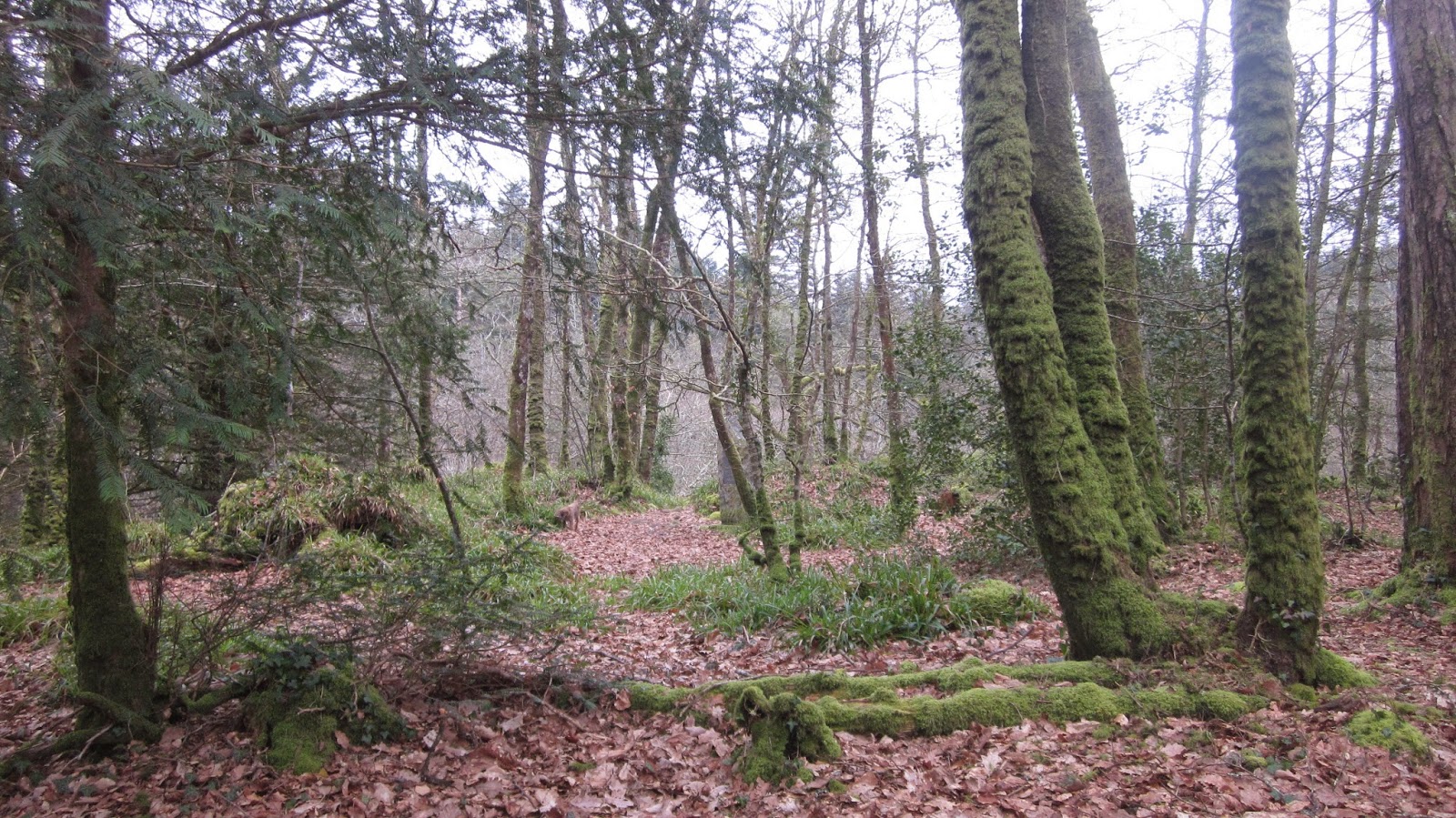
Working on my text about death in the forest this morning, which involved both writing and a long walk to review the relevant sites. Death comes easy and hard in the normal order of forest, with its acceptance and exploitation of the cycle of decay and regeneration in nature and the practice of hunting. But there is also murder and accidental death (or possibly suicide) to consider in my forest. 
Long after the war was over, the bodies of three young men, executed by the Germans, were found on the hillside above the Argent river. They represent the great number who, with all the desperate nonchalance of youth, took action to resist enemy occupation until such bitter ends as a blanket of dirt and leaves on a wooded slope. A stele marks the fate of Pierre Ruelen, Jean Volant and Emile Bérthou. Whenever I hear the explosion of a hunter’s gun echoing through the trees, I think of falling limbs with human faces.
In May 1919, the body of Victor Ségalen was found by his wife among the beech trees on top of a high granite outcrop, once the site of a medieval motte. He was apparently sitting propped against a tree with an open copy of Hamlet, having bled to death from a wound in his heel. This curiously staged scene – and his hurried burial avoiding an autopsy – has led many to think he took own life to put an end to the nervous depression and mysterious physical malady that had taken hold of his life.
Born in Brest in 1878, the profession of medical doctor took Ségalen on journeys that went far beyond the practical fact of travel. It was China that came to shape his remarkable inner life: he conducted archaeological digs there and became a Chinese language specialist, before returning to France. The cultural landscape of his experiences was manifested in poetry and texts (such as Stèles, published in 1914). He was in Huelgoat for his health, ironically, walking daily in the forest with a book and notebook, experiencing the profound sense of containment and aloneness offered by this special place. For a man who lived on the borderlands between reality and imagination, he chose a good place to die.

Thursday, March 05, 2015

La Belle Vie

Liz and her work
At the opening last night of my friend Liz Ridgway's fine exhibition in Brest, where a crowd of art-lovers were wowed by her reflective images of women in landscape. Good fun, happy people, promising sales. It's on until March 28th at the Espace Exposition, Saint-Marc.
www.artitudebrest.com             www.lizridgway.artweb.com
Liz's work will feature in my exhibition on landscape at L'Autre Rive in Huelgoat in October.

Thursday, February 26, 2015

It was Chaos...

AIKB group
Very pleased to take a large group of AIKB members around the forest at Huelgoat today, considering basic questions of history and legend. We started with a Trembling Rock and ended near the spot where Victor Ségalen finished his life under the beech trees high above the Gouffre. A bit of Chaos and King Arthur came in between. I really enjoyed the afternoon and thank everyone for their company and good cheer.

Sunday, February 15, 2015

Welsh victory

Spent the day at book fair at Le Cloitre St Thegonnec (a good old Welsh saint himself) and so missed seeing the match and Wales' great win over Scotland, but managed to fly the flag nevertheless. Writer Hervé Bellec told me that a group wants to ban the dragon from the Welsh flag as it represents the devil, but that can't be right as everyone knows the Devil is English. It was a good day, with lots of old friends - both writers like Catherine Chartier and Anne Guillou, and visitors - and some new ones, like professional magician and now thriller writer Alex Reeve (alexreeve.net).

Sunday, February 08, 2015

Walking, noticing and leaping hares

Walked for hours today, on familiar territory but with renewed awareness, thanks to a book by Claire Thompson recently given to me by a perceptive friend. Mindfulness and the Natural World is one of the simply meaningful editions published by the Leaping Hare Press. (That name in itself is enough of a connnection for me as David Brayne's unbelievably rich painting of a leaping hare has long hung on my wall, purchased in the far off days when I had money to invest in art.) I already have The Art of Mindful Walking by Adam Ford in the same beautifully produced series - these books deserve to be better known.
What I am most grateful for today is the reminder of the difference between looking and noticing, and the concomitant quality of mindfulness as an active state. Walking with all the senses is a direct experience, complete in itself and only stifled by the process of thought. Claire Thompson's opening chapter 'We are Nature' joins up all the dots of existence and expresses my own feelings of belonging in the natural world where - as she puts it - 'I don't feel alone, I feel alive.'

Sunday, February 01, 2015

A big change


After writing the previous post on this blog, I could no longer ignore what has been gnawing away at me for the last two months, ever since I started work on the new Finistère guidebook. Raising the perennial problem of guidebooks (where the good stuff that digs beneath the surface gets cut and only the basic facts remain) made me finally face up to the most important basic fact of all. I do not want to do this any more.
My last book, Brittany – a cultural history (Signal Books, Landscapes of the Imagination) at least allowed me the luxury of arguments and issues to the extent that overall word and page count would permit, and now there is no way back to the more constricting, prescriptive format of conventional guidebooks, the need to conform to expectation in terms of sites and coverage, to reader profiling and in-house styles.
I need a more creative process, a focus on my landscape writing, whether or no a book in publishable form emerges. I need to work from the inside out and not vice versa. I need to give more time to other things and other people. What I no longer need is to sit at my computer for ten hours a day or travel under frustrating pressure of collecting and regurgitating information in a limited timescale. So I have reneged on an agreement for the first time, something quite against my normal instincts, and in doing so have made a major change in my life.
Walking in the early evening today, the debris of frozen hailstorms still lingering on the rocks in the forest, I felt a sudden sting not of panic but hesitation and uncertainty. What on earth will I be doing at 9 o’clock or 10 or 11 tomorrow morning? I have worked so hard for so many years on a clear progression of full-time, demanding writing projects (usually fired by economic imperative) that I’ve forgotten the sense of freedom that accompanies true creativity. 
A minute later, the last ray of a previously veiled sinking sun flashed through the skeletal trees right into my face, lighting a golden path ahead. It was a simple reminder of alignment, of the beauty of doing the right thing at the right time. Whatever I do tomorrow morning will be new and exciting and worthwhile, even if it’s only sleeping in for a change…

Monday, January 26, 2015

Perennial problem

I'm writing about Morlaix for a new guide to Finistère, and the creation of the text soon brings up the perennial problem of guidebooks. It's important to write about the famous viaduct, a work of art as much as functional architecture. When and why it was built are essentials. How it transformed journey times between Brest and Paris must certainly be mentioned to give the economic context of such a major construction. Then of course it's necessary to describe the RAF bombing raid on January 29 1943 that killed 67 civilians. Surely people will want to know that of those victims, 39 were children between the ages of 4 and 7, studying the catechism with their teacher in a school at the western end of the viaduct, not least because a little chapel 'of the angels' built in its place to mark their collective burial on the spot can be visited today. And that's really as far as I can go.
There's no room to write about the painful religious manoeuvrings that presented the tragedy as God's will, a new 'Slaughter of the Innocents', the children as chosen martyrs for the redemption of others (a stance which not surprisingly roused some of their parents to anger). And how barely a word was spared for the other 20 who died. Or the political repercussions and attempts to stir anti-English feeling: La Bretagne's headline on February 1 read 'Raid terroriste de l'aviation anglo-américaine sur Morlaix. Or to analyze the extraordinary decision of the allies to make such a day-time raid where large loss of civilian life was highly likely instead of targeting other viaducts carrying the same railway across other valleys in the middle of unpopulated countryside. Or the fact that only one arch of the viaduct was hit, and that the Germans had the trains running normally again only eight days later...

Sunday, January 11, 2015

We marched in Morlaix today...

... powerfully in the spirit of freedom and equality. Thousands of Bretons and others of all ages and backgrounds - the presence of many young adult men and women was a special sign of hope - milled and smiled together in what amounted to a considerable display of solidarity within wide diversity. There were those who laughed and chatted, others grim or solemn with tears in their eyes, but all alerted by this simple physical act of walking together to the importance of our shared values and the reality of our enviable quality of life, which rests on tolerance and inclusivity.


Monday, January 05, 2015

Strange start

2015 has not got off to the best of starts. I had to leave my appartment because of noise problems over the New Year itself, an oddly disorientating experience and more endless to-ing and fro-ing with bags and supplies, upstairs, downstairs, etc. I'm doing the Walk a Thousand Miles challenge this year and on target so far, but feel as if I would be well ahead on the Climb a Thousand Steps event if such existed.
Workwise all seems rather fragmented too, with a translation for a scientific association in Quimper spanning the Xmas/New Year period, website updates to organise and many routine administrative tasks. Frustratingly, my new Lumix camera refuses to co-operate with my computer, or vice versa, so many photos remain unprocessed and unusable for the moment. Hoping to get going in a more settled way this week and focus on the new Finistère guide without distractions.

Tuesday, December 30, 2014

Landerneau - no

Landerneau
Disappointing visit to Landerneau for work today. Ten years ago I used to live in the vicinity and included a look around the town in Walking in Finistere. It was always busy, being a dormitory town for Brest whilst having plenty of light industry and commerce of its own, but a stimulating place with its estuary setting and truly glorious architecture. There is still an air of prosperity in the centre, which is full of individual shops, bars and restaurants. The Elorn estuary is still beautiful. The range of historical buildings is still pretty stunning.... But I couldn't wait to get away from intrusive loud 'music' blasted from public speakers every few metres, the littered streets (unusual in Brittany) with the wonderful cobbled bridge of old houses lost under a thick layer of fag ends, and the incredibly dangerous traffic with local drivers making tight corners in the one-way system by mounting the pavements at high speed, oblivious to adults, children and dogs. I had to wait several minutes to cross a narrow side-street against a constant stream of cars. In Brittany. There's an air of neglect about it all, and the shameful state of the Maison Duthoya (1667) seems emblematic of a loss of sense of the importance of heritage here.
All these things make for an unpleasant visit. Luckily a quick jog up to the top of the castle at Roche-Maurice soon restored my spirits. Until I saw all the information boards with the translation of donjon as 'dungeon'. Aaaaaaaaaaaaaaaarrrrrrrrrrrrrrrrrrrrrrrrrrrrrrrrrrrrrrrrrrrrrrrrr
La Roche-Maurice

Saturday, December 20, 2014

Happy Yule and all that

Wintry lake at Huelgoat
Wishing all my readers a very happy Yule and other festivities, with thanks for the many supportive and cheering letters/emails about books or articles you have enjoyed, and a special welcome to new readers in America following my contribution to the latest Now Write! volume. It's been a strangely up and down sort of year with a long delay between finishing Brittany - a cultural history in January and having to wait until November for publication, circumstances conspiring against the project conceived with artist Jill Jamieson, being nearly blind for half the year, two house moves in the last few months, etc. Lots of good things too, with friends from the UK visiting Brittany, Cornish idylls, some fun talks to associations and plenty of development in my own landscape work, which may well see the light of print in 2015. Not settled there yet, but on another front, I have agreed to write a new type of guide to Finistere in the next year.
I'm looking forward to these challenges, and hope you all have a happy and fulfilling New Year.

Monday, December 08, 2014

London blues


Lovely purple seats on an almost empty TGV
A quick seasonal visit to my nearest and dearest in London has been both an eye-opening and painful experience. Took National Express coach up from Portsmouth ferry port to Hammersmith to get a bus the last couple of miles. Slight problem - apparently buses don't accept money any more. What sort of world is it when cash is not allowed on public transport? I walked the whole way with all my luggage, thus aggravating tendonitis in my right arm that's been getting worse daily for some months now.
Yesterday, strolling to the local shop with a friend, I fell off the pavement, managing to wrench and skin my right knee and give my left elbow an equally savage cut and jolt. Multiple plasters were applied at said shop, where staff seemed alarmingly unfazed by the appearance of a customer dripping blood. The whole thing was quite a shock, and I wished later I had agreed to brandy in the reviving coffee supplied afterwards, because a 26 hour journey from London to Finistere involving two car trips, two coaches, one ferry, two trains and a taxi is not something I ever want to do again in that degree of pain and discomfort.
It's nice to be home :-)

Thursday, November 27, 2014

Brittany - a cultural history

What is the new book about?  It's a personal reflection (affectionate but not uncritical) on Brittany's history and cultural development structured around elemental themes. Each theme takes four varied examples ranging all over Brittany. To illustrate: the chapter entitled SEA looks at a) threats from the sea over many centuries, b) legends connected with the sea, c) the adventurers of St Malo and d) the cod-fishers of Paimpol, the latter elevated to a bizarre super-hero status through popular literature. FOREST covers the history of the Foret de Fougères, the (fragile) association of the Foret de Paimpont with Arthurian tales, clog-making and the oral tradition in the Foret de Coatloc'h and manufactured claims of Druid blood sacrifice in the Foret de Cranou. Other chapters are STONE, MARCHES, LAND, COAST, RIVER, TOWN, MOOR and ISLAND.
The book tries to bring out the realities of Brittany - extraordinary enough in themselves - behind the clichés of touristic hype, with contemporary life featuring alongside the assessment of past highs and lows. It also intends to create a vivid physical sense of the land, sea and coast, which figure as major characters in the narrative. In common with the other studies in this series Landscapes of the Imagination, there is also an emphasis on culture, particularly the strong oral legacy of the Breton language.

Available now: published by Signal Books (www.signalbooks.co.uk)

Sunday, November 02, 2014

Holiday weekend

November 1st is a public holiday here in France, and also my dog's birthday. We always celebrate with a trip to the coast - this year down south to the area around Le Guilvinec, where we stayed in an impeccable dog-friendly B&B (www.cap-ouest.com) and did a lot of coastal and estuary walking over two days. Saturday was as hot and blue-skied as July, and Sunday a typically moody autumn grey, so the best of all worlds for watching the water and getting that uplifting liminal feeling.
Plage de Squividan

Pointe de Men Meur
To the small extent that the weekend was purposeful beyond that, I did check out half a dozen neolithic sites for a new writing project, and revisited the Romanesque church of Loctudy.
Menhir de Léhan

Thursday, October 30, 2014

WWII Shelter in Brest

I recently visited the Abri Sadi-Carnot, a tunnel running for more than half a kilometre from the arsenal at the port to the centre of Brest, the only city in France to construct massive capacity shelters during WWII. This one was built between 1941 and 1942 as a refuge against allied air raids for the Germans and civilian population alike. The lower end is accessed directly from the Boulevard de la Marine, but 154 internal steps were needed to reach the exit at the other extreme, the end assigned to the local population. Despite successfully saving many lives during bombing raids aimed at the submarine base, it suffered the historic irony in September 1944 of causing hundreds of deaths thanks to a horrendous accident  - one waiting to happen considering the German practice of stocking munitions and petrol in their lower end of the shelter. The resulting fireball and asphixiating gases sped through the tunnel, leaving mounds of corpses on the staircases to witness a stampede for safety.
During the Cold War, the Abri Sadi Carnot was adapted to a nuclear shelter, the radiation-proof doors still in situ today.

Sunday, October 26, 2014

Ile Tristan


Today was one of the occasions when very low tides enable a crossing on foot to Ile Tristan, just off Douarnenez. The two and a half hour window allows plenty of time to explore the island, although only certain parts are accessible to the public - the Maison de Maitre and another large house used as a temporary cinema for the day, orchards and the exteriors of a 1930s chapel and a 19th century fort. As is often the case in Brittany, culture has priority over history: short films (fiction and documentary) were showing, there was an exhibition of photographs and various miserable-looking musicians were performing in selected spots. There was no information about the island's chequered past, and no sign on the island itself of occupation in the 16th century by one of the most intriguing characters of Breton history.
My own personal research interest is the bloodthirsty career of Guy Eder de la Fontenelle, a young nobleman who held the island from 1595, and used the Wars of Religion to spread mayhem throughout western Brittany, from his native Cotes d'Armor to this western edge of Finistere, where his most notorious achievements were the destruction of Penmarc'h - burning the population in the church and taking control of 300 ships in the port -  and the sacking of Pont Croix. He was pardoned for his crimes or acknowledged for his acts of war, depending on your point of view, and actually officially made governor of Ile Tristan at the end of the war. Accusations of intrigue with the Spaniards made this a short tenure, however, and he was executed in Paris at the ripe old age of 29.
His persona has lived on in the oral tradition, but aside from a short profile published in the 1920s, little serious and un-romantic work appears to have been done on the historical evidence of the life of this extraordinary, excessive personality. Sociopath or product of his times, able to get away with more than most in this far flung corner of France? I've made some effort to go further with research, with little result as yet. On the island today I wanted to get an idea of the strategic positions and the defensibility, as all efforts to dislodge La Fontenelle during his reign of terror proved fruitless. Not sure I made a lot of progress, but it's certainly true to say that the less I can find out about him, the more interesting he becomes.

Tuesday, October 21, 2014

Carhaix

Eglise de St Trémeur
Carhaix presents something of a challenge for a guided tour. It's a town of exceptional pedigree, having been a major centre in Roman Brittany, a thriving focus for medieval commerce and the hub of transport networks in the 19th century, but with some sorry slumps in between. A Welsh visitor in the 1870s described it as 'a primitive place', and it was indeed forced into a depressing isolation by the re-arrangements of the Revolution which separated Carhaix from its natural territory of the Poher in central Brittany, leaving it a border town without administrative status on the eastern edge of Finistère. These days it is enjoying something of a revival, with a lively cultural scene and new economic initiatives to keep employment in the town.
The problem for a heritage tour is that whilst some arresting visual evidence of a significant past remains, these scattered nuggets are overwhelmed by the low-rise, dull white modern development that swamps the town even into the central areas. Some fine houses still stand in the rue Brieux and Place de la Mairie, odd traces of aqueduct linger in modern industrial areas and religious architecture offers a few beauties worth walking for, but getting around is generally not easy on the eye and physically constrained by cars everywhere and narrow pavements - many with cars parked on them to obstruct individuals, let alone a meandering group. Today I tried to devise a workable route and wasn't entirely satisifed, but will persevere. I'm going to give it a go with Brittany Walks next month, and the town will figure in a new book I'm probably going to do next year.