Thursday, September 26, 2013

Dol and the rewriting of history


The gap between tourism and history gets ever wider. Dol-de-Bretagne now hands out tourist information stating prominently that Nominoe was crowned first king of Brittany at the cathedral here in the 9th century. There is even a recent statue of that great man wearing a crown opposite the cathedral entrance. Perhaps this is a response to falling visitor numbers; it is certainly a case of self-aggrandisement.
The 'evidence' for Nominoe's coronation comes a text from hundreds of years later, suddenly appearing at a time when the status of Dol cathedral was under threat and its challenge to the Metropolitan see of Tours was about to be put to rest. Contemporary documents do not use the title king, not even in the Cartulaire of Redon Abbey, an establishment he was instrumental in founding. It's all a bit like Glastonbury Abbey miraculously discovering the grave of King Arthur just when funds were short .... any legend in a storm.
Nominoe's actions regarding Breton bishops and episcopy of Dol in particular are complicated and difficult to interpret confidently - such is the fascination of the 9th century in Breton history. His son Erispoe certainly has the status of king, a reflection of his achievements against Charles the Bald,  but to claim definitively that such an event took place with Nominoe is a travesty, a triumph of competitive tourism over intelligent presentation of historical issues.


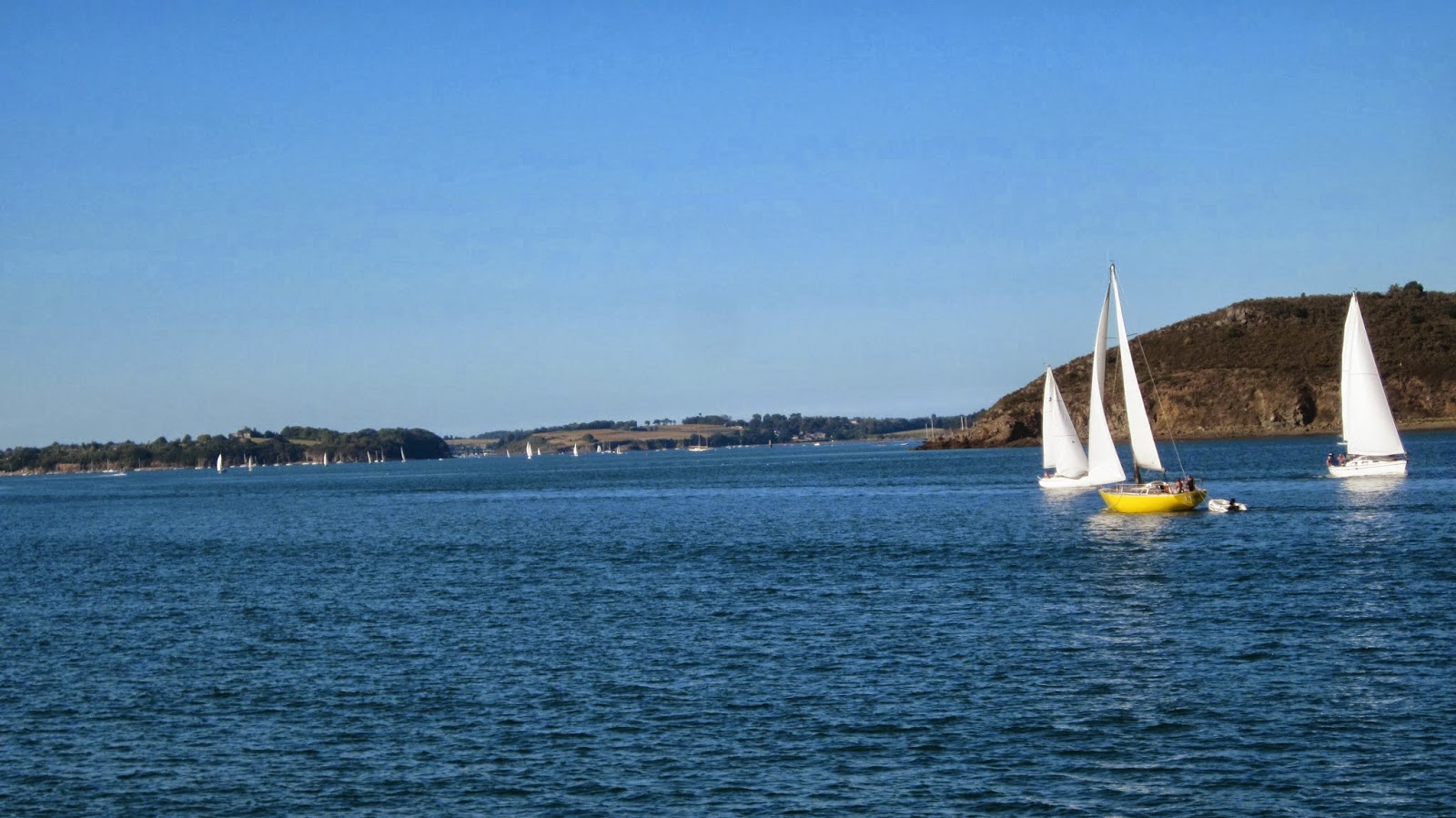
Sunday, September 22, 2013

Rance

What an amazing day to be cruising on the maritime section of the Rance!

Friday, September 20, 2013

Not a bad place to be buried

Spent a day around St-Malo today, including a visit to Chateaubriand's grave on the island of Grand Bé as the tide was low enough to give access. I've been thinking and writing so much about him in the context of Combourg - where he lived in formative teenage years and which remained the scene of his 'madeleine' moments, a touchstone of his identity, for the rest of his life. He was born in St-Malo, and his fame and significance managed to persuade the municipal council and the 'department of war' to whom the island belonged to agree to his request to buried in a spot where the only sound would be the wind and waves (and the piercing shrieks of lunch-hour school kids echoing across from the town beach).

Monday, September 16, 2013

Polders


Long walks today across the polders in the Baie de Mont St-Michel and I have the wind burn to prove it. Sun and showers coming and going all the time but constant blasts of up to 50mph with nothing on those flat lands to impede their force. I'm happy to look at the Mont itself from a distance for the moment and have no intention of revisiting until 2015 when it will have been returned to its natural island state. Destroying the causeway which has so disturbed the currents and tide of the bay and replacing it with a low passerelle will achieve this effect. Until that's done it's all a bit of a mess.

Thursday, September 12, 2013

Fabulous Fougères


High on the list of my all-time favourite places, Fougères has one of the best castles in Europe and inspired settings for novels by Victor Hugo and Balzac. The old town in the Nancon valley contrasts with the mainly 18th century High Town where there's a statue of the Marquis de le Rouerie, founder of the original Association bretonne in 1791 and key anti-Revolutionary figure. After lunch at Le P'tit Bouchon in rue Chateaubriand - Eric and Isabelle's welcome and cooking recommended - I had a pleasant afternoon in the adjoining beech forest, with 12th century cellars, megaliths and lots of good walking to enjoy.

Monday, September 09, 2013

Viking Camp

After a sunny walk along the Rance at Taden with my good friend (and nature expert) Lesley, I went further north in search of the 10th century Viking camp at St Suliac, lying greenly in the bed of the same river at low tide. It is best viewed from Mont Garrot, a spectacular viewpoint over the estuary in both directions, and of course the burial site of the giant Gargantua. They had to fold him in seven - it's not a very wide hill...

Wednesday, September 04, 2013

Combourg

In Combourg on the eastern edge of Brittany, on Chateaubriand's literary trail. He grew up in the castle here.

"C'est dans les bois de Combourg que je suis devenu ce que je suis"


Saturday, August 31, 2013

Nantes-Brest Canal


I never tire of the Nantes-Brest canal, despite writing two books about it and doing many talks, walks on the subject. My favourite part is the Aulne in Finistere, where I walked this morning. Hope one day I'll find the time to write a little guide Along the Aulne, because it is one of the loveliest rivers in Brittany.

Monday, August 26, 2013

Festival Fisel


At the Festival Fisel in Rostrenen yesterday to hear some music but mainly to see the dance competitions, underway after a long delay which the packed hall didn't even seem to notice. The danse fisel, product of this area, is one of many variations of the gavotte. The children's event was impressive partly for the incredibly crisp clean movement of the boys' back-flicks and their timing, but most of all for the assured future of Breton dancing into another generation.

Wednesday, August 21, 2013

Day off


Went to Douarnenez for a relaxing day off. Still too warm for comfort, but we had a good meal on a shady terrace at La Trinquette, my usual lunch spot overlooking the fishing port (in photo). I had a scallop, bacon and tomato kebab with saffron sauce and my companion a fillet of lieu jaune in shellfish sauce, both followed by chocolate fondants. Then we walked right along the Plomarc'h in glorious greenery to see the extensive remains of a Roman garum (fish sauce) factory above the water. Next stop the famous Boat Museum hoping to see the exhibition of the Viking ship excavated on the Ile de Groix (a recent visit). Unfortunately another hot dog issue, so I had to stay outside with Tex in a shady spot, but was delighted to find bargain of the year in the shop: 100 prints by Mathurin Méheut, my favourite Breton artist, for 13.50 euros. As each one can be torn out and framed, this is fantastic value and a very satisfactory souvenir of a lovely day when for once I had nothing to do but enjoy ...

Saturday, August 17, 2013

Wolves


No, not the football team I supported so fervently in my youth, but the real thing. I'm writing about wolves in the final section of my chapter on the Monts d'Arrée and made yet another visit to the Musée du Loup at Cloitre-St-Thégonnec this week. I do their book fair every year and an occasional walk from the village, so it's familiar territory. This time we walked in blazing sun right up onto the Landes de Cragou, a typical terrain of the Monts d'Arrée's distinctive landscape.
An unpleasing irony is that the wolf museum does not allow dogs in, so it was a fleeting look on a very hot afternoon. I just wanted to get a bit of the atmosphere of the days when wolves were common in Brittany and look again at some examples of the oral tradition. It was ill-advised to call a wolf a wolf in those days: Yann and Willy were apparently preferable modes of address. Hard to imagine the circumstances - it makes me think of Ogen Nash:  If called by a panther, don't anther.

Go away in the name of St Hervé if you are a wolf,
In the name of God if you are Satan.

Tuesday, August 13, 2013

Day out in Pays Bigouden

Pleased to take my friend Jeanne out for her birthday on a leisurely trip around Pays Bigouden. First we visited the Menhir of the Rights of Man, named after a ship wrecked here in the 18th century, with a commemorative inscription put up by Major Pippon from Jersey who was one of the survivors. Lunch at Pors Poulhan consisted of moules frites (J) and delicious fresh sardines (W), followed by a strange yet ultimately yummy concoction of chocolate and salted caramel. Time for a stroll along the coast at Penhors and a paddle for me and the dog. Beautiful day, all well with the world.

Friday, August 02, 2013

Quiet time

As I seem to be the only person on the planet who does not like hot weather, I'm having a few weeks at home with no trips away until September. This fits in with work, as I'm now on the chapter Moor, which is mainly about my own area - the Monts d'Arrée. Today I visited the Maison du Recteur at Loqueffret for some research about the rag-and-bone trade that characterised certain communities for centuries. Next door is one of the very few churches in Brittany dedicated to a female saint - Jenovefa in this case, sister of Saint Edern who has his church at nearby Lannedern.
Lots of interesting and varied work outside the book lately, with a fun interview with my friends from Spotlight Radio (who are very good at editing, and needed to on this occasion as I forgot the thing I most wanted to say about Morlaix and had to stick it on at the end). I've written an article for the Brittany Ferries magazine winter edition, started a leaflet for a local commune and finished my commissioned Nantes piece. Wish I'd taken the time to write the Nantes section for my book at the same time, but it will have to wait its turn.
This week I did a tour of Quimper for visiting Canadian academic Chris Andersen and his wife Nish. That was a very interesting encounter as Chris is working on a project about nationalism and identity involving Brittany. We had a stroll round the town and then  (yet another) delicious lunch at Chez Max.
Other than that, I've been to a couple of festivals, including jazz at Chateauneuf-du-Faou in pouring rain, and walked a lot. Despite how this may sound, there have still been many hours at my desk writing, with Barzaz playing in the background.

Thursday, July 25, 2013

Festival de Cornouaille

I spent two days in Quimper this week, at the fantastic Festival de Cornouaille. I watched a few bands on the outdoor stages, followed a marching bagad, saw the Breton dance classes for children and adults, learnt how the local dentelle biscuits are made and went to a conference on costumes from Pays Bigouden, an area close to my heart.

The highlight was the Barzaz concert in the theatre last night, for which I had a precious ticket. This seminal group (with the best chanteur in Brittany, Yann-Fanch Kemener) had enormous success in the late 80s/early 90s and recorded two albums before splitting up. This year they have reunited for a 25th anniversary series of concerts. I've only ever heard them on disc before but they are truly scintillating on stage, such depth of musicianship and the compelling voice of Kemener always driving the gwerziou. This is not world sound, not Celtic fusion, not fuzzy folk - this is Breton music in a pure tradition.
After the concert, I walked back through the centre at nearly midnight, head fizzing with excitement. But what struck me was the good order that still holds in Brittany. This is a huge festival and no-one was drunk or loud, the streets were calm, and cheerful goodnights came from all I passed. In Place St-Corentin there were still a few hundred people of all ages dancing in the round to the rhythm set by a pair of sonneurs on the stage. Everyone was happy. Such is life here.

Monday, July 15, 2013

The art of Nantes

In Nantes last week for a commissioned piece and some research of my own, as the city and the Loire will figure in the River chapter of my book. I took three trips on the water, the best being a three hour journey to St-Nazaire stopping at various works of art that are part of the Estuaire creative project. Nantes never does things by halves, and this is an extravaganza by any standards, from the house half-submerged in the river to a huge serpent on an estuary beach.

The city itself is full of visual jokes - like the 'grey men' of bureaucracy - and surprises, many with light effects designed to be viewed after dark, like the Nymphea by Corsican artist Ange Leccia. A permanent fun piece on the 32nd storey of the Tour de Bretagne 70s tower block is Le Nid, where the eponymous nest is a bar and the elongated white bird encloses broken egg tables and stools.
Nantes is a dynamic place at any time of year, but it's positively sizzling in this July heat. I came home exhausted, overloaded with art and ideas. Good excuse for a rare day off work today.


Thursday, July 04, 2013

Huelgoat guide

My little tourist guide to Huelgoat is out now in both English and French editions, and doing very well. It was designed to meet the requirements voiced to me by many French and British visitors over the last few years, and to provide exactly what they need for a short visit and a few varied walks. I often meet people lost in the forest because of a dearth of proper, accurate (i.e. GPSed) walking maps and am frequently asked about the history of the town, the mines, the war, etc.
I tried to respond to all this in a format that was cheap, attractive to look at and easy to handle - something that any visitor would think worth a 5 euro punt. As well as the walking maps, which at last enable people to make their own circuits, there's a good town map with facilities shown as well as sights/sites.
I'm very grateful to Red Dog Books for agreeing to publish it and my good friend Monique Le Bouhellec for her translation of my original text, and her ability to reconcile the completely different styles of the two languages for this type of production. Having a separate French edition has proved a successful gambit and one I hope to repeat next year for a different location.

Friday, June 28, 2013

Chez Max - Quimper restaurant recommendation


Love, love, love this newish restaurant on the quay near the cathedral in Quimper. Chez Max is in the house once belonging to the family of Max Jacob, poet, artist and visionary who died in the camp at Drancy in 1944. He was born a Jew and arrested as such by the Germans despite his status as an artist of internaitonal standing and a converted Catholic - Picasso stood as his sponsor. The famous drawing of Jacob by Modigliani is etched below the passerelle erected in 1994 over the Odet river in Quimper centre on the 50th anniversary of his tragic death.
The restaurant has a courtyard for outdoor eating, an upper room for groups and a large, welcoming dining room on the ground floor. You can eat à la carte but who needs to with a 13 euro two course lunch that includes a glass of wine. Plentiful main courses and desserts from a choice of two items each. Today I had pork and chorizo sauté served with aubergine two ways, salad, tomato and their gorgeous home-made chips. The iles flottantes dessert managed to be substantial and light as air at the same time, with a sea of creme anglaise to splash about in.
Chef Christophe Getin has an imaginative way with vegetables - unusual over here - yet doesn't mess about too much with the high quality meat and fish. Staff are young and enthusiastic, the tables well-spaced and the period decor unspoilt.
I won't be eating elsewhere in Quimper for a long time to come.
Chez Max - Cour Jacob, 8 rue du Parc
02 29 40 10 20

Sunday, June 23, 2013

The Empress Eugenie's chamber-pot...


It's always amazing what strange stories appear during a forage among the archives of any place, anywhere. This week I've been in Pontivy (once Napoleonville and famous for its imperial town planning), before and after a welcome interlude with friends in Arradon on the Gulf of Morbihan. I'm looking at 19th century politics in this piece, and a very tedious subject this can be, but every so often something ridiculous or amusing turns up to brighten the long hours.
The allure of royal, or imperial, souvenirs is not a new thing. After the brief visit of Emperor Napoleon III and his wife Eugenie to Pontivy in 1858, the 'vase de nuit' (chamber-pot, rather than 'night-jar' which you sometimes see in translations!!) used by the Empress during her night's stay, became a much sought-after item, and not merely for its quality English porcelain. But the very nature of 19th century politics is seismic shifts. Fifty years later, the pot was on sale in a second-hand shop in Vannes.
The Empress was good enough to promise funds for a new church in the town, having been asked pretty bluntly by the priest during the celebratory banquet organised for the imperial couple. How pleased she was to be represented in gargoyle form on the facade, we'll never know. And sometimes it is better not to know things, especially endless detail about the lives of people in whom we have no interest at all.

Monday, June 10, 2013

Qui voit Ouessant voit son sang

Just back from a working holiday on the amazing island of Ouessant. Managed to complete the coastal walk started on a previous trip and highly recommend it: for me it is far the best of all the Breton islands, being harsher and more remote than much vaunted, pretty Belle-Ile. That sense of being far out in the Atlantic (with weather to match - from hot sun to a wind force I've never experienced), and the lengthy, often rough, journey to get there adds to the experience.

Thursday, May 30, 2013

Qui voit Groix, voit sa croix

Trip to the Ile de Groix in very bad weather yesterday. Whilst walking for hours in sodden clothes is not my favourite occupation, it turned into a great day thanks to my companion, a geologist - an essential on this island once tortured by tectonic plate movements that have left the most spectacularly dense folding and the coloured stones for which Groix is famous. Garnet dust turns many sands red, and tiny garnets stud the deep blue/green glaucophane.

My other goal was to visit the haunts of one of my favourite poets, Yann-Ber Calloc'h, a tragic loss to Breton literature at the age of 28 in WWI. To hear his moving lines about his beloved native island read aloud in Breton beside his memorial on the cliff-top was an experience that saturation could not spoil.

We left in a brief of spell sunshine, past the very unusual convex beach of Grand Sables, Groix gleaming greenly in our wake.