Thursday, July 03, 2014
Le Guilvinec
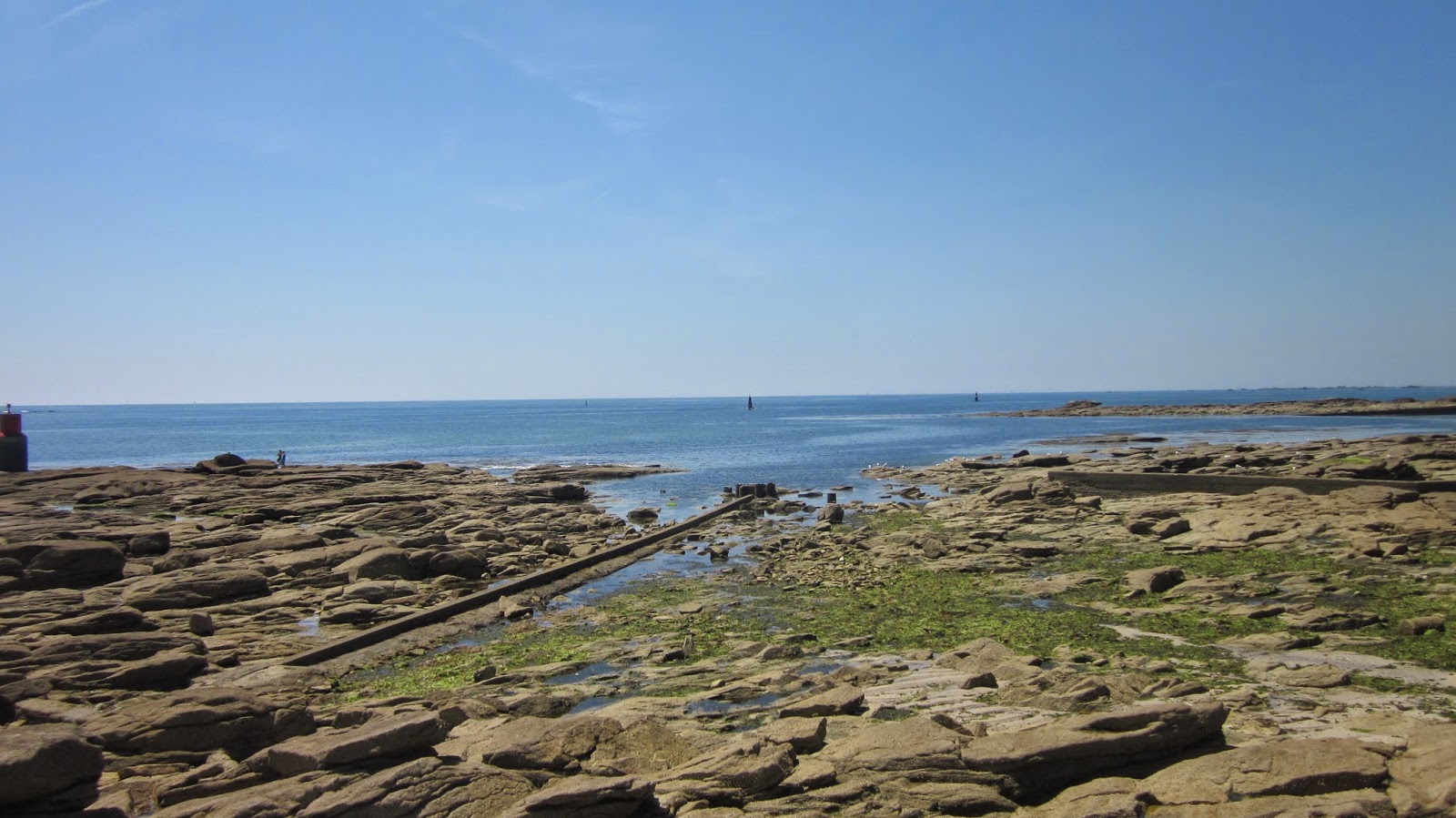
Pavé de merlu followed by a café gourmand at the Poisson d'Avril in Le Guilvinec on a boiling summer's day in Pays Bigouden.
Tuesday, July 01, 2014
New website
Saturday, June 21, 2014
Theatre in Morlaix
Went to the theatre in Morlaix today to see a friend perform in Gogol's The Nose. It's many years since I saw a play here and the theatre has had a complete refit to restore its Italianate splendour. It's also a very long time since I saw this particular play in London, and I liked it rather better in this masked version staged by Pascal Péron. Great experience all round. Congratulations, Jeanne!
Tuesday, June 17, 2014
Morlaix guided tour
I was in Morlaix again yesterday giving a guided visit to a small group of British people who (mostly) live in the area. The focus was on the river, a confluence of the Jarlot and the Queffleuth, which flows out 24 kilometres beyond the town into the Channel at Carantec, past the Chateau du Taureau, a fortified island.
The original impetus for establishing the latter in 1544 was an up-river raid by the English in 1522 which led to the sacking of Morlaix and severe economic hardship before the medieval port could recover its prosperity. This was based primarily on the cloth trade with England and Spain, although paper, leather and butter were other exports. Morlaix was also an important stop on the wine route from southern to northern Europe.
A more unusual economic strength was the tobacco industry, established on the Quai de Léon in 1736, having started out at the Manoir de Penanru on the opposite bank about fifty years earlier. Success demanded larger premises as the huge structure which remains today indicates. The factory only closed in 2004, although by then only 38 workers out of the thousand-odd employed in the heyday remained. Apart from the cigar production for which 'La Manufacture' was well-known, the business was also socially progressive, providing a creche, literacy classes and sick-pay.
We also had a look at the memorial of Tristan Corbière (and his father Edouard), and I read a short extract of the La Pastorale de Conlie to give the flavour of this avant-garde poet who died at 30 with just one self-published volume - Les Amours Jaune - to his name. His posthumous fame came from the acclaim of Verlaine: 'son vers vit, rit, pleure très peu, se moque bien et blague encore mieux.' The scandal of Conlie, during the Franco-Prussian war in 1870, where Breton conscripts were kept in camp in appalling conditions apparently because French generals feared 'an army of Chouans' (the counter-Revolutionary movement that had seen strong support in the Vendée and parts of Brittany) is a powerfully sour memory in Franco-Breton relations. The Bretons were finally sent ill-equipped into battle as canon-fodder: the French baying "Good dogs" as Corbière puts it.
The final stage of our tour was to the grounds of the Chateau de Kernanroux, where we got some much-needed shade from the strong sun, and did a little tour of the dovecote, cascade, lake and ruined medieval chapel with its fine carving. This is a concessionary route, with no access to the chateau itself apart from a brief glimpse of the rear façade if you continue along the GR footpath to the village of Ploujean. The sunken heart of the park around the lake feels like a secret place, and it well provided the 'special' element I always like to add to a guided visit.
The original impetus for establishing the latter in 1544 was an up-river raid by the English in 1522 which led to the sacking of Morlaix and severe economic hardship before the medieval port could recover its prosperity. This was based primarily on the cloth trade with England and Spain, although paper, leather and butter were other exports. Morlaix was also an important stop on the wine route from southern to northern Europe.
A more unusual economic strength was the tobacco industry, established on the Quai de Léon in 1736, having started out at the Manoir de Penanru on the opposite bank about fifty years earlier. Success demanded larger premises as the huge structure which remains today indicates. The factory only closed in 2004, although by then only 38 workers out of the thousand-odd employed in the heyday remained. Apart from the cigar production for which 'La Manufacture' was well-known, the business was also socially progressive, providing a creche, literacy classes and sick-pay.
We also had a look at the memorial of Tristan Corbière (and his father Edouard), and I read a short extract of the La Pastorale de Conlie to give the flavour of this avant-garde poet who died at 30 with just one self-published volume - Les Amours Jaune - to his name. His posthumous fame came from the acclaim of Verlaine: 'son vers vit, rit, pleure très peu, se moque bien et blague encore mieux.' The scandal of Conlie, during the Franco-Prussian war in 1870, where Breton conscripts were kept in camp in appalling conditions apparently because French generals feared 'an army of Chouans' (the counter-Revolutionary movement that had seen strong support in the Vendée and parts of Brittany) is a powerfully sour memory in Franco-Breton relations. The Bretons were finally sent ill-equipped into battle as canon-fodder: the French baying "Good dogs" as Corbière puts it.
Thursday, June 12, 2014
Glittering Groix
I
have just been walking on the Ile de Groix, 10 kms off the south
Brittany coast. Tex (issued with his own ticket!) and I got an early
morning boat from Lorient and after a quick coffee/pain au chocolat
in my favourite port café, set off westwards towards the Cote sauvage.
At first this was re-tracing my steps of last year when I came in
search of the roots of Breton poet Jean-Pierre Calloch, who was killed
in WWI. His statue on a gorsey headland was just as moving on a second
visit. Then off into the loneliest part of the island - in fact I didn't
see a single other walker all this first day, just a small group of
bird-watchers on the nature reserve - and it proved a very long, very
hot walk with some spectacular scenery, like the Iron Age fort Camp des
Gaulois, and some infuriatingly poor signage adding extra kilometres. A
local kindly then provided a lift to the villlage in the interior for
our overnight stop, and a really pleasant experience this turned out to
be (thank you Christiane). Walked into the bourg of Loctudy to pick up food and then both dog and I very happy to lie down for the rest of the evening.
The
next day we started off early for the Trou d'Enfer, before continuing
along the south coast to a welcome stop at the bar in Locmaria before
following the sea past the Viking burial spot to the geologically famous
section with its blue and green rocks, many studded with garnets, and
everywhere the micaschiste shimmering like silver and gold. It was even
hotter than the first day and I decided to change the plan and take a
long rest on a beautiful beach with some welcome cooling of the feet
(all six of them) in the sea before striking off inland. Unlike many of
the Breton islands, the interior of Groix is quite varied and
interesting. I was surprised to discover a good-sized lake, luckily with
a shady seat. After a long slog back to the bourg and a brief ice-cream
stop, we went down to the port and waited for the boat back.
So that's the summer holiday over. Just as well there's the World Cup, Wimbledon and the Tour de France to keep me occupied...
| Hot dog under a megalith |
| Garnet-encrusted rocks |
So that's the summer holiday over. Just as well there's the World Cup, Wimbledon and the Tour de France to keep me occupied...
Sunday, June 08, 2014
Admirable by association...
Today I went to the AGM of an association I've belonged to for many years. Au fil du Queffleuth et de la Penzé may not be the catchiest of titles for an organization, but the two names of rivers reflect the geographical and environmental parameters of a dynamique group which has laboured long and hard to preserve and present important local heritage. A recent exhibition concentrated on the manufacture of paper in the Queffleuth valley, an industry with connections to the linen trade with England and the pilhouarien (rag-and-bone men) of the Monts d'Arrée, the latter a subject I've studied a lot recently. As well as historical research, field work and nature study, AFQP has many educational projects, develops local themed walking circuits and offers guided visits for tourists and locals.
Associations are the prime example of that social inclusivity and cohesion that has traditionally given such strength to French society, and there are more in Brittany than anywhere else. Collective values and aims are supported here by many thousands of volunteers who give their time, expertise and experience to honour their local communities in all the many aspects of history, culture, sport and recreational activities. Much of any village social life is bound up with the activities and celebrations of such groups. I belong to a few, but AFQP with its good-humoured sense of solidarity and initiative is exceptional.
Today following the AGM in the village hall of Cloitre St-Thegonnec (whose annual book fair I faithfully attend) and discussion of various changes to the statues of the association, we processed around the streets for the inauguration of a new circuit highlighting the importance and uses of water in local history and legend. Individuals led songs as we walked, the well-known refrains eagerly rendered by about half the group, and a story was told at the last stop before adjourning to the village hall for drinks and food.
And here's the catch, the only possible thing to hold against associations - before anyone is allowed so much as a drop of liquid or a single crisp, there will invariably be at least five speeches.....
Wednesday, June 04, 2014
More Morlaix
In Morlaix yesterday for various things and dropped into Skol Vreizh, publishers of books in Breton, for a look at the very moving exhibition of poetry by Naig Rozmor, who used her creativity as a defence against dementia. 'There have been times of sunshine in my life because I learned how to chase away the rain.'
Skol Vreizh have their offices in the former tobacco factory, affectionately known as 'La Manu,' which was built in 1736 after the growing tobacco industry - a royal monopoly - outgrew its earliest manifestation in the nearby Manoir de Penanru. La Manufacture des tabacs was an important employer in the town with up to 1000 local workers, who benefited from enlightened provisions such as a creche, sick pay and pensions, as well as literacy classes. The site continued to function until 2004 and remains a striking example of industrial architecture, although sporting a sadly neglected air today despite housing many offices and artisanal workshops. Does Morlaix recognise and understand the growing trend towards industrial heritage tourism? It would have been a great location for a Morlaix museum, something scandously lacking a proper venue for many years. What other town with such a history fails to present a coherent image of itself to visitors?
Monday, May 26, 2014
More moor
As I am increasingly interested in psychological
response to landscape, I often ask people about their preferences for viewing,
walking, visiting or living. The responses will invariably speak of water in
one form or another or green hills and lush valleys or pointy peaks and mountains.
If I do not mention moor, moor will not be mentioned.
The appeal of this wild terrain with its bleak
reputation is to a certain sort of person, and not necessarily the clichéd solitary
spirit of romantic literature. Moor is rarely obvious, but a landscape of
subtle expectations and obscure purposes, often a blend of jarring and sinking
that calls for physical dexterity echoed in the mind. Even – or especially - in
good weather conditions, many people are uncomfortable with the temptingly expansive liberty of the heath, its very openness mistrusted for a lack of delineation
and directive patterns.
The cultural legacy of supernatural danger,
disappearing paths and cruel death associated with misty, cloud-bound moors
lingers on in today’s world of facile communication and location-fixing devices.
Despite the proliferation of arrows and signposts, we fear losing sight and getting
lost as the elements descend more now from the context of our comfortable lives
than earlier generations ever did.
Our severance from nature is perhaps most clearly seen
in the context of moor, which has little time for aspirations. It operates
primarily on the enduring horizontal plane, a deficit in a world which admires
the easily comparative vertical in man-made structures and natural configurations
of landscape. All those little cairns of walkers’ stones patronise the moor
with their implications that endeavour is an upward instinct, like the
religious faith which placed the megaliths.
A few Bretons, particularly those from the coast, have
told me of their almost superstitious aversion to the moor and wondered how I
can bear to live there. But the problem for me, as I face the need for moving
on, is rather whether I can bear not.
Thursday, May 22, 2014
Out
The new little booklet is finally out - available in both English and French editions. Let's hope it is as well received as Huelgoat, the companion volume, which continues its success of last season. The English version of that is shortly to be reprinted. The first French edition sold out pretty quickly and I suspect the Monts d'Arrée guide will follow the same pattern. I am very grateful to my friends Monique Le Bouhellec and Yves Marhic for their excellent translations of my texts in this series.
Thursday, May 15, 2014
The moor in May
Out early this morning in beautiful weather to take a long walk on the moors. May not be the best preparation for writing about caves, but I felt fantastic afterwards.
Saturday, May 10, 2014
Ploermel talk
| La Cheze |
I would normally also have enjoyed the five hours of driving, out via Loudeac and back via Josselin, but in the circumstances only had energy for one stop, deciding to make a brief revisit to the castle site at La Cheze, former Rohan stronghold, like so much else in the area, with a very chequered history.
Tuesday, May 06, 2014
Just back
I've been in London for the last week with my closest friends and family. Saw this new addition (photo) whilst hanging about on Rennes station on the return journey today. Four different travellers sat down and played the piano during the half hour I waited on the concourse, and very good they were too. Jazz and classical both featured heavily. During this spontaneous entertainment, I was surprised to see the new form of an apparently routine security patrol doing the rounds of the station: a policewoman flanked by two soldiers - one male, one female - both carrying semi-automatic rifles. Oddly it made me feel less rather than more safe.
Thursday, April 24, 2014
The Druid that never was ...
I've been working a lot lately on 'traditions' that were invented in the 19th century to promote certain images of Brittany or to try to attract people to particular areas. The Foret de Paimpont's artificial association with Arthurian Brocéliande is a case in point, fostered especially after the publication in Paris in 1812 of La Table Rond, a work of high Romance. Its influence encouraged men like Blanchard de la Musse to seek out suitable physical places for scenes from the Arthurian tales in their own neighbourhoods. He decided to locate the Valley of No Return in the Foret de Paimpont. Later it had to be moved because they built a factory in the original setting, but that's another story...
The glass window above is from the remarkable church at Rumengol, richly decorated by Marine artisans from Brest. The window is late 19th century and it shows a sad Druid lamenting his loss of status as two early Breton saints lord it over his former domain, setting up a statue of the Virgin Mary on top of a dolmen (neolithic burial place). Leaving aside this latter anachronism, the illustration purports to relate to the very well-known and strong tradition that the church was built on the site of a former Druid sanctuary, where human sacrifice was carried out. The adjacent forest of Cranou is certainly an atmospheric place with plenty of oak trees even today, and it may well once have been a focus of Druid ritual, but in as much as any wooded area - which doesn't narrow things down much in Brittany - might have been.
The Druid connection has given rise to songs and stories galore, incuding the legend of St Guenolé, outraged by the thought of pagan practice, running all the way from Menez Hom to remonstrate with the Druid and teach him the error of his ways before making poor old King Gradlon build a proper Christian church on the spot.
So where has all this come from? All too often it is impossible to find the end of the thread of local traditions, many of which do genuinely go back to a distant past. But in this case, I think it is possible to point the finger at one individual and hold him responsible for creating an image of Rumengol out of his own imagination. The Chevalier de Freminville (often called La Chevalière for his fondness for dressing up in women's clothes) was no Breton speaker but he had an unquenchable interest in the mysteries of Brittany, and in his treatise of 1829 on antiquities here, came up with a translation of the name Rumengol that gives us 'glowing red stone.' From here chuck in a dolmen and it is but a short bound to Druids and blood sacrifice - at that time it was still wrongly thought that neolithic remains were the work of the Celts. Later writers soon picked this theme up and ran with it - hence we now have an infallible 'ancient' tradition, and the curiosity of this stained glass window.
Wednesday, April 16, 2014
Trévarez
We had a good walk all round and then tea and cake in the courtyard café area. Brought back memories of working for the National Trust at Stourhead.
Friday, April 11, 2014
AIKB trip
| Pebble factory |
| Rochers at St-Guenolé |
The lethal lower rocks all around the nearby Pointe de Penmarc'h featured in Chaucer's Franklin's Tale, and we finished up beside them at the magnificent Phare Eckmuhl, built at the end of the 19th century to mitigate the threats this treacherous coast poses to passing shipping. Lovely warm, sunny day to enjoy this unusual area, which features in the Coast chapter of my forthcoming book: Brittany, a cultural history.
Wednesday, April 02, 2014
Lac St-Michel and the Yeun Elez
The advantage of this circuit is the almost flat level of the whole thing, offering a long walk to those whose knees may not appreciate the usual very up and down Breton terrain. There are also great views of all the highest hills in Brittany, without the need to climb them. Crossing the Yeun Elez, often on wooden walkways, gives a close experience of the peaty tourbières characteristic of this area, in contrast with the upper heaths or landes. Here you are crossing the cradle of Breton legend as well as a distinctive landscape.
Monday, March 31, 2014
Talich quartet in Quimper
I first went to hear the original Talich quartet in London at the Wigmore Hall about 30 years ago. The dense power, lightness of touch and liquidity that were so impressive then were equally evident yesterday afternoon in Quimper, when the current line-up, including a member of the original family, performed Schubert's Death and the Maiden and their speciality, Dvorak, (Quartet No.10) at the Theatre de Cornouaille. This was a Sunday 'chocolate concert' with hot chocolate to drink and handmade chocolates to sample before the show. And what a show it was. We were sitting in the balcony, a perfect vantage point for every bowing, facial expression and bald spot. It was magnificent, and a packed theatre would have sat for many more than the three encores we got. This morning I unearthed my recording of the Talich playing Dvorak quartets and quintettes and it is playing as I write. Moving, exciting and so evocative of my long love-affair with eastern Europe and time spent there.
Saturday, March 22, 2014
Coming soon - my two new books
Thanks to all who have enquired about a follow-up to the much appreciated little tourist book I did on Huelgoat last year. In exactly the same format and to be published in separate English and French editions is 'The Monts d'Arrée.' Same kind of thing - sights including villages, nature trails and local museums, history, legends and walking maps, plus a glossary of Breton place-names. I am told it will be out in May.
On the other hand I don't have a firm publication date from Signal Books for 'Brittany: a cultural history,' but it is being edited at the moment and I've just seen the cover for the first time, so things are happening over there in Oxford.
Monday, March 17, 2014
A change of scene
| Bécherel |
The French friend I was with had not visited this area before so we did some sights, including the Menhir de Champ Dolent. I have been pretty underwhelmed by Dol-de-Bretagne's treatment of tourists and distortion of history on many previous visits, but yet another example can be seen at this famous menhir, one of the best known in Brittany and a feature of various TV films needing a bit of mysterious atmosphere. The new noticeboard is a jokey cartoon of the legendary origin of the menhir - no information whatsoever about the actual historical date and context of the stone, but only a silly story drawn in (dated) comic book style. What a pathetic service to offer visitors! Apparently no-one is capable of understanding or appreciating anything unless it is whimsical and trivial. Dol must be the dumbed-down capital of Brittany.
Otherwise we went to Cancale for my friend to eat those renowned local oysters but failed to see the sea despite lunching in a cliff-top restaurant at the Pointe du Grouin - a heavy mist lay over the NE corner of Brittany throughout the day and very little was visible. Went up Mont Dol to see the Devil's footprints anyway.
| Statue of Chateaubriand below the chateau |
Sunday, March 09, 2014
Tuchenn Gador
Out early onto the moors this morning in glorious weather, all around the summit of Tuchenn Gador. This is topped by a natural rock formation (not a megalith, although many climb all the way up in hope) of schist and quartzite, hence the sparkles in the surface. Thanks to the mishearing or misunderstanding or sheer carelessness of an 18th century French map-maker who neither knew nor cared about the Breton language, it is often marked Tousaines (All saints) on maps to this day. Tuchenn actually means an eminence or mound, sometimes a burial mound, so Tuchenn Gador (Kador) is the 'mound of the chair,' in the sense of throne-like rocks. The views are exceptional from the summit, taking in the crests all around Lac St-Michel and the widespread tourbières or peat-bogs.
There are many little cairns of stones along the paths to the top, gradually built up by modern walkers and pilgrims. Some want to mark their own passage, out of a sense of personal achievement or in the age-old way of men determined to mark the landscape with evidence of their ability to conquer it. The inspiration of the neolithic megaliths is all around in this part of Brittany. Others are honouring elemental deities and nature itself, for it is on the moor on such a day as today that one is forcefully aware of the interplay of earth, air, fire and water.
Saturday, March 01, 2014
St David's Day
Sadly no rugby today but daffodils were out in my garden to offer a button-hole to celebrate St David's Day. After meeting up with friends who are just back from Hong Kong, I bumped into Fred Dixon at the supermarket. His well-researched novel Ring of Minos (about ancient Thera and Crete) is just out, and definitely a recommended read - available now on Amazon.
I was pleased to receive in the post a contributor's copy of Now Write: Science Fiction, Fantasy and Horror, published in the USA by Tarcher/Penguin. I was asked to do something for this volume a long while back and publication is finally here. My article and creative exercise for those looking to develop their writing skills is entitled Leaping into Landscape, and mostly about the work on forest I was pursuing when the Signal contract came along and distracted me. The Mirror of Landscape themes will now form the major part of my output this year instead, but in conjunction with an artist for a pictures and text exhibition. We have our first meeting on the project coming up this week.
Friday, February 28, 2014
On the coast
Stayed with friends this week and we made a trip to the north coast at St-Samson. Ran the dogs on the beach and then walked south past the Pierre Double towards Terenez. Perfect weather, lively sea and great company.
Sunday, February 23, 2014
Book Fair
Tuesday, February 18, 2014
Stormy spring
Been a rough old couple of weeks since finishing the book - storms and long power-cuts wearying enough, but a severe throat infection and the totally impossibility of getting warm or dry inside my hovel have created something of an endurance test when I have no energy to deal with it.
Walking has been very limited for these reasons lately - I even missed the Brittany Walks event last week, only the third absence in 10 years - but I did get into the forest in Huelgoat on Sunday. More trees are down but water levels are now lower than during the December deluge. The river bridges were passable although signs they had been underwater earlier. Yesterday on a brief sortie in the rain the atmosphere was spring-like with banks of primroses, budding trees and excited bird song all around.
Monday, February 03, 2014
Double celebration
Wednesday, January 22, 2014
Landscape talk
| The Great Cairn of Barnenez |
It was a really enjoyable occasion, the highlight being given a gift of postcards of her paintings by Jill Jamieson. One was based on a guided visit I did with the AIKB to the Cairn of Barnenez last year. My photo here in no way does justice to Jill's work, which presents the physical and emotional layers of landscape in a way I really appreciate. Have a look at her website - www.jilljamieson-12640-painter-brittany.com - to get the full flavour.
Tuesday, January 07, 2014
Moor wind, moor rain
After being up most of the night - unable to sleep so used the long dark hours to work on the completed first draft of the book - I needed a burst on the moor this morning despite feeling hardly able to put one foot in front of the other, exhausted and aching in every bone and joint. It was a real battle to meet the storm blasts head on, but turning north-east came as a sudden relief and it seemed as if rather than trudging I was suddenly moving at the speed of a galloping horse (actually about 4kph). The wind is less forceful today than at the weekend, but still racing about with all the energy of anger. I missed the rain, so came back dry, but weary as could be.
Wednesday, January 01, 2014
New Year's Day
| Odet rising in Quimper, Dec 24th |
Instead of resolutions for the New Year I'm adopting the ZenHabits policy of habit-breaking on a month by month basis. In January I will abstain entirely from my favourite computer game and one website where I waste a lot of time - the idea being to channel those extra hours into something constructive. I have made a long list of small creative projects I'd like to do this year, mostly unconnected with the day-job writing, so that should work well. If only my fingers are not so cold there is little possible beyond emerging from a nest of blankets to press buttons on the TV remote... No, I'm very positive and looking forward to 2014.
Happy New Year to you all.
Subscribe to:
Posts (Atom)