Wednesday, March 06, 2013

Busy ...

Seem to have had a great deal to do on many fronts lately. The book fair at Cloitre-St-Thegonnec on Sunday was not very lucrative but a pleasurable day out reconnecting with other writers. As I'm now a member of the Association  Ecrivains bretons I'm more in the swing of events and competitions, not that there's any time to do much creative writing these days. I've made a start on the cultural history of Brittany for Signal Books (www.signalbooks.co.uk).
The Saints Shore Way book is finished and going to press shortly, and I hope to the complete the Huelgoat booklet by the end of this month, although I've a bit of walking still to do to complete the path maps. Due a short break with a friend before that at Le Conquet (pictured) to have some quiet thinking time and breathe the sea air.

Sunday, February 24, 2013

At the top

Managed to struggle up onto the highest point in Brittany, Roc'h Ruz, this week, drawn out from my sick bed by beautiful weather. Two weeks seem to have disppeared without much result under the onslaught of a virus that has felled half the population of Brittany, very expensive car repairs and days with no transport and a terrible mistake (OK, my fault) that has seen all files labelled Brittany (hard to imagine how many) disappear from my computer, many never to be fully recovered.
Life goes on. On the plus side, I've just agreed to write a cultural history of Brittany for Signal Books in their excellent series Landscapes of the Imagination.

Saturday, February 09, 2013

France 6 Wales 16

We won! Fantastic result in Paris and even better in that it will make the French absolutely determined to beat England. Looking to Ireland tomorrow now for another display of passionate graft. Celtic discipline - who knew?

Thursday, January 31, 2013

Fantasy (and Horror)

I was delighted to be asked last year to contribute to the latest in the very successful Now Write! series, published by Tarcher/Penguin in the US. Each book deals with a different genre: established writers describe their conceptual approach and current preoccupations, then set an exercise for aspiring writers to develop new skills.
So, which genre? History? Travel writing? No, I'm to be in Science Fiction, Fantasy and Horror! And in some distinguished company - Ursula Le Guen et al. This has come about through my work on legend and landscape, a satisfactorily loose fit for Fantasy, despite my usual protestations that legends are historically based and connected with specific places.
I wrote a piece called 'Leaping into Landscape' with an exercise of getting imaginatively lost in a forest. Looking forward to publication in coming months. Fun.

Thursday, January 17, 2013

Landscape Writing


The Mirror of Landscape begins with a semi-diary entry for December 30th, describing a moor-land walk. I follow the same route today through a changed world. Squelching is replaced by crackling as the land is finally frozen after weeks of fairly constant rain. I cannot resist that satisfying snap of ice beneath my boot, although soon regret this childish over-enthusiasm as I sink deep into the earth and have to wrench my leg out of the reluctant bog.
The muted winter sun is a novelty, brightening what has been lost in mizzle for so long. Sounds are sharper, no longer muffled by the wet air or hurled away by the buffeting winds. Where the moor runs right down into the reservoir below me, the oatmeal expanse of grasses is transformed into a shallow beach of lemon sand. On the same gorse plants sit rusty stems of old woody growth and fresh deep green points newly alert. The long, unmarked body of a dead snake lies lightly coiled, mostly upside down, on the broad rutted path. It must have been lured out of a warm lair by the deceptive sunlight into an unwelcoming chill. On the bottom of a tiny footprint pond, its lifeless pen-nib head moves gracefully in time with the trickling current above, as run-off water is carried into the lower bank.
As I’m looking at everything, so familiar and yet so constantly fluctuating, I’m thinking about writing and expressing what’s around me, and then wonder if this is inevitable. Is it possible to remain within the landscape without anticipating the warmer hours in the study capturing the experience on paper? Does that degree of separation forcibly introduce a note of manipulation or make the temptation of enhancement irresistible? Is the original experience in the head or of the body?
I see I have written ‘muted sun’ when on the spot it was simply ‘pale.' So can I be true to the land and to my own criteria, or is this a meaningless distinction? I know it bothers me a lot. 

Monday, January 14, 2013

Please visit the Saints Shore Way blog

Please have a look at the new blog, even though it is only a baby blog as yet. Now that the text is almost finished, I'll be updating much more regularly with articles, photos, etc. Once the Saints Shore Way book is out in April, I hope to add personal experiences of walkers on the route during the rest of the year.

www.thesaintsshoreway.blogspot.fr or link opposite.

Saturday, January 12, 2013

Boots made for walking

Very pleased with my new boots from Hotters. I've admired them online for a while and decided to take advantage of a good sale price - turning out to be a real bargain. I walked several miles with them straight out of the box the day they arrived, in total comfort. They are also warm which would never have been a criterion for me in the past but since my terrible and chronic right foot problems, it makes an important difference. (I should maybe wear them in the house, as no heating is not helping my poor foot's long term recovery.) Only possible concern is that the tread seems to pick up small stones easily, but that's not an issue on most walking terrain. Definitely recommend these walking boots and Hotters shoes are pretty hot too ...www.hottershoes.com

Wednesday, January 02, 2013

New Year begins ... back to work

My 2013 begins with a walk in Huelgoat forest under alternating sunshine and heavy rain, and a cloudy day checking details around Locquenolé, Ploujean (ruined chapel of the Chateau de Keranroux pictured), Plouezoc'h and Barnenez. I must finish the Saints' Shore Way text by the end of January and my little Huelgoat book for April. More excitingly, I am back to the Mirror of Landscape with a rather clearer vision of the form the book will take, but it will take at least a year to write. This is one case where the process is to be spun out and savoured.

Saturday, December 22, 2012

Maths and Geography

I see you through the window,
Absent in a meeting.

A short span
From my finger-tip
To the contours of your face.
Beloved geography:

I always did like maps,
But not those tedious tallies
Of economic growth,
Some soulless reckoning.

How can so many so muches
Add up to nothing in the end?
That’s our kind of maths.

Driving home, the sky is sadly
And I am not so shining.

© 2012

Thursday, December 20, 2012

Great year ending...

Happy Yule and 2013 to all my readers, with thanks for all the cards and messages received.

Never mind the end of the world, there will certainly soon be an end to 2012. A great year for me, full of interesting work, important new people and improving health. My main book Legends of Brittany has been very well-received and had excellent sales - the two don't always go together - and the West Coast Brittany Focus guide I did for Footprint in Janaury has also done well.
I've had so many commissions and projects with others that there's been little time for my own stuff, so the new landscape writing remains undeveloped thus far, although I've done a lot of reading and research, and not a lot of progress has been made on the fiction front. Still, once my two 2013 books are out in April/May maybe there'll be a chance to focus on those things. Maybe not.
In fact, all I really want for 2013 is a home of my own.

Saturday, December 08, 2012

Sea walking


First time I've ever seen this - sea-walking at St-Pol de Léon this morning. Now I want to try it ...

Thursday, December 06, 2012

Brest again

Gave a tour of Brest to a small group this week and was once again struck by how much improved the city feels with the new tram and modern artwork brightening up the place. It looks clean and less mean, ready to put itself on display with a degree of pride rather than the old take-it-or-leave it vibe.
Brest developed relatively late. A fortified site on the mouth of the Penfeld river defended by Celts and Romans, it became the chateau stronghold of the lords of Léon until they fell on hard times and let the duchy of Brittany get their hands on it. During the 14th century Wars of Succession (part of the Hundred Years' War), the English - over here in numbers to support Jean de Montfort's claim to the duchy, as Edward III was eager to get into France by this back door - managed to grab and hold onto the castle for nearly fifty years. Even that archetypal medieval warrior du Guesclin baulked at a full siege to oust them and supplies finally came in via the magnificent Rade to secure their position.
But it was not until the 17th century, when Brittany was firmly part of France, that a larger centre grew up here, thanks to the decision of Richlieu in 1631 to make Brest the main base of the French navy on the Atlantic coast. The creation of the Arsenal, a vast worksite of ship-building, rope-making, barrel-turning, hinge-forging enterprise led to an upturn in the city's fortunes, as everything that was needed to construct, equip and supply the ships was made on the spot. Add to that all the sailors, officers and administrators and the simmering pot of nautical life illustrated in many painting and engravings springs to life.
Not surprisingly, Brest flourished in times of war when these activities were in high demand and there was work for many thousands of hands. England was happy to keep it all going in serial exchanges during the 18th and 19th centuries, but when there was peace, hardship soon followed for the Brestois labour force.
It was all the other way about in WWII, when German occupation and in particular the submarine base, a crucial factor in the Battle of the Atlantic, made Brest an essential target for allied bombing. Much of the city lay in ruins when it was all over and a brand new structre had to be thrown up in a hurry to house more than a million displaced people.
The grid-plan lay-out between the hideous concrete Place de la Liberté and the Chateau along the axis of the rue du Siam contrasts with much older pockets to be found across the bridge in Recouvrance. The Maison de la Fontaine retains its Renaissance doorway, and the rue St-Malo has preserved a row of houses dating back perhaps to the 17th century. But the large space for rebuilding and rethinking a city (a bit like Rennes after the great fire of 1720) has led to some interesting modern structures, none more so than the Eglise St-Louis, rebuilt on a vast scale in the 1950s. The interior is stunning, with a bleak wall of lamentation in direct contrast with slashes of light outlining the coloured chess-piece figures of Breton saints and biblical luminaries. The windows recalling the life of St-Louis himself - pictured - are pretty damn fine.

Tuesday, November 20, 2012

A cross-Channel connection

I had the good fortune today to be given a personal tour of the Musée Maritime in Carantec by Jean-Pierre Daffniet, President of the museum association.  On one side of the road there's a well-presented room devoted to resistance evacuations from Carantec to England during WWII, plus a highly symbolic artefact - the actual boat, Le Requin (The Shark), in which local boat-builder Ernest Sibiril got a small group away on October 31st, 1943. Among these was George Wood, an English pilot who miraculously escaped after his plane exploded over Ploujean and was hidden for months by the resistance before being taken across to Plymouth. J-P Daffniet spoke movingly of his recent encounters with George Wood, who visited Carantec and Morlaix in 2010 at the age of 90.
Across the road the main building has two large rooms of maritime memorabilia such as objects recovered from the Malouin corsaire ship L'Alcide, which went down nearby in 1747, numerous models of boats and some curiosities like scrimshaws and, weirdest of all, a tiny model of an allied plane made by the Germans to educate anti-aircraft gunners about what to look for overhead.
What I particularly liked about this museum was that all temptation to chuck in anything vaguely related to the themes has been resisted: what is here is a telling local record of important experiences. Many of the families involved in war-time activities are still here, many buildings where allied airmen and Free French fighters were hidden under the very noses of large German contingents remain. The emphasis is on individuals, who spring to life under M.Daffniet's articulate rendering of quiet heroism and fortitude in a time of profound uncertainty and danger. His narrative brings home the extraordinary responsibility and risk borne by almost the entire community of Carantec to shield and succour those who needed to be saved.
It is a proud, though sobering memory that belongs collectively to its community, however much it also represents a piece of the jigsaw of events repeated all along the north coast. The museum association is not just preserving the past but transfering local heritage - a precious possession - from one generation to the next so that no-one will forget what has shaped post-war society in Carantec.

Thursday, November 15, 2012

Happy day

Glorious walking today from Beg an Fry to Toul an Hery. I am nearly at the end of my very long journey for the Saints' Shore Way, having cunningly done the last section first during the summer months.

Friday, November 09, 2012

Montecassino - landscape and emotional connection

Watching the BBC Alba documentary about Montecassino last night was an emotional experience.
In 1972 I walked the site of the siege with my father who fought there in WWII, spending a month in a freezing, mud-bound hole in the ground under heavy fire. The Scotsman interviewed on the programme had exactly the look in his eyes, the sudden tremble in his voice when he recalled going back to visit the war graves as I witnessed in my father's deeply moving reaction to returning to the landscape where he spent the formative period of his life. He fought elsewhere during the long years of war and wrote a memoir of his time as a soldier entitled A Good War, a characteristically ironical title with massive subtext.
But the intense physical, emotional and mental ordeal of Montecassino stayed with him. From it grew, almost as a reactive healing instinct, an equally intense love for the land of Italy. The happiest times of his life were spent walking and hitch-hiking about that simple, passionate country in later years.
It is true that suffering can create strong bonds with landscape that has shared it. In a Somerset village I became great friends with an elderly man who had also fought in Sicily and then Italy. He took up painting in middle age, and his scenes of the Italian coutnryside - in better weather than the incessant rain that beleaguered the Montecasino action - reproduced exactly that particular bond of affection for a landscape that only adversity can breed.
He gave me one of these images that still brings tears to my eyes for all it says to me of a beloved father, who found life hard in many ways and whose powers of emotional expression were crushed in a conflict that both bound him to mankind in general and separated him from individuals for a long life-time.

Thursday, November 08, 2012

The start of strange


My walking is just reaching the beginning of the singular granite rock formations (here the Pierre double) that culminate in the monster rocks of the Pink Granite coast. I prefer it here, simpler and more effective. 
Now taking a few days rest to try to alleviate the severe back pain that's hampering my journey.

Monday, November 05, 2012

November walking


The Saints' Shore Way project is now full steam ahead and I must finish walking the 125km route asap. Although none of this coast path is new to me, it often appears so as I am walking from west to east, contrary to my usual (and preferred) practice. The changes of weather from one minute to the next make November a dramatic time for views and sensations, with storms tracing their path across moody seas to dissolve in rain or rainbows against dark landfall lit to brilliance by dashing sunshine seconds later. Sometimes the air is so still it feels as if the globe has stopped turning; then simply round a headland and I must pocket the tape-recorder or GPS or camera to have a free hand to hold my hat on. It all contributes to a good night's sleep after any day spent on the SSW.

Wednesday, October 24, 2012

Best of Brest


In Brest this week for a commissioned piece on all the city has to offer. I have to say the place is looking much more appealing these days: the smart new tramline has been adorned with striking works of modern art and an increase in verdure up in the Place de la Liberté has considerably softened the ugly lines of that concrete jungle around the town hall, so off-putting to visitors in the past. It's also a lot less scruffy, and the calming effect of keeping traffic - apart from the sexy new tram-cars - out of much of the Rue de Siam should be a good thing. But the centre does seem almost deserted - surely everyone can't be in IKEA?
There are also lots of interesting initiatives to develop understanding of Brest's tragic past, with a shelter used during the terrible allied bombing in WWII now opening to the public, and the Rue St-Malo, a rare survivor of that ghastly onslaught, being given a place of honour on the tourist trail. It's true that there's abiding interest in the war from my generation, whose parents fought and suffered, but also a more detached curiosity  on the part of younger visitors of many nationalities. No war they ever experience will be fought in quite that way.
Together with the sensational location of the city on the Rade de Brest, a glorious maritime history outlined in the excellent chateau museum, the development of new marinas and a general air of sleek modernity, Brest is looking good as a competitor for that lucrative European city break market.

Wednesday, October 17, 2012

Shades of grey...

Today I was working around Douarnenez and Audierne before moving south to the coast of the Baie d'Audierne, checking routes for InnTravel. Wonderful autumnal weather in Pays Bigouden.

Saturday, October 13, 2012

Alan Stivell

Last night I went to Alan Stivell's concert at the Glenmor in Carhaix with English friends, one of whom has been following this remarkable musician since the 1970s when she had close contact with Brittany through a pen-pal connection. It was an impressive performance, but almost more impressive than that wondrous talent was the warm emotional devotion of the audience - several thousand people from babies to elderly grand-parents - to a man who has symbolised the revival and evangelisation of Breton culture over the last forty years, by virtue of the transfer of traditional music to the electronic age. He also stands as a quasi-political figure for the devolution of Brittany and French acknowledgement of the Breton entity, including a long overdue recognition of the language.
What I particularly liked was the fact that all his band were young musicians, clearly being nurtured and offered the opportunity to develop as individuals through working with someone of such international stature and vast musical experience. The violinist was sensational - no programmes and no detail on websites, so I can't give his name (and couldn't hear it announced in the thunderous noise of the auditorium).
It was an emotive evening, powerful enough to ensure an almost sleepless night. Wow.

Saturday, October 06, 2012

The spice of life ...

This week has been a typical reflection of my current varied and pretty intense workload. I had a very short time to produce an essay and exercise for a new volume of the Now Write series (Penguin/Tarcher) on the theme of fantasy (legend/landscape from my point of view). These books have had great success in the US as manuals for budding writers wanting to develop their work by learning from the experience and practical advice of established authors. I hope someone somewhere will benefit from my offering when the book is out.
Next I spent a day at my desk on the Saints Shore Way project, researching and writing background features. Research always leads in unexpected directions - at one point I was emailing to India to consult an expert on a famous British lawyer whose wife revamped a manoir in northern Brittany in 1903. Small details, but I like to chase everything up. This work was followed by a day 'in the field' for the same purpose. Unfortunately it proved a very wet and fairly unrewarding time, although I had a good lunch with a friend in Carantec at the Abri du Pecheur, a very reliable restaurant on the sea front by the causeway to Ile Callot.
Another day was spent in Lannion, for a Brittany Walks outing, with a brief visit to the historic town centre (photo), then a country walk nearby in the Léguer valley, including an abortive diversion to seek out a ruined castle, now well-barricaded as private property.
Other than that, I began to plan the updates on Finistere cycle holidays for InnTravel, a UK company I've worked with twice before, and to prepare the new History of Brittany course that begins in Huelgoat on October 15th. Just when I thought I had October quite well under control, yesterday I received new commissions to write city profiles for Nantes and Brest for the end of the month... Not to mention that the new term started this week at ORPAM in Morlaix, where I teach three classes of retired French people.
Luckily, I love my work and it's all good.

Sunday, September 30, 2012

In the magic forest ...

I have just returned from a fun few days in the magic forest of Brocéliande, showing the sites of Arthurian legend to an American, Michele Newman, who is writing a book featuring Merlin and Lancelot. We had an especially atmospheric walk in the Valley of No Return and were treated to a rare view of Vivanne's castle underneath the lake at the Chateau de Comper.

Last weekend I was working with Angela Locke's creative writing group (including Michele) at Huelgoat, presenting the landscape and legends of Brittany as a backdrop to their exercises. We also had a grand tour of the Monts d'Arrée, completely invisible under the mist at the time - a good challenge for their creative imaginations. It was a great pleasure and experience to share ideas such interesting and talented people. Angela herself would be an inspiration to anyone.

Friday, September 21, 2012

St-Malo - any port in a strike


Returned today from a trip to London to see my nearest and dearest, by good fortune taking the last boat from Portsmouth before the Brittany Ferries strike. So I began and ended my journey in St-Malo, taking an overnight there on the way out in the San Pedro hotel, where I was warmly welcomed by the owner Mireille Morice. We first met when I stayed and reviewed her establishment for the Footprint guide some years ago and it has remained one of my absolute favourite places in Brittany. Also discovered a new restaurant/café, Couleur Safran (4 Grand rue), which is tiny but serves food - such as savoury pies - packed with flavour, and will certainly go on my recommended list. The banana, pear and chocolate crumble was obscenely delicious.

Sunday, September 09, 2012

Voyager returns

I've just finished my stint on Brittany Ferries for 2012, with two talks yesterday on Walking in Finistere on the Armorique during an out-and-back between Roscoff and Plymouth. It's a very long day, but the double crossing is always pleasurable and I'm kindly given a large cabin with TV and hot drinks, so plenty of comfort. It's been great to work with the friendly professionals of Brittany Ferries and Joel the technician deserves an award for his unfailing patience as he is summoned time and again to help me with 'cabling issues.'
Giving the talks has been fun. What has been most enjoyable is to meet so many nice, interested and interesting people in the audiences, and talking to them afterwards about their experiences of Brittany and its tourist offerings has been helpful for my own work. Earlier this week I was delighted to find Michael Dodds, head honcho of Brittany Tourism in Rennes, listening to my talk on The Great Outdoors, and we had a good exchange in the bar after about, guess what, tourism in Brittany.
The Saints Shore Way has provoked a lot of enthusiasm among passengers (many of whom are from Cornwall) which encourages me to think the project will prove a real attraction for 2013.
Overall this assignment has been a great success (feedback forms very appreciative) and I'm actually proud of being able to do what I do best - promoting Finistere and Brittany in general - in a new and important arena. Brittany Ferries passengers are the dragon's teeth of Brittany tourism. They all have extended families and friends, they are group members and have work colleagues - every positive Brittany feeling and comment on their part can potentially lead to many decisions by other people to take their holidays here and come over to see for themselves all that Brittany has to offer.

Sunday, September 02, 2012

An oddity

The tiny oratory of St Gelvest in the commune of Plougasnou is something of an oddity. It is only accessible on foot (and before that a track your car will not appreciate), sitting in a deeply silent isolated spot by a source. It is said that a farmer found a statue near the spring, built the oratory on his land and established a pardon for the saint. But because he kept the money donated at such times rather than offering it to the church, the oratory was never consecrated and no priest - to this day - takes part in the pardon.
This celebration takes place on the third Sunday in May, because St Gelvest, the Cornouaille version of St Servais, is a 'saint de glace' to be invoked against late frosts damaging the crops. In this case it is the flax crop, once so important in the economy of the Trégor (and Léon), so St Gelvest is also a 'saint de lin', and the only one as far as I'm aware. At the time of the lucrative cloth trade with England, flax seeds were imported into Brittany from the Baltic via Roscoff, as local crops did not produce sufficiently strong seed to ensure a healthy yield.

Tuesday, August 28, 2012

Roscoff - a spa better thing ...


Took two friends to the spa at Roscoff today to enjoy the two sea-water pools with full-length windows giving views over the sea that laps at the foot of the building. The swimming pool is very warm and the smaller one with jets and jacuzzi corners (with underwater seats) a bit cooler. There is also a Turkish bath (too hot for me) and a sun terrace, all included in a price of €13. Seemed a bargain, as there were few people so a real chance to swim lengths or just float about undisturbed. I sat for half an hour in the whirling water section watching the tide come in and the Ile de Batz just a few hundred metres away. It was incredibly relaxing, but also with the uniquely tonic effect of sea-water. Pity I had to drive all the way back after - a sleep would have been the perfect ending.
Such a pity that Roscoff doesn't get all the tourist trade it deserves. The ferry port is on the eastern side of the town, so there's no need to make a detour before heading south. But the town is architecturally exceptional, as well as having many historical links with Britain, from corsaires and smugglers to Mary Queen of Scots and Dorothy Silburne (d.1820), an English society lady and tireless worker for the poor who lived in Roscoff for the last few years of her life.

Tuesday, August 21, 2012

Saints Shore Way - cliffs of Trédrez

I've been working this week on the Saints Shore Way, a project in conjunction with the Pays de Morlaix. This picks up the idea of the Saints Way walking trail in Cornwall and follows a coastal route from Roscoff to Lannion, part of the shore where the Celtic monks and their followers landed. The themes of the guidebook will relate to the age of saints - particularly the early origins of Brittany and the Breton language, as well as economic connections with Great Britain and historical conflicts.
The GR34 coastal path in Brittany is based on what was originally a route for military defence and smuggler-watching, with many guard-houses and lookout towers remaining along the way. The cliffs of Trédrez where I walked yesterday offer a wilder stretch of heather-clad slopes above the sea in the bay of St-Michel-en-Grève, with views across to Grand Rocher and Locquirec. The path snakes along midway between the summits and the water before arrival in Locquemeau.
This area of the Trégor is one of the earliest districts of Brittany, based on the bishopric of Tréguier. Unfortunately carved up by the French at the Revolution, it now straddles the departments of Finistère and Cotes d'Armor. Both the coast and the interior are exceptionally worthy of exploration.

Tuesday, August 14, 2012

Chateau de Rosanbo


Took a friend here yesterday for a look at the gardens, with a superb charmile (hornbeam arcade) running around the margin and various 'rooms' of greenery and sculpture. Not a flower in sight for a pleasant change. With all my work about trees and forests lately, I was completely entranced by this deceptively simple concept of greenery (best seen against the grey sky), where shape and tone are everything. Some parts are geometrically designed, others natural with apparently random patterns of huge trees. I lay on a stone bench and just looked for a long time.

Friday, August 10, 2012

L'Orient


Lorient is not in any sense an old place. It began in 1666 as a new port on the confluence of the Scorff and Blavet, and a base for the Compagnie des Indes (French India Trading Company), the town taking its name from one of the first ships built there, the Soleil Orient, more commonly called L'Orient. This maritime history is graphically portrayed in a 17th scene now adorning one vast wall of the Chamber of Commerce's entrance hall. It shows Madame de Sevigny, society lady and prolific letter-writer, arriving at the port amidst ships, merchants and goods from all over the world. The facades of a few houses on the same quay today indicate the prosperous life-style of the ship-owners, but there is little else of Lorient's former glory since WWII bombardments aimed at destroying the German submarine base pretty much levelled the town. An unobtrusive stele marks the spot where the last surrender took place - not until May 1945.
Under the blistering August sun, the stylish modern white apartment blocks and pleasure harbours give an impression of renewed wealth and self-confidence. The stunning post-war church of St-Louis is a glowing advert for the versatility and downright beauty of 1950s concrete. I am here for the iconic Interceltique festival, mingling with my Welsh confreres, Cornish language promoters, Breton unificationists (who assure me Rennes will remain the capital under their plan, so as not to upset anyone - nice news for Nantes) and any number of bands and bagpipes. A terrific set from an Acadian trio is the highlight, Acadie in New Brunswick being this year's special invitees, as the Celtic world seems to be undergoing a remarkable period of globalisation. There is a strange history behind this connection, a tale of early 17th century French colonists, many from Brittany, many later repatriated, often unhappily, to Belle-Ile amongst other places. Today they are seeking to attract holiday-makers and entice higher-education students across the Atlantic. I doubt either group could do better than just staying here.

Saturday, August 04, 2012

Forest


I'm working on the forest chapter of my new book, which looks at the symbolism and emotional experience of landscape as well as the history of Brittany through its terrain. The forest theme ties up with work I have in hand for other audiences later in the year so it seemed a good place to start. The beginning of a book is always tough for me, but the great chronological and geographical range here offers plenty of ways in. I often walk in the forest at Cranou or Huelgoat, lately with ideas positively dripping off the trees everywhere I look. This helps to convince me I'm doing the right thing.
The text will look at forest clearance, particularly during the Age of Saints and the later Cistercian initiative in the unusual quevaise system in western Brittany, as well as forest exploitation and production from sabots to timber for the navy at Brest. The forest as a place of concealment will include detail of salt smuggling on the eastern border of Brittany and resistance activity in WWII.
The Foret de Paimpont, more commonly known these days as the Brocéliande of Arthurian legend, takes us into the imaginative world of the forest and its association with enchantment and transformation. The striking symbol of the Golden Tree there is a recent memorial to the forest's power of regeneration after a series of terrible fires in modern times. The shape of the tree echoes the stag's horns in the Arthurian-themed church at Tréhorenteuc.


Sunday, July 29, 2012

Postscript

Yesterday's competition was in fact won by Tangi Josset and Yannick Martin, who performed first and were indeed terrific. The audience was very appreciative, except for a middle-aged man who had been standing near me and behaving oddly throughout, talking loudly to himself while the duo were playing. As the rest of us clapped enthusiastically, he spat on the floor and muttered almost in my ear 'They're not Bretons'. A pretty repulsive reminder of why Yannick Martin felt compelled to go to court last year with Breiz Atao, a small shower of right-wing Breton nationalists who lose no opportunity for racist slurs on their unsavoury website. Twins Yannick Martin and Tangi Josset were adopted by two different Breton families as children and today are amongst the most talented of all Breton musicians - and that's saying something. I hope to hear them again at Lorient in August in the great InterCeltic festival. With a bit of luck, M.Allot will be there too...

Saturday, July 28, 2012

Bombarde drooling


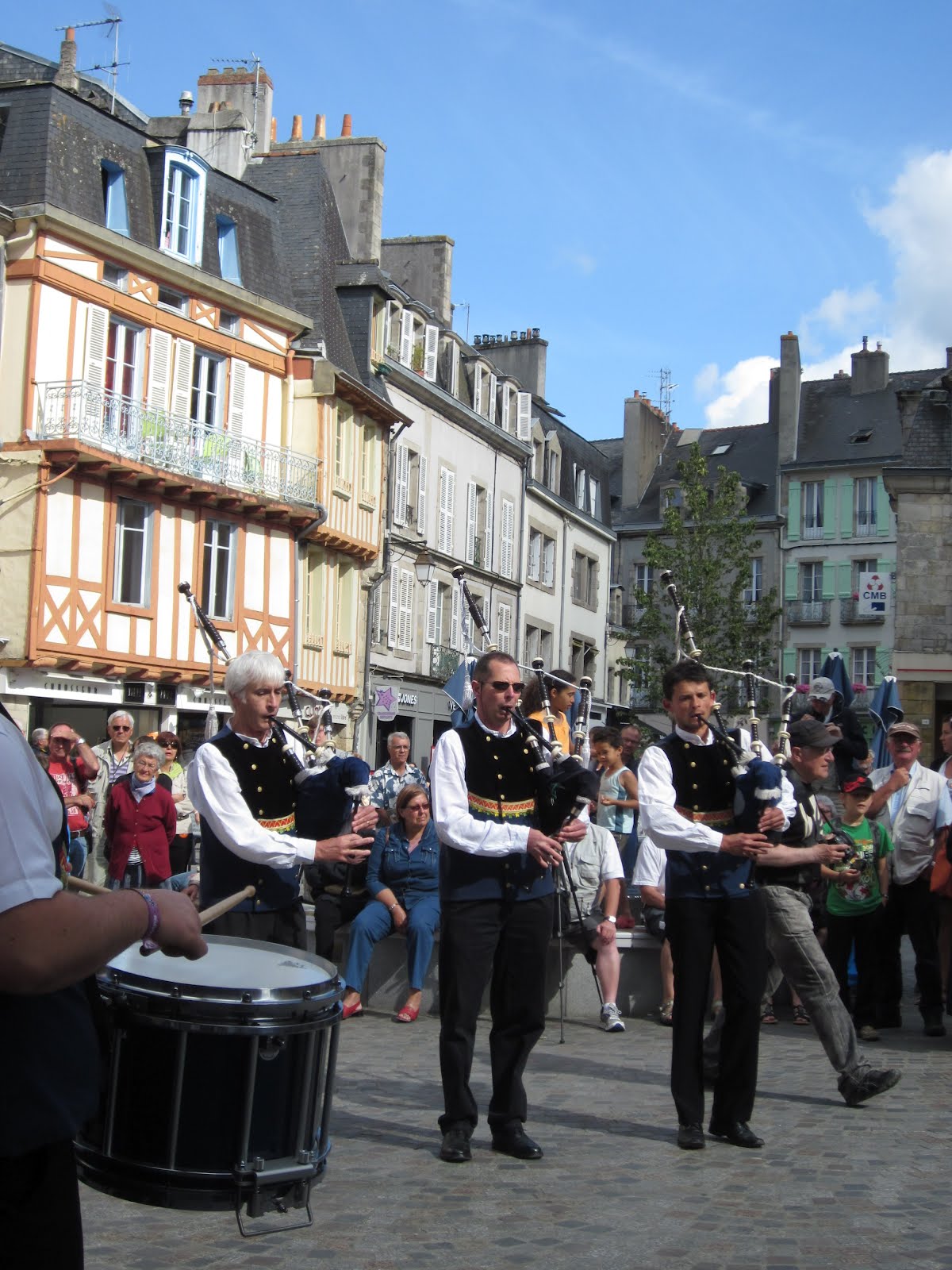
Went to the wonderful Festival de Cornouaille in Quimper and was not disappointed by the quality of musical offerings. Amongst bagad (Breton bands) and pairs competitions, I was very taken by the gorgeous Josick Allot (above), playing the bombarde with Erwan Le Hir on the biniou. I would defintely give him the gold medal in pretty much any contest. Except maybe the Olympic tennis.

Saturday, July 21, 2012

Nantes of many faces


I've been in Nantes this week to write a profile for London City airport. It's three years since I last visited and I'd forgotten the extraordinary vibrance and energy of this dynamic place. The city has had to reinvent itself several times and has done so with panache. Much of the exceptional 18th century wealth still so visible today in the merchant's houses with their iron balconies and sculpted 'masks' came from the 'triangular trade' whereby ships left Nantes for Africa, took slaves on to the Caribbean and returned to France laden with sugar and spices. This difficult theme in the city's history is in no way played down. The chateau museum graphically depicts the material benefits and the unspeakable cruelty of the practice, and a new Memorial to the Abolition of the Slave Trade has been established beside the Loire, including a long subterranean tunnel full of facts and quotations about the struggles of the abolitionists all over the world. A bold strategy, making virtue out of necessity!
Despite having magnificent heritage in the restored Chateau of the Dukes of Brittany and the gleaming Gothic cathedral, greater emphasis is placed these days on more innovative offerings, and many strategies are in place to lure visitors from the medieval centre to one bank or another of the Loire. Le Lieu unique is an arts centre set up in the old factory where the famous LU brand churned out biscuits in their millions. The interior remains a rude mass of concrete and metal, carefully made over in a minimalist kind of way - the underground toilets are deliberately awash with graffiti - to satisfy some criteria of the current craze for industrial art. The lone remaining blue and red tower with its gyroscope is now open for a panoramic view over the city.
On the Ile de Nantes the vast former ship-building works is now a centre for machines of a very different kind, like a larger than life mechanical elephant that will take you for a ride. With the decline of the port, as the Loire silted up and St-Nazaire developed to the west, Nantes has niftily adapted its maritime legacy to meet the service demands of a new age of tourism.
As to the fact that Nantes was capital of Brittany for a thousand years until the Vichy government severed the tie during WWII and the city became head of the new region of Loire-Atlantique soon after the war - what better opportunity than to shift identity once again (and totally avoid the complex political issues of reintegration with the four provinces of new Brittany - over Rennes' dead body) and become Nantes of many faces - Breton in some undefined way, but mainly top city of the Loire, commercial centre of all the surroundings territories, focal point of north-western France.
It's all done very cleverly, like a conjurer's sleight of hand, with the visitor so taken by the razzledazzle of festivals, initiatives, colourful street life, building developments and fluvial activities that there's really no time for analysis, just pure fun and enjoyment.

Tuesday, July 17, 2012

All at sea


Spent a fabulous day at Les Tonnerres, the international maritime festival held in Brest every four years. It was an extraordinary pageant of ships from all over the world, and a vast tent city of stalls and exhibitions running for several kilometres around the commercial port and on both banks of the Penfeld river below the chateau.
A trip out on the Rade in the morning to be in amongst the parade of schooners, sloops and cutters of every variation imaginable was a sensational experience, despite my ignorance of matters maritime. Offerings on land were pretty good too with all kinds of music, food and crafts from Brittany and the invited nations - Norway, Russia, Mexico, Morocco and Indonesia - as well as boat-building, historical reconstructions and guided tours of many ships in dock.
Get along now or don't miss this in 2016!

Friday, July 06, 2012

Significant others

Today I had the pleasure of meeting poet Angela Locke for the first time. We have corresponded about a collaboration for her creative writing course to be held here in Finistere in September but never actually spoken. It was a significant meeting, one of those special occasions when making a connection has immediate and surprising consequences. We didn't have time to do much more than than exchange compliments about our books (I have recently read her stimulating collection Whale Language: Songs of Iona) and talk of arrangments for me to give a talk and a walk (yes, I can even do both at once in an emergency) for her group when the time comes. But there was a strong current of sympathy, humour and incipient affection running across the table even on such brief acquaintance, and I left for another appointment looking forward very much to seeing how she works and contributing to the process myself.
I was driving along happily afterwards thinking of all I had to do at the weekend with another couple of ferry talks to give and Wimbledon finals to watch when - suddenly the whole beautiful entirety of the book I have been wanting to write for the last two years and never quite glimpsed full-on, crash-landed in my head. The afternoon has passed in a whirl of ostensibly functioning on a normal plane whilst idea after idea flowed out and everything I've been thinking about for so long now without form or substance presented itself in a coherent, natural sequence.
This happened to me once before. After spending an afternoon walking and chatting with sociologist Anne Guillou about things completely unrelated to any creative work, the whole story of the Five of Cups leaped out of my brain, fully armed like Athena from the head of Zeus. But that book was hell to write, so let's hope the similarity ends with the initial inspiration.
It's been a great day. Thanks, Angela.