
Monday, April 13, 2015


Monday, April 06, 2015
A good day's work
 |
| Rade de Brest |
I deliberately chose a peninsula which has no coastal path, and therefore is inevitably far less walked than the many others on offer in Finistere. It also had a merit of a culminating point in the Rade de Brest which is inaccessible by road - indeed the complete absence of cars and mechnical noise was a major advantage of the whole circuit. Apart from a few family walkers in the hamlets, I saw no-one else on the route. It was three and a half hours of blissful peace and spectacular views. I still feel excited about it now, sitting at my desk in the calm of the evening.

Friday, April 03, 2015
Falling in love again
I've been in Rennes all week. Little leisure time, but did manage to
spend a few minutes gazing at one of my favourite constructions in the
world, Les Horizons. It's such a happy building, I have to smile every time I look at it.
 And it always smiles back...
 I
ITuesday, March 24, 2015
Moor thoughts
.JPG)
I can trace my deep connection with the moor to early journeys over the Brecon Beacons. My poor exiled Welsh parents, miserable in manicured and over-managed Gloucestershire countryside, often made the return to their homelands - Swansea, Mumbles, Gower - with four children in tow. It was part of my father's hopeless quest for identity and part of my own very early passionate attachment to landscape. The passing of the beloved object on the way to another destination has also had its legacy, and later made travel more valued than arrival in almost every aspect of my life.
There was no more to this early love than that the sight of the moors made me happy. To a childish imagination they represented endless, boundless freedom and apparent simplicity. Other landscapes were psychologically more complex to me even then as a small child: the sea with its tides, the endless movements of a river, the uncertainties of woodland, hills lost to the unsettling exploitation of farming. But those long, high rounded slopes, empty of life and difficulty, solid and unchanging, gave me both a powerful sense of permanence and an invitation to endless possibilities, to the open heart and mind that seemed so perplexingly elusive in the constraints and compromises of the everyday world. I came to learn that there was far less isolation and considerably more connection for me in the wilderness of moor than in family life.
Sunday, March 15, 2015
Death in the forest
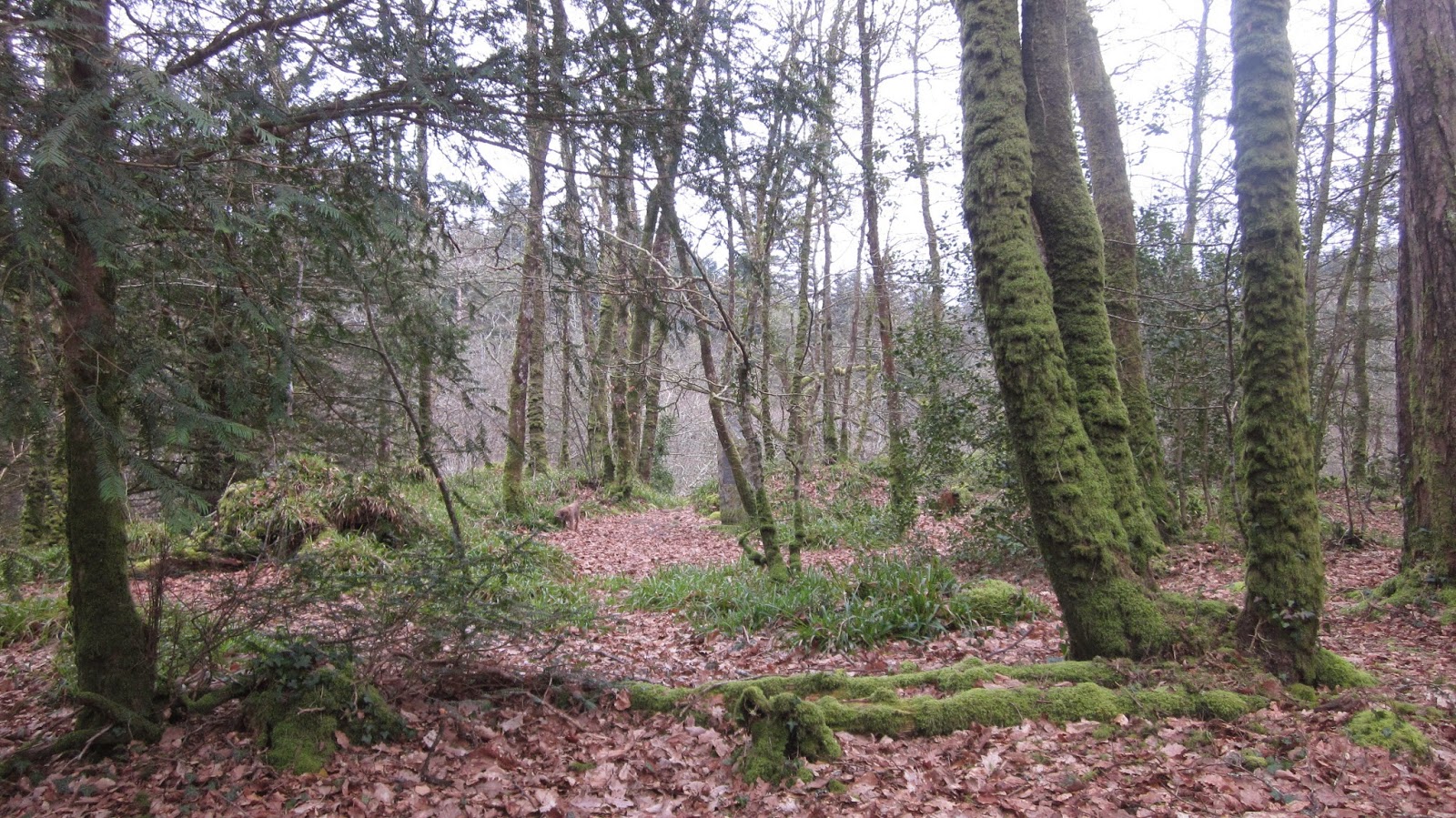
Working on my text about death in the forest this
morning, which involved both writing and a long walk to review the relevant
sites. Death comes easy and hard in the normal order of forest, with its
acceptance and exploitation of the cycle of decay and regeneration in nature
and the practice of hunting. But there is also murder and accidental death (or
possibly suicide) to consider in my forest.
Long after the war was over, the
bodies of three young men, executed by the Germans, were found on the hillside
above the Argent river. They represent the great number who, with all the
desperate nonchalance of youth, took action to resist enemy occupation until
such bitter ends as a blanket of dirt and leaves on a wooded slope. A stele
marks the fate of Pierre Ruelen, Jean Volant and Emile Bérthou. Whenever I hear
the explosion of a hunter’s gun echoing through the trees, I think of falling
limbs with human faces.
In May 1919, the body of Victor Ségalen was found by
his wife among the beech trees on top of a high granite outcrop, once the site
of a medieval motte. He was apparently sitting propped against a tree with an
open copy of Hamlet, having bled to death from a wound in his heel.
This curiously staged scene – and his hurried burial avoiding an autopsy – has
led many to think he took own life to put an end to the nervous depression and
mysterious physical malady that had taken hold of his life.
Born in Brest in 1878,
the profession of medical doctor took Ségalen on journeys that went far beyond
the practical fact of travel. It was China that
came to shape his remarkable inner life: he conducted archaeological digs there
and became a Chinese language specialist, before returning to France. The
cultural landscape of his experiences was manifested in poetry and texts (such
as Stèles, published in 1914). He was in Huelgoat for his health,
ironically, walking daily in the forest with a book and notebook, experiencing
the profound sense of containment and aloneness offered by this special place.
For a man who lived on the borderlands between reality and imagination, he
chose a good place to die.
Thursday, March 05, 2015
La Belle Vie
 |
| Liz and her work |
www.artitudebrest.com www.lizridgway.artweb.com
Liz's work will feature in my exhibition on landscape at L'Autre Rive in Huelgoat in October.


Thursday, February 26, 2015
It was Chaos...
 | |
| AIKB group |
Sunday, February 15, 2015
Welsh victory

Sunday, February 08, 2015
Walking, noticing and leaping hares

What I am most grateful for today is the reminder of the difference between looking and noticing, and the concomitant quality of mindfulness as an active state. Walking with all the senses is a direct experience, complete in itself and only stifled by the process of thought. Claire Thompson's opening chapter 'We are Nature' joins up all the dots of existence and expresses my own feelings of belonging in the natural world where - as she puts it - 'I don't feel alone, I feel alive.'
Sunday, February 01, 2015
A big change

After writing the previous post on this blog, I could no longer ignore
what has been gnawing away at me for the last two months, ever since I started
work on the new Finistère guidebook. Raising the perennial problem of
guidebooks (where the good stuff that digs beneath the surface gets cut and
only the basic facts remain) made me finally face up to the most important
basic fact of all. I do not want to do this any more.
My last book, Brittany – a cultural history (Signal Books,
Landscapes of the Imagination) at least allowed me the luxury of arguments and
issues to the extent that overall word and page count would permit, and now
there is no way back to the more constricting, prescriptive format of
conventional guidebooks, the need to conform to expectation in terms of sites and coverage, to reader profiling and in-house styles.
I need a more creative process, a focus on my landscape writing, whether
or no a book in publishable form emerges. I need to work from the inside out
and not vice versa. I need to give more time to other things and other people.
What I no longer need is to sit at my computer for ten hours a day or travel under
frustrating pressure of collecting and regurgitating information in a limited
timescale. So I have reneged on an agreement for the first time, something
quite against my normal instincts, and in doing so have made a major change in
my life.
Walking in the early evening today, the debris of frozen hailstorms
still lingering on the rocks in the forest, I felt a sudden sting not of panic
but hesitation and uncertainty. What on earth will I be doing at 9 o’clock or 10 or 11 tomorrow morning? I have worked so hard
for so many years on a clear progression of full-time, demanding writing
projects (usually fired by economic imperative) that I’ve forgotten the sense
of freedom that accompanies true creativity.
A minute later, the last ray
of a previously veiled sinking sun flashed through the skeletal trees right into my face,
lighting a golden path ahead. It was a simple reminder of alignment, of the
beauty of doing the right thing at the right time. Whatever I do tomorrow
morning will be new and exciting and worthwhile, even if it’s only sleeping in
for a change…
Monday, January 26, 2015
Perennial problem
.jpg)
There's no room to write about the painful religious manoeuvrings that presented the tragedy as God's will, a new 'Slaughter of the Innocents', the children as chosen martyrs for the redemption of others (a stance which not surprisingly roused some of their parents to anger). And how barely a word was spared for the other 20 who died. Or the political repercussions and attempts to stir anti-English feeling: La Bretagne's headline on February 1 read 'Raid terroriste de l'aviation anglo-américaine sur Morlaix. Or to analyze the extraordinary decision of the allies to make such a day-time raid where large loss of civilian life was highly likely instead of targeting other viaducts carrying the same railway across other valleys in the middle of unpopulated countryside. Or the fact that only one arch of the viaduct was hit, and that the Germans had the trains running normally again only eight days later...
Sunday, January 11, 2015
We marched in Morlaix today...
... powerfully in the spirit of freedom and equality. Thousands of Bretons and others of all ages and backgrounds - the presence of many young adult men and women was a special sign of hope - milled and smiled together in what amounted to a considerable display of solidarity within wide diversity. There were those who laughed and chatted, others grim or solemn with tears in their eyes, but all alerted by this simple physical act of walking together to the importance of our shared values and the reality of our enviable quality of life, which rests on tolerance and inclusivity.


Thursday, January 08, 2015

Monday, January 05, 2015
Strange start

Workwise all seems rather fragmented too, with a translation for a scientific association in Quimper spanning the Xmas/New Year period, website updates to organise and many routine administrative tasks. Frustratingly, my new Lumix camera refuses to co-operate with my computer, or vice versa, so many photos remain unprocessed and unusable for the moment. Hoping to get going in a more settled way this week and focus on the new Finistère guide without distractions.
Tuesday, December 30, 2014
Landerneau - no
 |
| Landerneau |
All these things make for an unpleasant visit. Luckily a quick jog up to the top of the castle at Roche-Maurice soon restored my spirits. Until I saw all the information boards with the translation of donjon as 'dungeon'. Aaaaaaaaaaaaaaaarrrrrrrrrrrrrrrrrrrrrrrrrrrrrrrrrrrrrrrrrrrrrrrrr
 |
| La Roche-Maurice |
Saturday, December 20, 2014
Happy Yule and all that
.JPG) |
| Wintry lake at Huelgoat |
I'm looking forward to these challenges, and hope you all have a happy and fulfilling New Year.
Monday, December 08, 2014
London blues
 |
| Lovely purple seats on an almost empty TGV |
Yesterday, strolling to the local shop with a friend, I fell off the pavement, managing to wrench and skin my right knee and give my left elbow an equally savage cut and jolt. Multiple plasters were applied at said shop, where staff seemed alarmingly unfazed by the appearance of a customer dripping blood. The whole thing was quite a shock, and I wished later I had agreed to brandy in the reviving coffee supplied afterwards, because a 26 hour journey from London to Finistere involving two car trips, two coaches, one ferry, two trains and a taxi is not something I ever want to do again in that degree of pain and discomfort.
It's nice to be home :-)
Thursday, November 27, 2014
Brittany - a cultural history

The book tries to bring out the realities of Brittany - extraordinary enough in themselves - behind the clichés of touristic hype, with contemporary life featuring alongside the assessment of past highs and lows. It also intends to create a vivid physical sense of the land, sea and coast, which figure as major characters in the narrative. In common with the other studies in this series Landscapes of the Imagination, there is also an emphasis on culture, particularly the strong oral legacy of the Breton language.
Available now: published by Signal Books (www.signalbooks.co.uk)
Saturday, November 08, 2014

Sunday, November 02, 2014
Holiday weekend

 |
| Plage de Squividan |
 |
| Pointe de Men Meur |
 |
| Menhir de Léhan |
Subscribe to:
Posts (Atom)
