Showing posts with label brittany. Show all posts

Friday, December 04, 2020

Vikings in Brittany (Part 1)

Replica Viking boat at Pont l'Abbé

Here in Brittany the image of the Vikings has undergone what has become a familiar sea-change, from bloodthirsty sadists to high-spirited entrepreneurs. What is certain, however, is that they insinuated themselves into the Breton/Frankish power struggles like a ragged cross stitch for a hundred years, often acting in temporary alliance with one side or the other. The initial hit-and-run marauding in search of booty and adventure became over time a more complex mixture of power and land seeking. Most important of all for the development of Brittany, there is no doubt that their activities between 840 and 940 had highly significant consequences for Breton identity, language and culture, striking at the very time that Brittany the political entity was in formation.

In the 830s, Nominoë, a Breton count initially acting as representative of the emperor of the Franks to keep the peace, had begun what seem to be deliberate attempts to unify Bretons against the Franks and establish distinct spheres of political and religious control. After Charles the Bald inherited the western part of the Frankish empire from Louis Le Pieux, he was soon on a collision course with Nominoë and fighting in the disputed lands of the Marches of Brittany was fairly constant, with the Bretons pressing as far east as Le Mans.

Nantes cathedral today (before recent fire)

In June 843, the Viking attack on Nantes was an explosive shock, coming nearly fifty years after the first raids further south on Noirmoutier. The fleet of 67 ships were from Norway, possibly having followed the northern route around Britain via the Shetlands and Irish sea to access the Loire estuary. Whether by luck or insider information, it took place on the feast of St Jean, as the bishop Gunhardt was celebrating mass in the cathedral. According to a later (religious) source, he was pronouncing the eucharistic prayer ‘sursum corda’ (lift up your hearts), giving a ritualistic tinge in Catholic tradition to his brutal murder at the altar. The 11th century Chronicle of Nantes gorily describes the slaughter of the congregation that ensued.

Gunhardt slaughtered at the altar

After this crippling assault, the Vikings departed with their booty. It was to be ten years before Nantes suffered a repetition, but the struggle with these ruthlessly mobile new intruders, consisting of different groups acting both jointly and independently, was only just beginning in Brittany. The Annales de Saint-Bertin record three battles fought by Nominoë against the Vikings in the year 847. The upshot was not the clear-cut victory he had hoped for and the negotiations that followed ended in the first Breton payment of danegeld to speed the Vikings’ departure. But this secured only the briefest lull in hostilities and the true scale of the threat could not yet be measured. TO BE CONTINUED....


Sunday, October 25, 2020

Here it is!


The Stolen Saint, my new novel set in a Breton village, will be published on December 1st. Details of pre-order to come shortly.

Wednesday, July 08, 2020

Newsletter

I've started a newsletter, largely with the aim of engaging more directly and personally with readers and answering questions I am asked about my life or writing. It will also be about Brittany, of course, as all my work whether fiction or non-fiction is centred on the history, legends and landscape of this remarkable place. Regular short features like Speaking of places, In the hut and a question box will combine with quirky facts around my writing and daily life. The new novel I am currently engaged on will also figure largely, as the (fictional) Breton village where it is set evolves.
Anyone who would like to be on the mailing list to receive about 10 issues a year of this emailed PDF document, can contact me at mewes@orange.fr or on Twitter @brittanyexpert  Your details will only be used for this purpose.

Monday, May 11, 2020

Coming very soon...

There have been some delays, not surprisingly with current working conditions, at the printing stage, but the book should soon be ready. News about launch also in the pipeline. Thanks to all those who've enquired about this. I know that the many lovely British and French fans of Spirit of Place kind enough to want to continue following my work have had a long three year wait, but it's nearly over now. At the very least I hope people will enjoy the 'triumph over adversity' aspect that accounts for the long delay in finishing this book. I can still hardly believe I made it to the end.

Tuesday, April 28, 2020

Nantes-Brest Canal guide - 4th edition

Very pleased to announce that the 4th edition of my Nantes-Brest Canal guide is available now. There will also be a new French edition for the first time on release shortly. The enduring popularity of this guide shows how important the canal is as a leisure resource, although the balance between walking and cycling has definitely swung towards the latter. It always saddens me to see cyclists whizzing along to make their daily kilometre target and not noticing all kinds of wildlife and natural treats along the way. The guide includes all the accommodation information needed to plan a trip, as well as showing restaurants and cafés or where provisions can be purchased within easy reach of the towpath. All this has been checked and updated for this new version and the route itself verified on the ground.
Every inch of the towpath is carefully mapped, with detail of locks and crossing points, direction of flow and distances. Places of interest on and around the canal are given on the relevant pages and there is a long introduction describing the origins and development of this extraordinary engineering feat. We have Napoleon to thank for the go-head for this incredibly expensive and labour-intensive project, with work carried out in fits and starts over twenty-odd years from 1806. The heyday of the canal was in the last years of the 19th century and first decade of the 20th. Burgeoning railways and, after WWI, lorry transport were invincible rivals for this slow form of transport and decline was long and sad, although a few barges operated right up until 1977 when the last load of sand was deposited at Saint-Congard in Morbihan.
Many people do not realise that that the vast majority of the 365km length of the canal consists of beautiful, wide, windy, free-flowing river with few locks, and it is only the connecting sections between river valleys that are the straight narrower channels often associated with the word 'canal'. There is nothing monotonous about a walk or ride across the very diverse territory from Loire-Atlantique to Finistere. The introduction to this guide gives an idea of the changing landscape and atmosphere right across historic Brittany. Better note before planning a trip that the canal actually starts just over 20km north of Nantes and ends nowhere near Brest....

Wednesday, March 18, 2020

Bretons: Vefa de Saint-Pierre

This extraordinary woman was born in 1872 in the Goëlo region of Brittany, although she is most closely associated with Spezet and the Montagnes Noires in Finistère for her later activities.
As a child she wanted to dress like a boy and harboured ambitions of running away to sea. Hunting was a real passion from an early age and throughout her life, guns were never far away.
At 18 she joined a nunnery, perhaps a surprising choice for one of such decidedly strong and individual character, but it did mean she got to go on her first significant journey, a mission to the Equator in 1899. This fuelled the thirst for long-distance travel which was to be another theme of her life, with a visit to America and Canada in 1906. By this time she had left the religious order definitively without taking orders or being thought suitable to take them by her superiors. She met President Roosevelt and spent a lot of time delightedly hunting caribou.
Back in Brittany in 1908 she bought the Manoir de Menez Kamm near Spézet which was to be her beloved home for many years. It was situated in prime hunting territory and she was soon well-known for fearless pursuit of the local wild boar. She learnt Breton and became an ardent (and militant) advocate of Breton history and culture, hoping for the kind of revolution in Brittany that Ireland had seen. She gave money and moral support to many Breton nationalist projects and local organisations, and was closely involved with Gorsedd bardic community. In 1930 she was given the bardic name Brug ar Menez Du (Heather of the Black Mountain).
She had a very lively intelligence, bent on constant learning throughout her life, whether languages, geography, natural sciences or theology, remaining a devout and committed Catholic. She also wrote poetry, although always very modest about her talents. A round-the-world trip in the 1920s gave her the chance to write about her travels and encounters for magazines and papers, as she visited Australia for an international Christian conference.
After the war, her beloved home was used as a centre of Breton culture, as she provided free bed and board for many writers and musicians. As old age loomed, she herself was increasingly based in Saint-Brieuc, until her death there in 1967. Claire Arlaux's engrossing biography tells the whole story of an exceptional and remarkable figure in 20th century Breton history, giving a new perspective on pre-war nationalism and subsequent cultural development.


Sunday, September 29, 2019

Taking stock

Menhir de Champ Dolent, Dol-de-Bretagne
After my annual long visit to Combourg, where I have been based to complete a chapter called the Devil's trajectory around Dol-de-Bretagne, it's time to take stock of the year's work and my progress along a very decided path for 2019. I arrived home to find author's copies of my little saints' guide  waiting - one objective achieved and a pleasing result of a great deal of effort. Much of the research was done for another saints' project last year, but trying to sift a mass of material for meaningful synopsis is not easy, and to convey complex issues in compact form is a veritable skill. Introduction to the Breton Saints forms a third volume in the series that began with guides to Huelgoat and the Monts d'Arrée, a format that has been much appreciated by very many people. There may well be a fourth topic in 2020, given the success so far.
As to the main purpose of my year, the completion of Wayfaring in Little Britain, the journey is far from finished, although I have made significant progress lately. This is the third year of trying: thwarted by serous illness for the last two, I am finding the physical demands of travel, walking and research extremely hard to cope with, but am determined to finish the manuscript by the end of the year, even though the last bit of route coverage is not scheduled until December 26th! With the encouragement of the few readers who have glimpsed the content of this elusive book, this theme of hard-won achievement has crept into the text - quite a change for me to write personally, but it perhaps it is time to be honest about the demands of walking and searching against a backdrop of pain and difficulty. Most people writing about history in the context of landscape are serious walkers covering 30-odd kilometres a day without too much trouble. That has never been the case for me, but I hope there is equal merit in a book constructed around hardship, where a day's walking for a healthier person may turn into two or even three for me on occasion and where considerably more logistical planning is needed.
St Samson's mitre, Mont Dol
I hope it can be done. The themes of journeys and different types of walking from neolithic ritual through Roman roads to saints' stories and medieval pilgrimage are fundamental to the discovery of Brittany's landscape and history. It will be a final summary of all my painstaking work in this field over many years, as next year is to be devoted to something rather different...
Start of the Devil's trajectory on Mont Dol

Monday, September 09, 2019

Megaliths

Alignements du Moulin
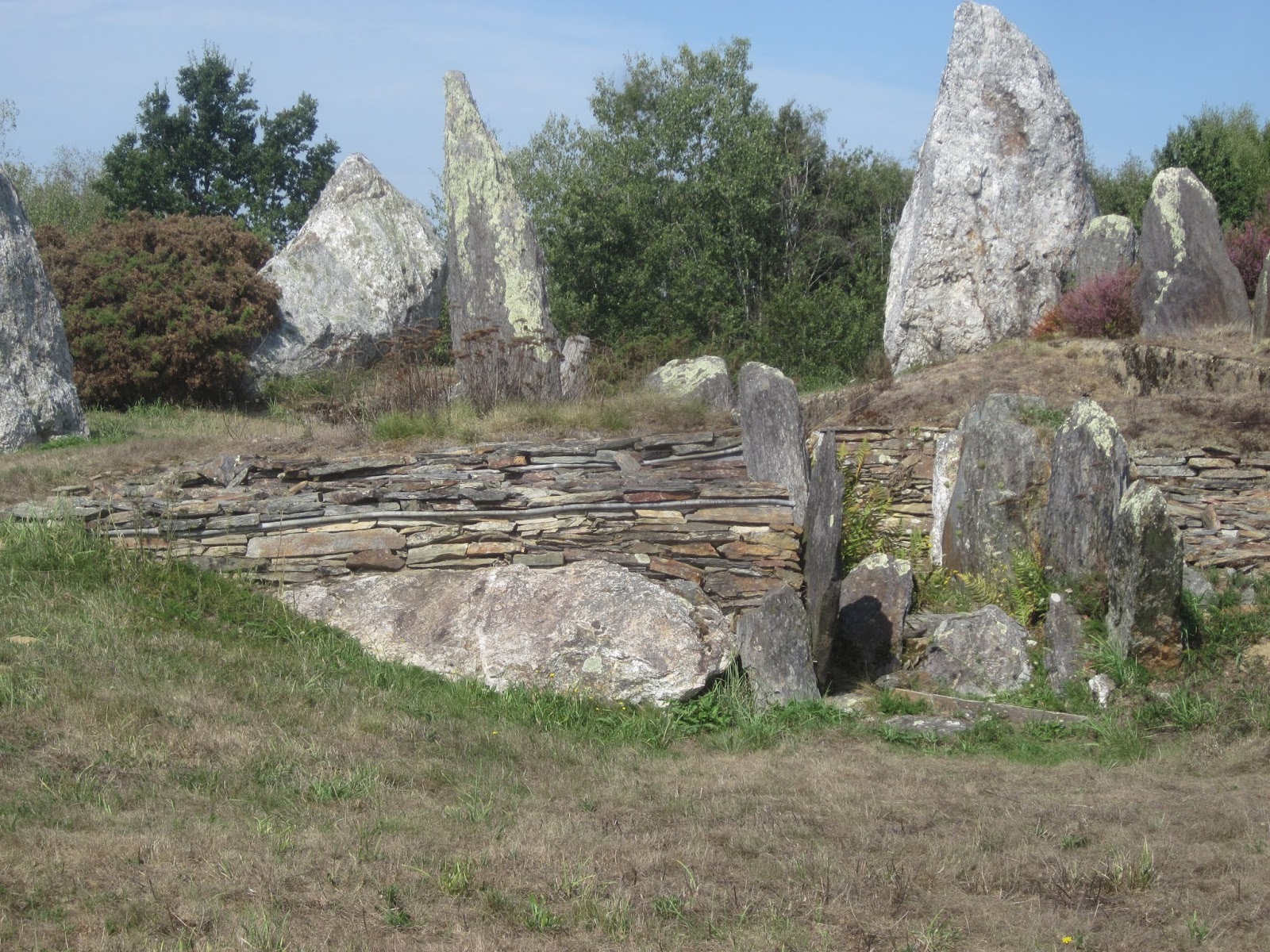
I have been in Ille-et-Vilaine, revisting the exceptional megalithic site at St-Just, which will figure in my new book Wayfaring in Little Britain. Here a walking trail leads out along the Landes de Cojoux with alignments, standing-stones, tumuli and graves all around for more than two kilometres. The site has been tamed and organised since my last visit to a lonely open plateau which then had little restriction for movement among the stones. It was also a forlorn sight at that time, just days after a major moorland fire had left the scars of burning everywhere, vegetation reduced to ashes and acridity filling the air. Now in late summer there was plenty of plant colour and clean quartz to gleam in the hot sun.
Le Tribunal
The monuments that I return to again and again are the Alignements du Moulin and the so-called Tribunal, the latter mooted as a stone age calendar, but named for its appearance of a row of judges and the accused. The 12 menhirs of the alignment, made of schist and organised east/west, are like people in their individual shapes, character and relative placings - a family photo covering the generations. Funerary remains found on excavation date to about 4700BC: the standing-stones came later. The function of the stones themselves or their role within the overall structuring of the whole complex is impossible to say. They appear to be on course to meet at a point with the line of chubbier quartz stones to the north. A further north/south line is suggested by a few remaining small stones.
What is so extraordinary about this site is the constant unfolding of remains, the accumulation of death, here, there and everywhere around the main path which forges across the open centre of the plateau. The loftiness of the location was obviously significant, and its dramatic end, abruptly above the valley of the river Canut and the Etang du Val.
Chateau Bu
On reaching the pinnacle at the Chateau Bu, with its neolithic burial in lateral chambers and later Bronze Age graves and guardian pillars, it is hard to imagine anything better, but huge complexes of inter-related monuments like the Croix St Pierre arrangements await. The place, even over its significant length, has a clearer sense of unity than Carnac, for example, and is to me much more compelling. The main practical advantage is that there are rarely other people to share the scene outside weekends and holidays. This sense of aloneness amidst serial funerary architecture from nearly seven thousand years ago offers a powerful experience and it was a strangely emotional one this time.
After a few days away, I made a slow journey back, stopping off to see if the megalithic site at Monteneuf in Morbihan had changed much over the years. It has, whether for the better or not is hard to say.
Monteneuf

Monday, July 22, 2019

Worth its weight in gold

Artichoke harvest
Léon, the northern area of Finistere is best known further afield for its ferry port at Roscoff, but no traveller heading south off the boat can have failed to notice the ubiquitous fields of artichokes, onions and cauliflowers. It is a prime growing area, part of what has long been called the Golden Belt of Brittany's agricultural harvests. Brittany Ferries itself was started in the 1970s to take the produce to Cornish markets. Breton artichokes were once flown on Concorde to the US.
The legend of Saint Goulven is at the heart of this idea of fecundity and its concomitant prosperity. His mother was about to give birth to him as soon as they arrived on the coast of Armorica, near where the bourg of Goulven is today. His father went on a desperate search for water, finally falling to his knees and praying for God's help. On returning to his wife, he found a newly born son and a newly flowing spring of freshwater. The land in Brittany provides. The elaborate Renaissance fontaine of St Goulven now marks the spot. Pilgrims later came for healing, particularly of fever. A stone sarcophagus in the wall by the statue is called the bed or tomb of the saint. Here sufferers immersed themselves and prayed for cures.
Sarcophagus in lefthand wall

Although much later a bishop of Léon, Goulven was a quiet and serious young man, who soon dedicated himself to prayer and preaching. He lived apart from society with a single follower. One day he had the impulse to send his friend Maden to a neighbour asking for a gift. After a short reflection, the neighbour hefted a clod of earth into the fold of Maden's tunic and sent him back. Maden found his load heavier and heavier as he struggled to return. Goulven came out of his hut to meet him and discovered that the earth had turned into a lump of gold. So we learn that the riches of Léon lie in its soil, and that Goulven was worthy of a miracle and destined for sainthood.
Earth turned to gold

Monday, May 20, 2019

The Pardon of St Yves

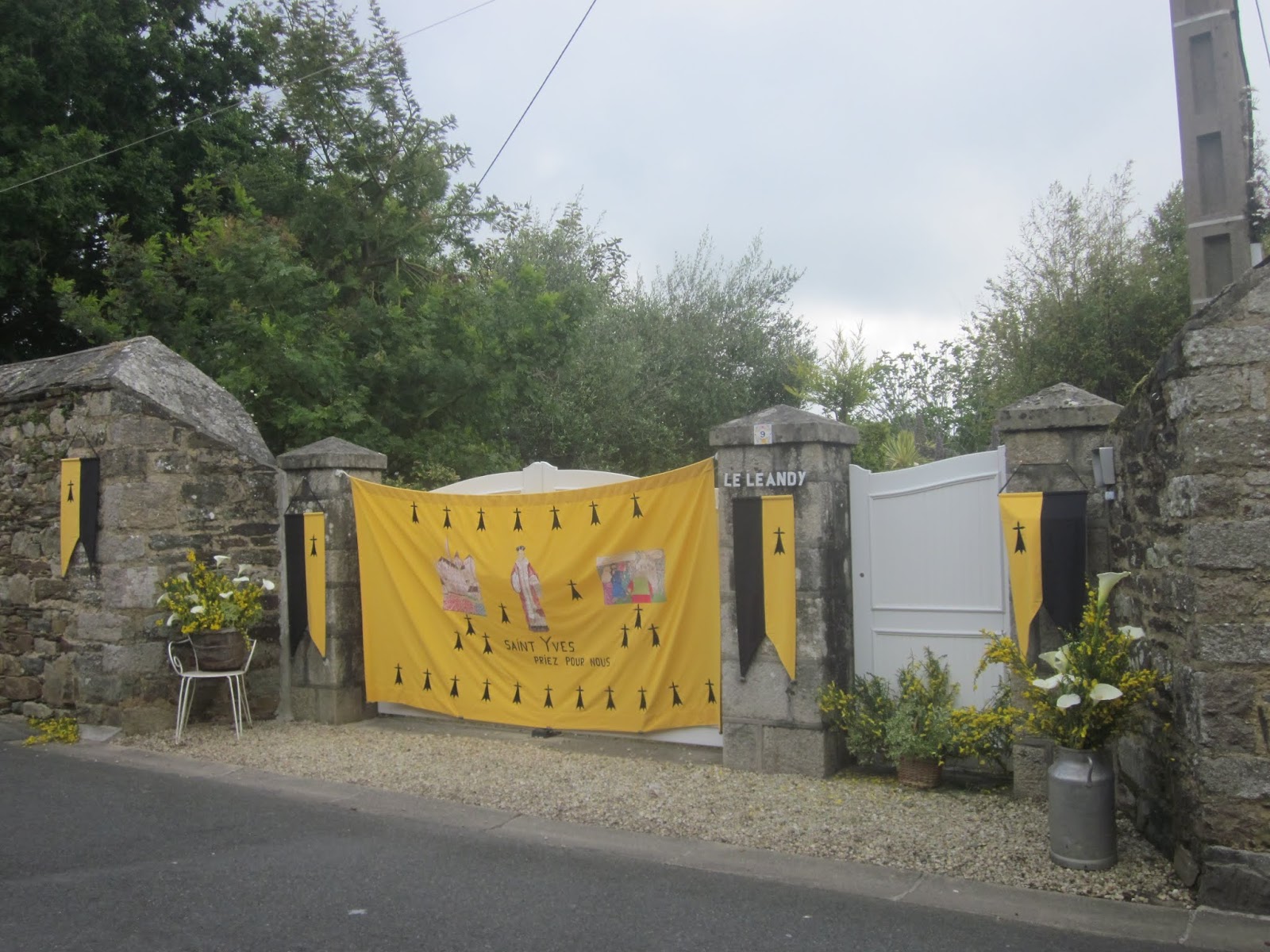
I spent the weekend in Tréguier, a favourite haunt, but for the first time to attend the great Pardon of St Yves. Yves Hélory (1253-1303) was an ecclesiastical advocate and extraordinary defender of the poor, well-known all over the Trégor in his day and considerably further afield following his canonisation in 1347. He is the patron saint of Brittany and his special day attracts thousands for a procession between the cathedral in Tréguier and the chapel in Minihy-Tréguier, his birthplace and home. The relic of his skull is carried by lawyer and priests along the 1.5km route and back.
The town is all dressed up for the event with his family's yellow and black flag (thanks to a crusader grandfather) displayed everywhere together with sheaves of yellow broom and hundreds of lily flowers studded into hedges along the way.
I attend the mass in Breton at Minihy, for a while in the back of the chapel and then outside in the cemetery, still singing along from the hymn sheet (Breton is easy to follow and generally pronounced as it looks), and watching pilgrims turn up now and then to crawl under the 'tomb' of the saint, an ornate stone table. The best sensations of the occasion - in the simple and emotional faith of St Yves - are most felt here without the great numbers thronging around the cathedral in Tréguier, where the service in French is also taking place.
Walking into the town along the processional way in reverse - Chemin de St Yves, rue de St Yves - I have time for a leisurely coffee while crowds gather to witness the spectacle. Suddenly I realise that just seeing a bunch of lawyers coming out of the south door with their proud burden is not what I want to see most, and it will be hard to do so or to take photos in the scrum of curious onlookers and the faithful following the parade.
I retrace my steps all the way back to Minihy, where a few are waiting at the point by a wayside stone cross where the main ritual of the procession occurs, on a ninety-degree turn down to the chapel.
After a short wait I hear singing floating up from the village - canticles of St Yves are repeated over and over during all the ceremonies - and the procession from Minihy with its three ancient banners arrives to await the cortege coming from Tréguier. The priests take up a position facing along the road towards the cathedral.
The crowd grows and seeking a place with a good view and the sun behind me, I'm forced to get up on a very narrow bank where three older people are sitting with their legs dangling. It requires considerable muscle and foot strain to keep perched up there for more than half an hour of anticipation. Finally the first figures appear and a Breton pipe band leads the way, passing in front of the cross and down into Minihy. Behind it an astonishing spectacle, wave on wave of banners and ceremonial crosses stretching as far as I can see.
The ritual of encounter begins as Minihy's tall metal cross is lowered and raised in a nod to various passing crosses from other parishes, which also dip so that the two metal faces almost kiss as they skim by one another. It is nearly forty minutes before the skull appears in the distance, a priest in front flanked by lawyers bearing the weight of the reliquary on their shoulders. They stop a little way away. The rest of procession has passed. We all wait. Finally the Minihy banner-carriers move forward and the skull is brought to face them. Up and down the banners go - what body strength it must take - high in the air then dropping towards the ground, saluting their saint as he arrives home in his own parish. This is the climax of the Pardon, the relic visiting its most profound site of connection. After passing through the village, the procession will return to Tréguier.
This is an old ritual, and of more significance that touches me than is usually the case in official ceremonies. The depth of relationship with place is something I understand. Indeed I am currently writing about St Yves and his paths in the Trégor. Almost every day, despite travelling far and wide in his duties as a priest elsewhere and preacher everywhere, Yves Hélory walked back home to the little family manor house where he tended the old and sick and saw that all their needs were provided for. Thirty or forty kilometres was nothing to him in search of home and belonging. The Pardon, despite all the trappings and pompous lawyers, both of which the saint himself would have deplored, still manages to symbolise this simple truth.

Friday, August 31, 2018

Saints preserve us

Making cow"s eyes - St Herbot
Summer has been slow, sad and full of difficulties, but I have to say that working on the new book about Breton saints has revived my tenderness for this bunch of introverted loners and misogynistic misfits. The tension between what they mostly wanted - isolated contemplation and spiritual struggle in the throes of landscape - and what became expected of them in terms of community leadership, man management and political nous (or maybe nowse) was nothing if not challenging. Some - St Pol, for example - rose above it all and maintained a lofty saintliness that was proof against the worst excesses of wordliness: others, like St Ronan, fought every battle with asperity and, one is tempted to think, the relish of a waspish personality. His namesake, the philosopher Ernest Renan, says he was more a spirit of the earth than a saint: 'son caractère était violent  et un peu bizarre'. St Herbot just gave it all up and settled down in a quiet spot away from people to commune more comfortably with cattle.
But their legacy is immense, and the particular nature of Breton faith that cherished them so is equally endearing. I am currently reading Anatole Le Braz's Au pays des pardons in which he describes (or rather tells how it was described to him) the pardon of St Servais when the faithful of Cornouaille and the faithful of Vannes turned up ready for a brawl, comported themselves as teams and fought for the privilege of hoisting the sacred banner of the saint, whilst the little statue of Servais was smashed to smithereens under the blows of staves and had to be replaced each year. The wounded were taken home on carts, bleeding and groaning.
Pardon of St Eloi - a more orderly affair

Monday, July 23, 2018

Huelgoat: as real as legendary

The lake
The town tour I am offering this summer is something of an oddity. Huelgoat (= high forest in Breton) is famous for its glorious forest, massive granite boulders and the associated legends. The town itself is not distinguished by impressive architecture - far from it - and away from the lake, rocks and sylvan streams there is little a romantic could find to celebrate. But I've been taking people round the forest and telling the same old stories since 2004, so more than time for a change, and surely reality can be just as compelling if presented in a coherent way.
The reality of Huelgoat is a distinct economic and social history that has fashioned the town differently from its neighbours. The key to history is often geology, and here the exceptional granite flowerings (product of volcanic magma) and considerable silver-bearing lead deposits have both played their parts in development and prosperity. Mining was practised by the Celts and Romans here, and this underground wealth attracted the attention of the dukes of Brittany in the late 12th century when they bought large tracts of land from the spendthrift lords of Léon. The oldest building in Huelgoat is the central mill (now called Moulin du Chaos), built in 1339 on the orders of Jean III (and sadly recently turned into a shop). The forest also provided extensive hunting grounds for ducal sport, a medieval equivalent of 'leisure activity' for the wealthy, an issue that was to assume renewed significance much later in Huelgoat.
Moulin du Chaos
German engineers constructed the lake - much smaller in form than today - in the late 16th century to serve as a reserve for the mines which were situated several miles away in what is now the commune of Locmaria-Berrien. No lake road existed until the early 20th century: a simple track gave cattle, horses and washer-women access to the water's edge. In the 1770s, at the height of exploitation, the size was enlarged and a canal cut from it to travel all the way through the forest to the mine, taking water to drop onto a hydraulic wheel and drive the underground pumps that forced water out of the galleries and shafts. An earlier canal, taken directly from the river Argent (Silver River) near the Gouffre had not proved adequate for the mine's requirements.
Little but long, canal heading out to the mine
Unskilled labour at the mines was mostly local, although peasants also had to work their farms, with many foreign professionals (Germans, English) and French (after the Revolution). This great influx of outsiders led French to achieve a dominance over Breton here which was not the case in the surrounding areas. There was also much inter-marrying as some local family names indicate, deriving from other parts of France. There were some tensions, some early strikes, plenty of environmental damage and pollution and finally decline of supply as it became more and more dangerous to access deeper deposits even with more sopisticated machinery in the mid 19th century.
Once the mines declined, quarrying became the main local industry with Huelgoat granite in great demand as building material. Where the creperie in the forest now stands beside the world-famous Chaos was once the manager's house and centre of activities. It explains why there are expanses here without boulders and why lone stones like the Trembling Rock (which bears a line of chisel marks, ready to be spilt) and the Champignon (Mushroom) stand out in what was once a sea of shapes like the surviving Chaos. The wide tracks so handy for roaming tourists today were then necessary for bringing out the cut stone in carts.
Roche tremblante with line of chisel holes
But the latter part of the 19th century saw changes of attitude towards nature and the development of leisure interests for ordinary people. Writers and artists (like Sérusier, one of the Nabis) flocked to the picturesque forest, and hotels blossomed to satisfy new tourist demands. One advertised the town as the 'Fontainbleau breton' and even had a dark room for budding photographers. Flyers in English reflect the early attachment of the British for this lakeside town, already referred to as an 'English colony' in the 1880s. Walking and cycling became serious leisure pursuits throughout the social scale and the beauty of natural scenery began to be valued for its own sake.
As quarrying caused more and more destruction of the great rocks that were attracting visitors from far and wide, a campaign to save them was mounted by the Touring Club of France and supported by many famous figures from the world of culture. In 1903 the town finally bought up the forest area of Saoulec to preserve what is now the main lure for tourists, an astonishing valley crammed with boulders of every size and evocative shape.
I throw in a single legend (the sort I like with social and economic significance) to show willing. It is a pleasing irony that the origin of this Chaos is attributed to the giant Hok Bras or Gargantua who rained down these rocks on the town as retribution for being offered nothing but thin gruel by the inhabitants once he tasted the creamy porridge available further north in wealthy Léon. The rocks thus began as symbols of poverty and are now the basis of the town's wealth, such as it, almost entirely derived from tourism.
The Chaos
Finally, one unprepossessing building can be used to illustrate this shifting economic balance between tourism and industry. The Hotel de France, situated in the town centre, put up this annexe close to the Chaos in 1904, a block of small appartments to accommodate the hordes of visitors that descended on the town in the first quarter of the 20th century.
Not pretty, but telling: early tourist accommodation


Wednesday, May 02, 2018

Magical places - some reflections


What do we mean when we say a place is magical?
Magical is something different from beautiful or majestic. It may include awesome, in the proper sense, stimulating respectful wonder of greater powers and new dimensions of time and space. A place that speaks to us of elemental forces, of presence, manifested in the luminous fabric of air, in effects on tree, rock and water especially, because magic is a transformative power and a skill of nature.
A magical place reflects back to us a sense of this potential, of the latent energy in the earth and the atmosphere. It is dynamic. Here speaks the long past, an age when nature was not only enough, it was all. Old energies die hard and in our world so often swift and superficial, we crave connection with those fundamentals of existence, the essence of life, things frequently obscured from us by heavy material and emotional trappings of modern life. They are zoetic and thrumming in magical places.
In these places, layers of being can merge and intermingle: spirits from all strata of existence, above, below and on the surface of the earth. Time is a circular continuity, drawing us into its aeonic embrace. We deeply long for this replenishment.
Magical places can also be a reflection of human endeavour: the site of megaliths, medieval ruins or modern structures can stir the power, through their harmony with the landscape, the shape of their expression, the open welcome they extend to otherness. They are aspirational symbols of connection.
The acknowledgement of a magical place is beyond Romanticism. It reaches out for a limpid simplicity buried deep beneath cultural layers that can enrich but also obscure. In a magical place we feel purer, inspired and elevated by a thrill of attachment.
A magical place is so intrinsically, and regardless of the personal baggage we bring along. Sad or happy, cynical or curious, we do not effect the magic. It comes not from us. But at last we look not from outside, but standing within, drawn through an invisible portal into space shared. We are ourselves in a new way. Alive.


Sunday, February 18, 2018

Parish Closes - Part Two

Pleyben
These extraordinary building projects often took decades (and more) to complete, with craftsmen and general workers billeted on the spot for the duration. The small close at Berven was a real exception, being constructed in one seven year fell swoop. The English organ-maker Thomas Dallam, whose father Robert had fled from Catholic persecution in Cromwell's Britain, was not only in constant employ in Brittany, but managed to produce several children whilst based in Pleyben (1688-1692) working on his masterpiece there. Another of his fine pieces can be seen at Guimilau, perhaps the most beautiful and well-set of all the parish closes.
Pleyben
Many of the craftsmen who had come from outside Brittany to work on the Chateau de Kerjean, north of Landivisiau, at the end of the 16th century, found themselves in demand to transfer their skills in new Renaissance styles to the religious context of the parish closes. It was a highly competitive field, with villages vying with their neighbours to have bigger and better examples to boost their local pride and proclaim their prosperity by a public show of wealth. This sort of communal devotional ostentation was highly acceptable to the Bretons, even though they tended to shun excessive display as individuals.
La Martyre
The closes were largely funded by the wealth that poured into western Brittany from the cloth trade, until Colbert's protectionist measures dealt a hammer blow in 1687, and business almost ceased overnight, as figures from goods passing through the port of Morlaix show. There were other important sources of local revenue such as large fairs - that of La Martyre, which has the most beguiling and unusual of all parish closes, is a good example, with merchants coming from as far afield as England and Flanders. Local legend says that Shakespeare's father came here as a glove-seller, possibly with the young Will in tow. At Lampaul-Guimilau, one of the 'big three' parish closes just west of Morlaix, the tanning industry generated considerable profits to be poured into the magnificent bell-tower (which sadly lost its top to lightning in 1809) and the sumptuous church interior, which remains its principal glory today.
Lampaul-Guimiliau
It is quite extraordinary to imagine these tiny rural villages full of life, purpose, excitement, religious emotion, movement, noise and colour for long periods of construction work on the parish closes from the 15th to 17th centuries, achievements which remain symbols not only of exquisite art and architecture from Gothic to Renaissance and Baroque, but also of an economic and social vibrancy now long since vanished.

Wednesday, January 31, 2018

Parish Closes - Part One


St Thegonnec

This architectural and important historical phenomenon is very much on my mind at the moment as I work on translations for a new exhibition centre opening at Guimiliau later this year. I have also been booked to give a talk on the subject in April and have several guided tours of various enclos to prepare for groups.
The parish closes are mainly, but not entirely, a product of northern Finistere, springing out of the affluence brought to even small villages by cloth production and the dynamic trade in that commodity across the Channel. Morlaix and Landerneau were important ports for the marketing and export of the various fabrics, and many of these fine churches can be found scattered around Léon between the two.
The sacred precinct was defined by an encircling wall and a combination of various standard elements were added within to the church enclosure. Whilst burials were still within the church, the enclosed outdoor open space could be used for fairs and markets. Later churchyards took over, a few of which remain. Most are now grassed and gravelled, setting the emphasis on the architectural elements.
Sizun
The entrance gate was often a magnificent affair, modelled on Roman triumphal arches; big on grandiose classical motifs. The main gate was often for the dead to enter on the way to funerary rites: everyone else climbed the steps and scrambled over the stone barriers designed to keep animals out.
La Roche Maurice
The ossuary or charnel house, for storing bones, was often decorated with symbols of death (skulls, crossbones, etc.) and inscriptions reminding the living what was in store for all of them: Me today, you tomorrow (hodie mihi, cras tibi). Many ossuaries were later consecrated as chapels and in modern times turned into little museums selling souvenirs.
Guimiliau
The calvary or calvaire, topped by a huge cross, usually tells the story of the Passion, beautifully carved on its upper panels, and offers various scenes from the earlier life of Christ on the lower level. The quality of the carving, especially when kersanton stone is used, is often exceptional. Detail of contemporary costume and hair-styles are especially interesting. These monuments were once brightly painted and could be used to teach the most important Christian story to the congregation. It was a reminder of the ultimate triumph of the Resurrection.
Pleyben
Many sacristies were added later, in Renaissance style, as a safe place for the church's valuables was needed and also a less public meeting place than the south porch, where once the fabrique or church council sat beneath the statues of the Apostles to make decisions and allocate funds for the grand building projects that echoed around these tiny villages year after year.
Lannédern

Saturday, December 23, 2017

Solstice

I walked on the high heath at dusk on solstice day. It was damp and misty,but numinous winter light glowed bright across the land. One of moor's beauties is that secrecy need not be silent. My ritual is aloud: talk, laughter, even a bit of yelling. Feelings flow in this state of pure expansive freedom. And I feel the response all around, as the elements stir, and somewhere beyond the clouds the great sun sets, poised for renewal. I wander back to the car in darkness, comforted and connected.

Monday, November 20, 2017

Rennes - the city experience

Rennes is a city I find more and more alluring with each visit. It's been two years since I last spent regular time there and my short stay in the metropolis last week was a real tonic, full of stimulation and heady intake of luscious architecture. I had forgotten how essentially rural I have become.
It's not possible to understand a city from a guidebook: knowledge of history and architecture or even the best places to eat and visit can only take you so far. Any urban development is about shape and fluidity, the relationship between horizontal and vertical, space and structure. Walking without purpose is a fine way to start, taking the good with the bad, observing without judging. I wandered from the centre up to the Prefecture a few kilometres away without a map, moving slowly along residential streets and increasingly busy arterial roads. This was new territory for me as in the past I would take the metro or a bus out to the university area, but I felt a sudden sharp pang of recognition outside a perfectly ordinary chemist shop. This was unsettling until I later remembered a week in an appartment near the hospital with a sick friend many years ago. That was where I went to get her medicines. Cities store up emotional coinage in this way over a long period of time, perhaps more so than the countryside because urban experiences are more transactional.
Other ways of exploring towns can be based on fundamental units: a river, a cathedral, a high point. Anything with function has influenced its environment, and observation can be a satisfying way of coming to know the underlying harmonies and compromises of consciously developed space. Of course, history helps. In Rennes the abrupt change from the cathedral district, medieval finery in the form of narrow streets of glorious half-timbered houses with colourful carved decorative detail, to grandiose neo-classical public buildings and noble residences is unmissable. It is on too large a scale to envisage deliberate clearance and the disaster of a great fire (actually in 1720) is not hard to deduce.
But there is also a powerful punch of 20th century magic and post-war vivacity in Brittany's capital. The vibrant mosaics of Isidore Odorico (1893-1945) adorn St Georges swimming pool and a stunning appartment block in Avenue Janvier amongst other locations. Circling the centre like signposts to the future are beautiful high-rises, the work of architect Georges Maillols who arrived in 1947 to help rejuvenate the city. I have never felt a stronger emotional pull from a building than Les Horizons. It was love at first sight a long time ago, but our relationship has endured and matured.
That's the thing about Rennes - it's a city to observe and feel, a place to make the heart beat faster. Never mind the guidebook.