Showing posts with label St Yves. Show all posts

Monday, May 20, 2019

The Pardon of St Yves

I spent the weekend in Tréguier, a favourite haunt, but for the first time to attend the great Pardon of St Yves. Yves Hélory (1253-1303) was an ecclesiastical advocate and extraordinary defender of the poor, well-known all over the Trégor in his day and considerably further afield following his canonisation in 1347. He is the patron saint of Brittany and his special day attracts thousands for a procession between the cathedral in Tréguier and the chapel in Minihy-Tréguier, his birthplace and home. The relic of his skull is carried by lawyer and priests along the 1.5km route and back.
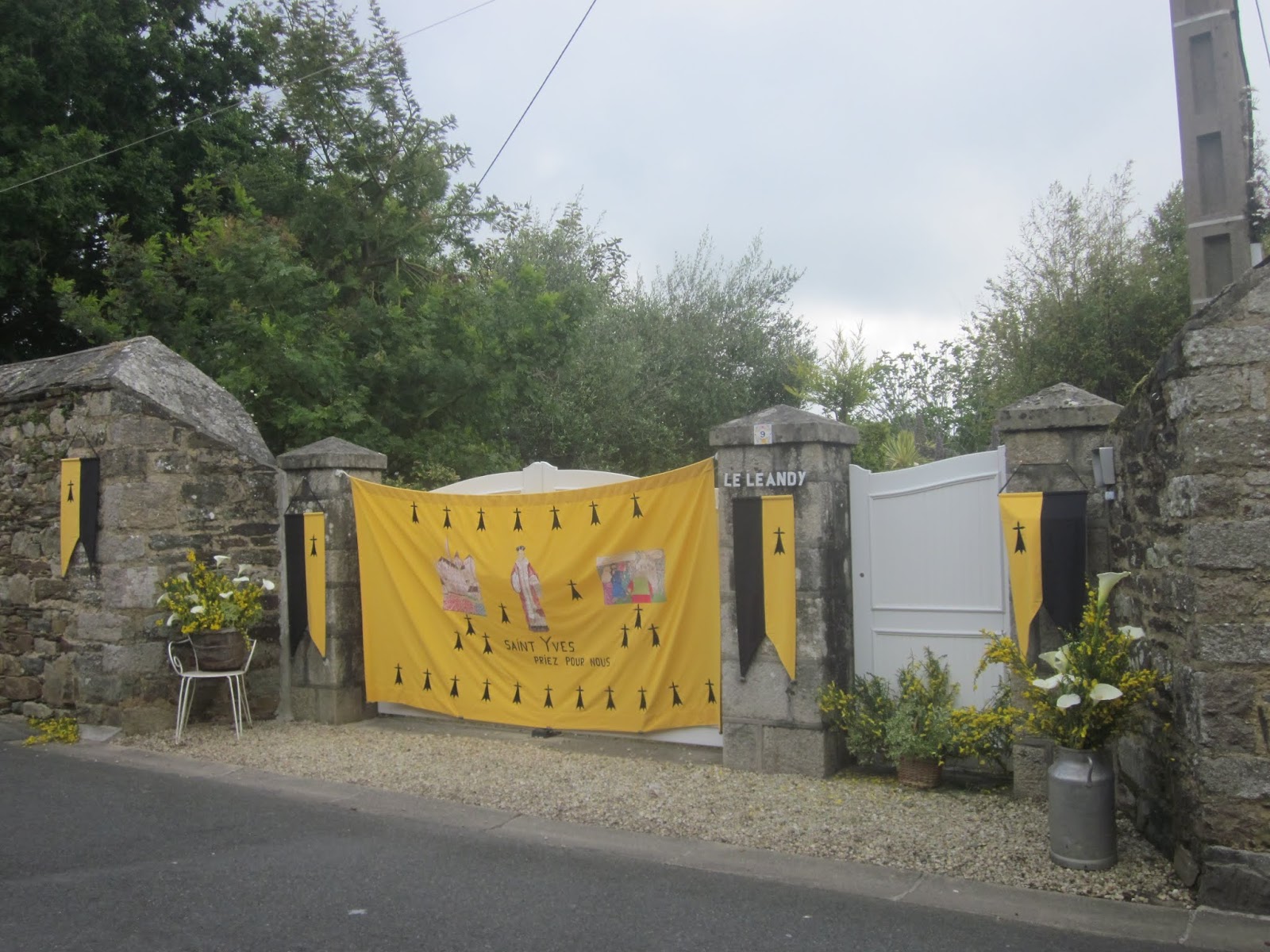
The town is all dressed up for the event with his family's yellow and black flag (thanks to a crusader grandfather) displayed everywhere together with sheaves of yellow broom and hundreds of lily flowers studded into hedges along the way.
I attend the mass in Breton at Minihy, for a while in the back of the chapel and then outside in the cemetery, still singing along from the hymn sheet (Breton is easy to follow and generally pronounced as it looks), and watching pilgrims turn up now and then to crawl under the 'tomb' of the saint, an ornate stone table. The best sensations of the occasion - in the simple and emotional faith of St Yves - are most felt here without the great numbers thronging around the cathedral in Tréguier, where the service in French is also taking place.
Walking into the town along the processional way in reverse - Chemin de St Yves, rue de St Yves - I have time for a leisurely coffee while crowds gather to witness the spectacle. Suddenly I realise that just seeing a bunch of lawyers coming out of the south door with their proud burden is not what I want to see most, and it will be hard to do so or to take photos in the scrum of curious onlookers and the faithful following the parade.
I retrace my steps all the way back to Minihy, where a few are waiting at the point by a wayside stone cross where the main ritual of the procession occurs, on a ninety-degree turn down to the chapel.
After a short wait I hear singing floating up from the village - canticles of St Yves are repeated over and over during all the ceremonies - and the procession from Minihy with its three ancient banners arrives to await the cortege coming from Tréguier. The priests take up a position facing along the road towards the cathedral.
The crowd grows and seeking a place with a good view and the sun behind me, I'm forced to get up on a very narrow bank where three older people are sitting with their legs dangling. It requires considerable muscle and foot strain to keep perched up there for more than half an hour of anticipation. Finally the first figures appear and a Breton pipe band leads the way, passing in front of the cross and down into Minihy. Behind it an astonishing spectacle, wave on wave of banners and ceremonial crosses stretching as far as I can see.
The ritual of encounter begins as Minihy's tall metal cross is lowered and raised in a nod to various passing crosses from other parishes, which also dip so that the two metal faces almost kiss as they skim by one another. It is nearly forty minutes before the skull appears in the distance, a priest in front flanked by lawyers bearing the weight of the reliquary on their shoulders. They stop a little way away. The rest of procession has passed. We all wait. Finally the Minihy banner-carriers move forward and the skull is brought to face them. Up and down the banners go - what body strength it must take - high in the air then dropping towards the ground, saluting their saint as he arrives home in his own parish. This is the climax of the Pardon, the relic visiting its most profound site of connection. After passing through the village, the procession will return to Tréguier.
This is an old ritual, and of more significance that touches me than is usually the case in official ceremonies. The depth of relationship with place is something I understand. Indeed I am currently writing about St Yves and his paths in the Trégor. Almost every day, despite travelling far and wide in his duties as a priest elsewhere and preacher everywhere, Yves Hélory walked back home to the little family manor house where he tended the old and sick and saw that all their needs were provided for. Thirty or forty kilometres was nothing to him in search of home and belonging. The Pardon, despite all the trappings and pompous lawyers, both of which the saint himself would have deplored, still manages to symbolise this simple truth.

Saturday, July 29, 2017

Zealous walker: St Yves, patron saint of Brittany

Iconography of St Yves - Quimper cathedral
Yves Helory (c1250-1303) was canonized in 1347 after due process in which 225 witnesses testified to miracles achieved in his name. He is the male patron saint of Brittany, his historicity in marked contrast to his female counterpart Ste Anne, a figure from the Apocrypha. No visitor to Brittany's chapels can have failed to observe the iconic image of St Yves, a figure in the garb of an ecclesiatical judge, between a rich man and a poor man, his head usually inclined towards the latter. He had the reputation of favouring the underdog in legal disputes and siding with have-nots, which makes his role as patron saint of lawyers who come from all over the world to his pardon on May 19th each year in Tréguier, a curious one.
St Yves passionately devoted his life to the sick and those living in abject poverty. He gave away all his own possessions and opened the family manor house at Kermartin in Minihy-Tréguier to unfortunates. But it is his physical presence in the landscape of the Trégor that is most memorable. All his formal education in law and theology at Paris and Orleans, his aptitude in French and Latin, did nothing to separate the man from his home territory. As well as his duties at the cathedral of St Tugdual in Tréguier, he was rector of Trédrez and Louannec. Sometimes he preached in seven different churches on a Sunday, walking many miles between them. He was said to take little rest or food on these excursions, leaving in the early morning and returning home exhausted late at night. Certain rocks along the routes he walked are dubbed the bed or pillow of St Yves, emphasising his rejection of comfort and luxury whilst so many suffered hardships of penury.
'Pillow' of St Yves - Trédrez
The indefatigable walking was part of his method and his commitment to God. It was a way of interacting with the peasants in the fields or workers in the forests and travellers on the road (as two women attested after his death). He always stopped to speak and make contact with those he passed, seizing these opportunities to spread the word of God. By all accounts his actual sermons - no texts survive - were highly emotional, tears figuring alongside examples from the lives of saints.
Before the violent mayhem of the Wars of Succession that ravaged the greater part of Brittany from the mid 14th century, it was apparently possible to walk without fear along the paths of the Trégor. From Trédrez in the west to the area of Goelo and the Abbaye de Beauport in the east, many legends of association in the landscape have grown up around the journeys of St Yves and the powerful image of this slight figure walking his way into sainthood.
St Yves - Tréguier cathedral
To be continued...

Monday, April 29, 2013

Tréguier


I've been in Tréguier, one of my favourite places in Brittany, for some research on the rationalist philosopher Ernest Renan, and more specifically the clash between the religious establishment and progressive Republicans in 1903 when a statue to the great man, flanked by Athena, goddess of Reason, was provocatively erected opposite the entrance to the cathedral. This building is associated with Tugdual (or more accurately Tudgual), one of the seven founding saints of Brittany from the Dark Ages, and later with Saint Yves, whose tomb and grinning skull lie there. The latter is the patron saint of Brittany and was an historical figure from the 13th century (d1303). His reputation as a priest and ecclesiatical judge was that of one predisposed towards the poor and disadvantaged. Odd that he is now the patron saint of lawyers, who come from all over the world to celebrate the Pardon on May 19th. Yves is also that rare thing - an 'official' Breton saint, canonised by Pope Clement VI in 1347.
Both St Yves and Renan are sons of Tréguier (600 years apart), offering me a profitable juxtaposition for the new book. Renan's great sin was to present Christ as a 'very remarkable man' (and not the divine son of God) in his lectures and book The Life of Jesus, published in 1863. This led to suspension from his teaching post until the Republican govenrment of 1870 reinstated him. The vicious caricatures of Renan with the Devil's horns and pictures of armed soldiers trampling good, honest citizens to the floor during the confrontations of that wet day in 1903 reflect the often violent polarisation of state and church during the later part of the 19th century, resulting in the final separation in 1905.
The immediate response of the Catholic Church to Renan's statue was to commission the last great calvaire in Brittany, erected on the quay of the Jaudy river at the foot of the hill leading up to Renan's family house and his statue. This lavish monument (complete with lists of donors) is called both the Calvaire of Reparation or the Calvaire of Protestation, depending on your religious stance. Renan's earlier spiritual advisors - for he had been intended for the priesthood, only experiencing a crisis of faith at the very last moment - refused to join the outcry about his book in the 1860s, retaining their affection and respect for him to the last.