 |
| Alignements du Moulin |
I have been in Ille-et-Vilaine, revisting the exceptional megalithic site at St-Just, which will figure in my new book Wayfaring in Little Britain. Here a walking trail leads out along the Landes de Cojoux with alignments, standing-stones, tumuli and graves all around for more than two kilometres. The site has been tamed and organised since my last visit to a lonely open plateau which then had little restriction for movement among the stones. It was also a forlorn sight at that time, just days after a major moorland fire had left the scars of burning everywhere, vegetation reduced to ashes and acridity filling the air. Now in late summer there was plenty of plant colour and clean quartz to gleam in the hot sun.
 |
| Le Tribunal |
The monuments that I return to again and again are the Alignements du Moulin and the so-called Tribunal, the latter mooted as a stone age calendar, but named for its appearance of a row of judges and the accused. The 12
menhirs of the alignment, made of schist and organised east/west, are like people in their individual shapes, character and relative placings - a family photo covering the generations. Funerary remains found on excavation date to about 4700BC: the standing-stones came later. The function of the stones themselves or their role within the overall structuring of the whole complex is impossible to say. They appear to be on course to meet at a point with the line of chubbier quartz stones to the north. A further north/south line is suggested by a few remaining small stones.
What is so extraordinary about this site is the constant unfolding of remains, the accumulation of death, here, there and everywhere around the main path which forges across the open centre of the plateau. The loftiness of the location was obviously significant, and its dramatic end, abruptly above the valley of the river Canut and the Etang du Val.
 |
| Chateau Bu |
On reaching the pinnacle at the Chateau Bu, with its neolithic burial in lateral chambers and later Bronze Age graves and guardian pillars, it is hard to imagine anything better, but huge complexes of inter-related monuments like the Croix St Pierre arrangements await. The place, even over its significant length, has a clearer sense of unity than Carnac, for example, and is to me much more compelling. The main practical advantage is that there are rarely other people to share the scene outside weekends and holidays. This sense of aloneness amidst serial funerary architecture from nearly seven thousand years ago offers a powerful experience and it was a strangely emotional one this time.
After a few days away, I made a slow journey back, stopping off to see if the megalithic site at Monteneuf in Morbihan had changed much over the years. It has, whether for the better or not is hard to say.
 |
| Monteneuf |


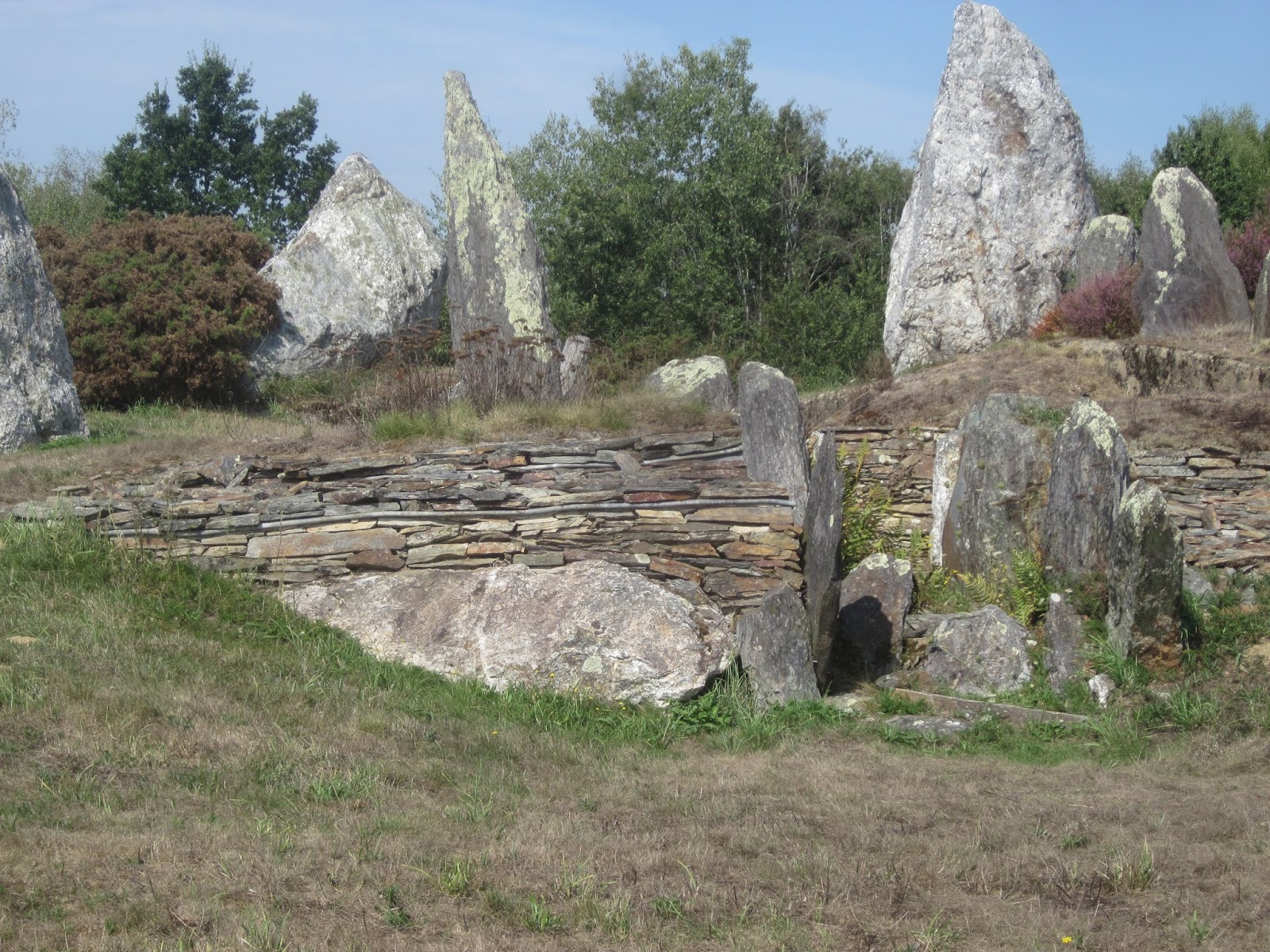


 To get the best out of any place, don't just do obvious things. If you're into megaliths, visit Carnac by all means, but for a sharper experience go to St-Just (top photo) afterwards, and then press on to Monteneuf to see how things were done in neolithic tmes. Take a boat to see the famous carvings on the Gavrinis tomb, but then examine other designs by stooping along the passage and squeezing into the chamber of the Pierres Plates (pictured above) on the Locmariaquer peninsula, or visiting the trio of graves at Mané Kerioned. These are all low-profile sites that give you a real sense of feeling - beyond mere looking. Worth a try?
 This neolithic allée couverte at Mougau Bihan dates from c3000. It has an entrance in the north, a corridor to the burial chamber (without significant distinction) and a small separate cella (front in photo). The giant roof slabs would once have been covered with earth and grass. Inside are carvings of paddles/threshing implements, goddess breasts (raised pairs of dots - I can't really believe in that interpretation) and a hafted axe on the wall of the chamber. The latter, like so many other 'pagan' monuments in Brittany, was daubed with Catholic symbols in flourescent pink paint soon after the new pope's anti-pagan speech. Truly enlightened behaviour.


