Saturday, August 04, 2012

Forest


I'm working on the forest chapter of my new book, which looks at the symbolism and emotional experience of landscape as well as the history of Brittany through its terrain. The forest theme ties up with work I have in hand for other audiences later in the year so it seemed a good place to start. The beginning of a book is always tough for me, but the great chronological and geographical range here offers plenty of ways in. I often walk in the forest at Cranou or Huelgoat, lately with ideas positively dripping off the trees everywhere I look. This helps to convince me I'm doing the right thing.
The text will look at forest clearance, particularly during the Age of Saints and the later Cistercian initiative in the unusual quevaise system in western Brittany, as well as forest exploitation and production from sabots to timber for the navy at Brest. The forest as a place of concealment will include detail of salt smuggling on the eastern border of Brittany and resistance activity in WWII.
The Foret de Paimpont, more commonly known these days as the Brocéliande of Arthurian legend, takes us into the imaginative world of the forest and its association with enchantment and transformation. The striking symbol of the Golden Tree there is a recent memorial to the forest's power of regeneration after a series of terrible fires in modern times. The shape of the tree echoes the stag's horns in the Arthurian-themed church at Tréhorenteuc.


Sunday, July 29, 2012

Postscript

Yesterday's competition was in fact won by Tangi Josset and Yannick Martin, who performed first and were indeed terrific. The audience was very appreciative, except for a middle-aged man who had been standing near me and behaving oddly throughout, talking loudly to himself while the duo were playing. As the rest of us clapped enthusiastically, he spat on the floor and muttered almost in my ear 'They're not Bretons'. A pretty repulsive reminder of why Yannick Martin felt compelled to go to court last year with Breiz Atao, a small shower of right-wing Breton nationalists who lose no opportunity for racist slurs on their unsavoury website. Twins Yannick Martin and Tangi Josset were adopted by two different Breton families as children and today are amongst the most talented of all Breton musicians - and that's saying something. I hope to hear them again at Lorient in August in the great InterCeltic festival. With a bit of luck, M.Allot will be there too...

Saturday, July 28, 2012

Bombarde drooling


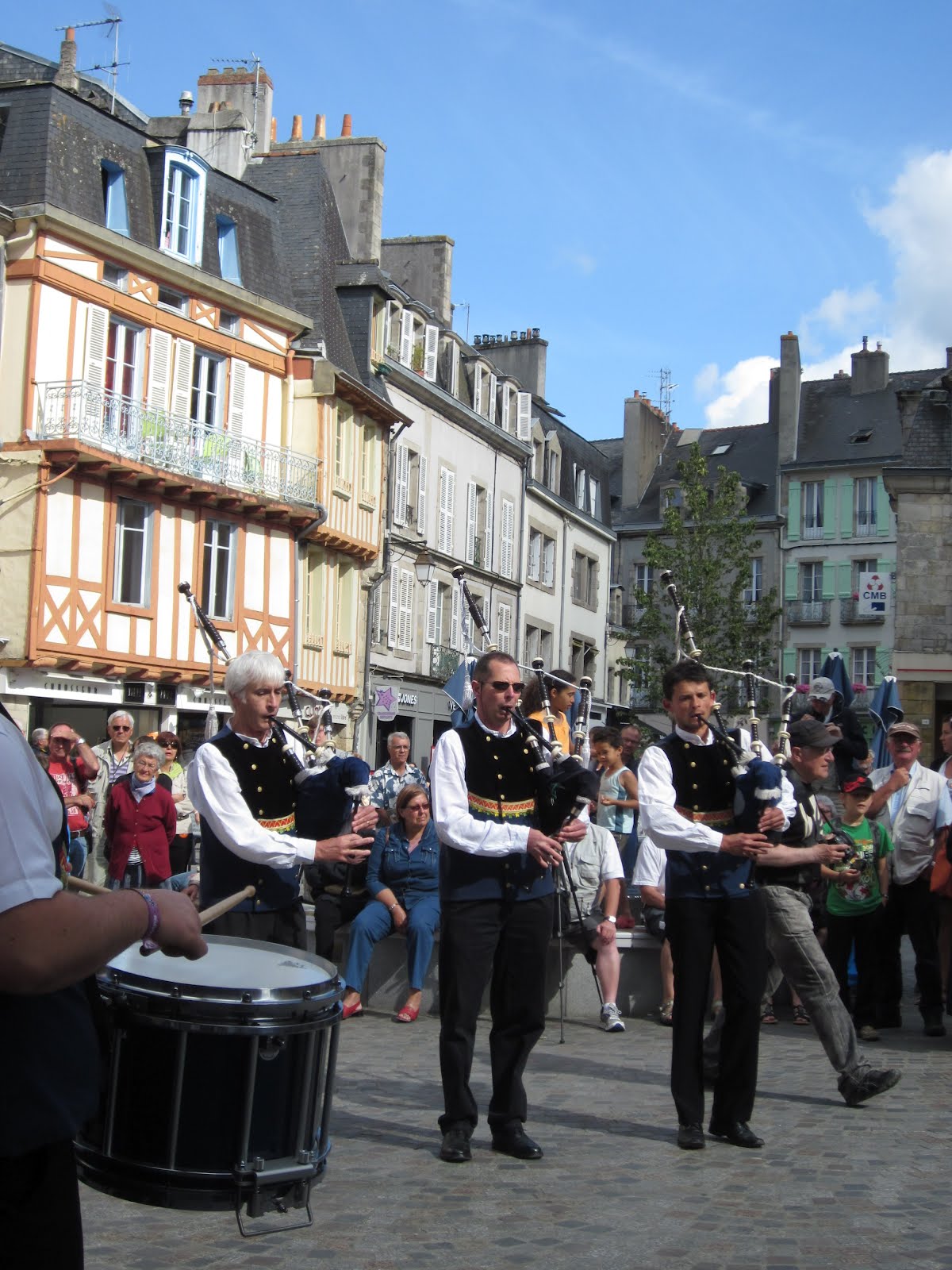
Went to the wonderful Festival de Cornouaille in Quimper and was not disappointed by the quality of musical offerings. Amongst bagad (Breton bands) and pairs competitions, I was very taken by the gorgeous Josick Allot (above), playing the bombarde with Erwan Le Hir on the biniou. I would defintely give him the gold medal in pretty much any contest. Except maybe the Olympic tennis.

Saturday, July 21, 2012

Nantes of many faces


I've been in Nantes this week to write a profile for London City airport. It's three years since I last visited and I'd forgotten the extraordinary vibrance and energy of this dynamic place. The city has had to reinvent itself several times and has done so with panache. Much of the exceptional 18th century wealth still so visible today in the merchant's houses with their iron balconies and sculpted 'masks' came from the 'triangular trade' whereby ships left Nantes for Africa, took slaves on to the Caribbean and returned to France laden with sugar and spices. This difficult theme in the city's history is in no way played down. The chateau museum graphically depicts the material benefits and the unspeakable cruelty of the practice, and a new Memorial to the Abolition of the Slave Trade has been established beside the Loire, including a long subterranean tunnel full of facts and quotations about the struggles of the abolitionists all over the world. A bold strategy, making virtue out of necessity!
Despite having magnificent heritage in the restored Chateau of the Dukes of Brittany and the gleaming Gothic cathedral, greater emphasis is placed these days on more innovative offerings, and many strategies are in place to lure visitors from the medieval centre to one bank or another of the Loire. Le Lieu unique is an arts centre set up in the old factory where the famous LU brand churned out biscuits in their millions. The interior remains a rude mass of concrete and metal, carefully made over in a minimalist kind of way - the underground toilets are deliberately awash with graffiti - to satisfy some criteria of the current craze for industrial art. The lone remaining blue and red tower with its gyroscope is now open for a panoramic view over the city.
On the Ile de Nantes the vast former ship-building works is now a centre for machines of a very different kind, like a larger than life mechanical elephant that will take you for a ride. With the decline of the port, as the Loire silted up and St-Nazaire developed to the west, Nantes has niftily adapted its maritime legacy to meet the service demands of a new age of tourism.
As to the fact that Nantes was capital of Brittany for a thousand years until the Vichy government severed the tie during WWII and the city became head of the new region of Loire-Atlantique soon after the war - what better opportunity than to shift identity once again (and totally avoid the complex political issues of reintegration with the four provinces of new Brittany - over Rennes' dead body) and become Nantes of many faces - Breton in some undefined way, but mainly top city of the Loire, commercial centre of all the surroundings territories, focal point of north-western France.
It's all done very cleverly, like a conjurer's sleight of hand, with the visitor so taken by the razzledazzle of festivals, initiatives, colourful street life, building developments and fluvial activities that there's really no time for analysis, just pure fun and enjoyment.

Tuesday, July 17, 2012

All at sea


Spent a fabulous day at Les Tonnerres, the international maritime festival held in Brest every four years. It was an extraordinary pageant of ships from all over the world, and a vast tent city of stalls and exhibitions running for several kilometres around the commercial port and on both banks of the Penfeld river below the chateau.
A trip out on the Rade in the morning to be in amongst the parade of schooners, sloops and cutters of every variation imaginable was a sensational experience, despite my ignorance of matters maritime. Offerings on land were pretty good too with all kinds of music, food and crafts from Brittany and the invited nations - Norway, Russia, Mexico, Morocco and Indonesia - as well as boat-building, historical reconstructions and guided tours of many ships in dock.
Get along now or don't miss this in 2016!

Friday, July 06, 2012

Significant others

Today I had the pleasure of meeting poet Angela Locke for the first time. We have corresponded about a collaboration for her creative writing course to be held here in Finistere in September but never actually spoken. It was a significant meeting, one of those special occasions when making a connection has immediate and surprising consequences. We didn't have time to do much more than than exchange compliments about our books (I have recently read her stimulating collection Whale Language: Songs of Iona) and talk of arrangments for me to give a talk and a walk (yes, I can even do both at once in an emergency) for her group when the time comes. But there was a strong current of sympathy, humour and incipient affection running across the table even on such brief acquaintance, and I left for another appointment looking forward very much to seeing how she works and contributing to the process myself.
I was driving along happily afterwards thinking of all I had to do at the weekend with another couple of ferry talks to give and Wimbledon finals to watch when - suddenly the whole beautiful entirety of the book I have been wanting to write for the last two years and never quite glimpsed full-on, crash-landed in my head. The afternoon has passed in a whirl of ostensibly functioning on a normal plane whilst idea after idea flowed out and everything I've been thinking about for so long now without form or substance presented itself in a coherent, natural sequence.
This happened to me once before. After spending an afternoon walking and chatting with sociologist Anne Guillou about things completely unrelated to any creative work, the whole story of the Five of Cups leaped out of my brain, fully armed like Athena from the head of Zeus. But that book was hell to write, so let's hope the similarity ends with the initial inspiration.
It's been a great day. Thanks, Angela.

Monday, July 02, 2012

Brest moves forward

I've been in Brest on and off lately. It's a time of change, which has involved considerable upheaval for drivers over the last few years. A new tramway with 27 stations has been installed to connect workers' residential areas to the east and west with the centre. The route will also cut down a bit of walking for tourists visiting both sides of the Penfeld river.
There's been a certain amount of urgency to finish the elaborate project before the International Maritime festival this summer. This huge event brings thousands of boats and tens of thousands of visitors to the city. I'm doing a piece for the Independent, so will have a chance to see first-hand how the system copes under the strain. When I contacted the tramway press officer a few months ago to ask about journey costs for a guidebook update, he couldn't tell me. Strange, as I discovered the ticket prices had already been published on the internet. Hope someone has told him by now.
Part of the system is operational. Only this week one of the smart new trams hit a car and was derailed, fortunately without injuries to anyone. In the west near the British mecca that is IKEA the new tracks are already surrounded by a lavish display of weeds, as if no-one thought to put a membrane down or, more likely, lay in a stockpile of Roundup.
But I have to say that there was noticeably less traffic around in the central areas when I was there last week. Could it all actually be a good thing? Let's hope so. After all, as old photos in the endearing Tour Tanguy (left in the picture) town history museum show, they only took the old tram line out in the 1970s.

Thursday, June 21, 2012

All aboard the Parish Closes


I'm starting my series of talks about Finistere on Brittany Ferries with the Parish Closes. This phenomenon of mainly the 16th and 17th centuries plays out the arrival of Renaissance architecture against the background of Flamboyant Gothic so popular in Brittany. But this is much more than an architectural topic, one that needs to be set in a religious, social and commercial context to be truly accessible to visitors, especially those who have no connection with Catholicism to draw on. I have often watched and listened to British visitors to Guimiliau or Pleyben puzzling over what it all means and going away not much the wiser because of the paucity of explanations.
And nowhere is attention drawn to the fun details - the rector used as a model for the devil, a Green Man holding legs of cattle in his mouth rather than foliage and sensuous sirens ... It's also hard to convey a sense of the colour, noise and bustle of these places in their heyday from the dour greyness under current Breton skies. Legend says that Shakespeare's father attended the markets at La Martyre, which has perhaps the earliest close of all from the 15th century. It was certainly the linen trade with England, Spain and Holland that funded these lavish ensembles, in much the same way as the wool churches of the Cotswolds or East Anglia in England.I hope that I can shed some useful light. Just by knowing the basics of each element of the ensemble and the usual sculptural subjects, the visitor has an easy pattern to use as the basis of comparison between sites - something I know from experience that people enjoy. Instead of describing the contents of a particular house, isn't it better to tell people roughly what to expect in any house and then give them the key to go and explore for themselves?

Thursday, June 14, 2012

Cruising in the rain


I had booked another island trip today but all sailings were cancelled thanks to the persistent peevishness of the weather god, so as any abnormal person would under glowering skies, blustery winds and grey drizzle, I agreed to take the alternative offered - a cruise on the Odet between Benodet and Quimper.
What a reward I got for my folly! One of the best boat-trips ever, not only for the absorbing scenery but also a gem of a guide in Céline, who spoke beguilingly in French and English with that rare perfect judgement of when to stop talking and let the riverscape speak for itself. All she had to say was worth hearing, a real aid to interpretation of the journey. The Vedettes de l'Odet are lucky to have her, and the other members of the crew on that sailing. This is an experience I can whole-heartedly recommend. Chapeau, Céline!
The trip itself is surprising. Much is made of the many chateaux glimpsed along the route, but that was not the highlight for me. I already knew that the vast majority of the land along the river is privately owned and that no public right of way applies in the estuary as it would (in theory) on the coast. So sadly it is not walking territory.
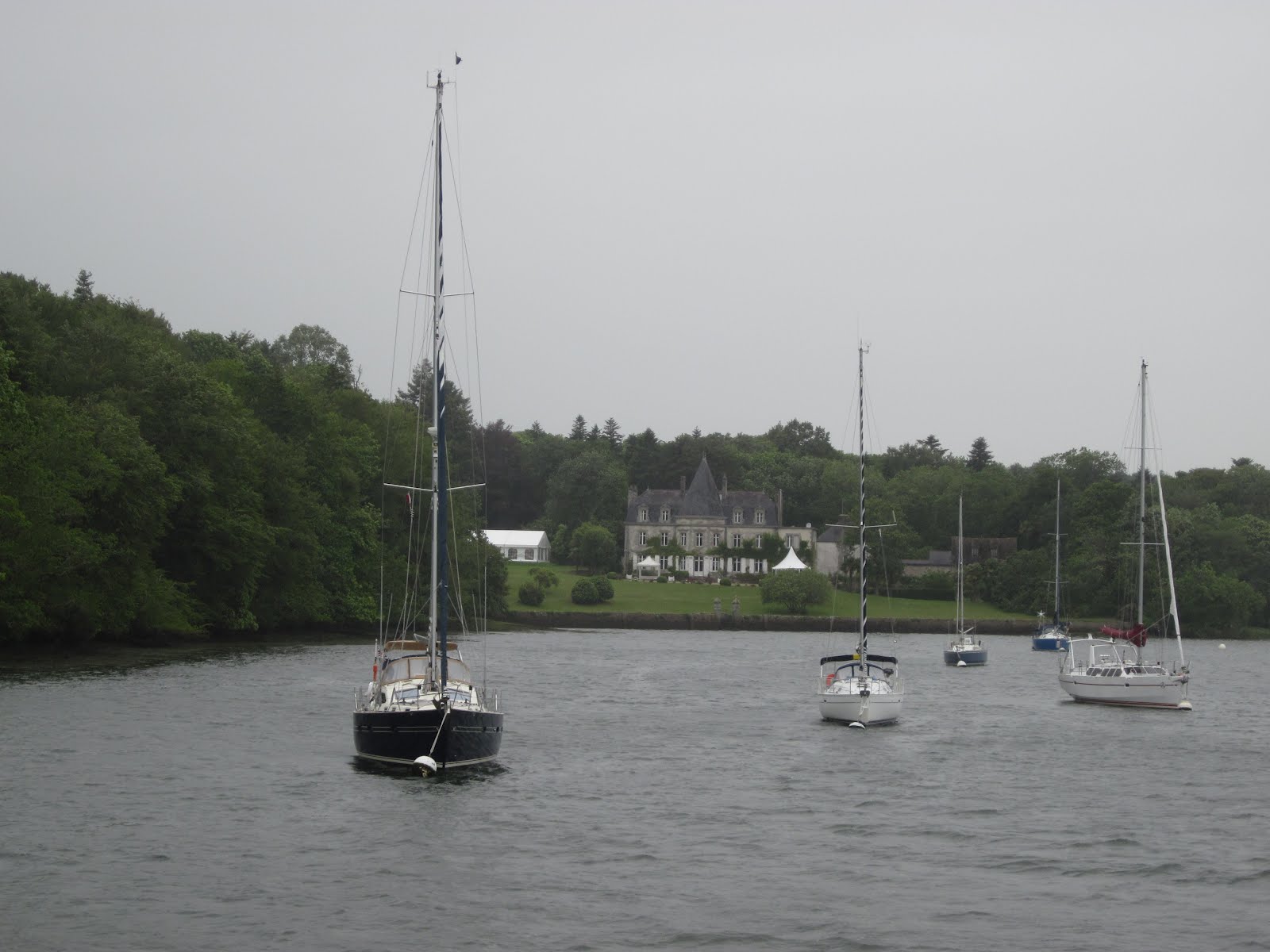
What is more important is that the law prevents these proprietors from cutting down the lushly dense trees that fortify the banks with high green walls. To get a narrow view of the river for their privileged pleasure, they have to hang around during storms and give a helping hand here and there ... It has certainly preserved a compelling verdancy. I spent most of the trip alone on the top deck in the rain just looking at trees ...

Tuesday, June 12, 2012

Writers' websites - why?

What is the point of a writer's website? This is a question I've been pondering lately, having been asked directly by a reader and also from talking with other writers. The issue is pertinent as my own website (www.wendymewes.com) has just had a major overhaul, having survived a recent cull in which I decided to deleted several websites and blogs in the interest of focusing my work.

The reader in question suggested very politely and with no obvious hint of irony that writers' websites should surely include examples of writing - which mine did not. I've ferreted around the web and seen that many other writers do not actually include even a single quotation from their work on their sites. It's true that titles alone often sell non-fiction books: if you're going on holiday to Finistere and like walking, my book Walking in Finistere is a likely purchase without much concern over style and ethos. But my serious and thoughtful reader is right and I've tried to rectify this lack.

What I have more problem with is the idea that readers have a right or a justified desire to know about a writer's background. Some writers' sites have lavish About Me sections, others are tantalisingly coy about their true persona. Whilst of course I find my past to be excessively interesting, I really don't see the need to give my educational, professional or personal history free of charge, as it were. Aren't I supposed to stick it in a book? Let the reader glean my all from Discovering the History of Brittany and Walking the Brittany Coast.

Fiction is another matter. I had a letter years ago from a reader about a character in Moon Garden. She felt sure that I had identified personally in the creation of this person - in fact, although like all characters this one was an amalgamation, I'd taken the essence of someone I thought particularly disagreeable...

Monday, June 11, 2012

An island in the rain


Spent some rather gloomy days on Belle-Ile last week and arrived home with a rucksack full of damp clothes and notebooks. The greatest interest for me was the Citadelle Vauban and the fort owned by Sarah Bernhardt and adapted to suit her very particular style of living. Our time on the 'cote sauvage' was limited by the weather, but I shall certainly go back and complete this most spectacular route when I can take the time to look and investigate properly. It is quite unlike the Atlantic islands of Brittany, having a lush vegetation and undulating interior. Pity the famously mild and sunny climate was itself on leave during our visit and what was, after all, my only prospect of a holiday this year.
Now I am really hard pressed with work again and don't expect much more time off this summer. I have two articles on the go, preparation of four talks, the Saints Shore Way project to walk and research and a most welcome contribution to Angela Locke's creative writing course in Huelgoat in September to shape in my head. The latter ties up neatly with my own work on landscape and the imagination, which is coming on well in odd unpressured moments. And all the sport coming up .....

Thursday, May 24, 2012

A matter of scale...


More and more I become aware that the attractiveness of Brittany's landscape to a great many people is a matter of scale. There are no extremes here, neither of terrain nor temperature, and the degree of comfort and security that confers is a major factor in connectedness. It is often the difference between feeling oneself within a landscape rather looking at it from the outside, which inevitably carries a degree of emotional detachment.

This may well be a matter of age - as we get older we start to seek peace from our surroundings, a reassurance relevant to our size and powers of endurance, rather than challenge or adventure or otherness. This is not a devaluation of experience, as our perception of significance is simply magnified in a smaller sphere.

Brittany’s highest ‘mountains’, the Monts d’Arrée, reach up less than 400 metres, the most towering cliffs near Plouha barely stand 100 metres above the sea. But these bald figures are quite irrelevant to impressiveness of the scenery, which is determined by context not comparison. These are magnificent settings in which to place ourselves.
So we can be ‘on top of the world’ on Mont-St-Michel-de-Brasparts or Menez Hom or ‘at the end of the earth’ at the Pointe de Corsen or the Pointe du Raz without becoming mountaineers or endurance hikers. And there we can feel our surroundings spectacular in a proportionate way to our own existence in the same world.

Monday, May 21, 2012

Snakes or vegetation?

It's important to know the difference out on the Pointe de Primel, but not so easy in the crypt of Lanmeur church.
This has been a good working day, spent on the north coast in the Finisterien Trégor, researching route and sights for my Saints Shore Way project. Nothing I haven't seen before, but what weather to enjoy it in!
A pleasant lunch-time interlude at St-Jean-du-Doigt with Tex running his little legs off on the beach once I'd finished more sombre moments in the church. The finger was not on show today.

Monday, April 30, 2012

Spring deluge

I fondly thought that finishing the Legends book would buy a little breathing space from what has been a constant intensity of work since the beginning of 2012. Not so. Preparations for the Brocéliande trip and making arrangements for a group walking holiday on Belle-Ile in the summer took up quite a time, as well as organising my book launch. Last week we miraculously escaped the terrible weather in the forest of Brocéliande, managing to be inside (e.g. the Arthurian centre at the Chateau de Comper) in the worst storms and enjoying some beautiful walks in varied landscapes.
On return I did a guided tour of Morlaix for a mixed English/French group, which was fun, and then the long awaited moment of bringing the Legends of Brittany into the light of day with a short talk and some readings. Yesterday I was supposed to be all day at the Salon des Légendes in the Monts d'Arrée, which promised to be a major event after its great beginnings last year. Unfortunately the weather was atrocious, and after sitting for nearly six hours in a wet tent, with gale force winds raging and feet reduced to blocks of ice, I gave up. It took several hours at home to thaw my bad foot properly and I wish in a way that I had not risked its condition, despite meeting up with lots of fellow writers I like very much, and even selling a few books. Now apart from a Brittany Walks event tomorrow, I must prepare Saints Shore Way information and questions for a forthcoming meeting in Cornwall with the person in charge of the British Saints Way. I intend to spend the rest of the year working on the development of the SSW here in Brittany, and also a second connected project on a long-distance circuit in the interior, from Roscoff/Morlaix down to the Monts d'Arrée and back up via the Parish Closes. In any left-over time, I'll think about a new direciton for my next book....

Monday, April 09, 2012

Trévarez and Batbox


I've been working on translations for the exhibition Batbox by Erik Samakh which opened at the Chateau de Trévarez on Saturday. First I did the information panels for the exhibition, and now there's a long discussion between the artist and an art historian to complete for the catalogue.
It's been an interesting job, and seeing the whole thing in situ at the weekend was even more so. The Batbox installation is basically a blackout of the huge stables room, with a mulched floor and the sounds of bats, transferred from the chateau itself which is inhabited by a protected colony of Greater horseshoe bats.
What was even more striking than the echoing bat calls and wing-strokes was the reaction of human beings - not to the bats, but to each other in conditions of almost total darkness. It revealed our virtually complete spatial ignorance and a deep rooted fear of moving without seeing. People were bumping into each other, putting out tentative hands to feel rather than sense a clear way ahead, far more aware of other bodily presence to be avoided than the absent presence of the bats themselves.

Thursday, March 29, 2012

Here is it ... or will be


Here's the cover for the new book, which comes out on April 27th, just before the Salon des Légendes book fair at Botmeur. I'm glad it's done. Looking forward to moving on to new things...

Tuesday, February 28, 2012

Is there an end to legends?

I am trying to bring my work on the Legends of Brittany book to an end and start writing up pretty sharpish as the end of March deadline looms. But the very nature of legend is that one thing leads always to another version and so on. I thought - no, still think - that the thematic structure is a good one but it does lead to a lot of cross-referencing as things overlap. Also having the actual legends in a different font or style will be important so people who only want to look at stories can avoid the analysis easily. And what is the best way to illustrate a book on legends? I'm trying to stick to photos - statues, landscape features, etc. - but what to do about giants and korrigans? They just won't stay still long enough for the camera. (But here's one someone carved earlier.)
Apart from ten hours a day at the legend-face, I'm also completing a short radio script on the history of Guingamp (yes, it is where the word gingham comes from, forget India), although I sadly won't have time to record it myself. Plus I am working on the SAINTS SHORE WAY project which really needs undivided attention to put flesh on bones. (Sorry, too much dwelling on relics lately.) I've managed to plan a second project for an inland walking route on similar themes. This time the thing might really go ahead so I need to be well prepared.
Otherwise, walking is slowly getting less painful over distances. Just as well as I have a lot of it coming up. And a few bits of translation work as usual at this time of year as tourist boards and heritage sites prepare their exhibitions. All good.

Friday, January 13, 2012

New Year

Happy New Year to all - a bit belated as I've had a busy start to 2012 with guided tours and two book deadlines looming. Footprint are issuing a short version of the Brittany guide I did for them in 2009 in their Focus series this spring, so a lot of updating and re-presenting of text to get through before the end of the month. And although an end of March deadline for the Legends book seemed a long way off over Xmas leisure time, it's all getting a bit close now, and little progress has been made recently on that front. I've spent a lot of time designing new French business brochures and an English one for potential tour work this summer.
Otherwise, no resolutions, just new interests and habits. This month I've started Pilates, read a book on astronomy and begun studying abstract art. How stimulating to think about something completely different from my daily fairly predictable working world!
Still keen to work on a project for an extension of the Cornish Saints Way walking trail in Brittany. It would work very well with ferries into Roscoff providing the starting point, and a coastal walk around to Brest or down to Morlaix - two places connected by TGV, makes good practical sense. The footpath is already there in the famous GR34 coastal route and there are lots of links with the arrival places and chapels of British saints - including the cathedral at St-Pol-de-Léon (pictured above) along the way. This is a good idea that deserves support - let's wait and see ...

Wednesday, November 30, 2011

Death and the Devil

Still struggling with physical movement, but working 'normally' on new book The Legends of Brittany. This is organised thematically with chapters on saints, Dark Age semi-historical tales, Arthurian stories, women in legend, landscape, giants and dwarves, megaliths, etc.
Currently researching death and the devil, which, in Brittany, means an amusing combination. Both Ankou (Grim Reaper) and the Devil (Red Man) are almost appealing figures until the Church sticks its oar in, puts the fear of God into life and demonises the poor old devil. The fact he's clearly working hard to punish sinners surely makes him one of the good guys?
I particularly like this photo of the Devil from the calvaire at Plougonven. It's traditional to represent the scene of the Devil tempting Jesus in statuary on this type of monument, but conventionally he wears the concealing robes of a monk - cloven hooves, claws or horns just poking out to give the game away. Here the Devil seems to be dressed as a 17th century rector, thus contemporary with the time of erection. Was there by any chance a falling out between the priest and the sculptor? Hope so.

Tuesday, November 01, 2011

Thanks for good wishes

OK, I'm back. Bloodied and bowed, but back. Many thanks for all the emails, and comments here (Ancestral Celt and Michael Dodds). I was confined to the house all summer, and after three months still have walking/driving problems. I have also been unable to work, so under severe financial constraints. Had to cancel my first holiday in seven years - a few days on Belle-Ile - and lost the money I'd paid: don't know which of those two facts was harder to bear!
Sadly had to scrap the Brittany islands book I had signed up to do, but have begun work on The Legends of Brittany, which will be published next year some time. I am also going to add themed walks to the Brittany Expert site - individual routes with all the background, maps, etc. for sale very cheaply in PDF form.
What I really want to do is set up a continuation of the Cornish Saints' Way in Brittany. It's a great project, and themed distance walks are more and more popular, but will anyone in Brittany tourism be the least bit interested? I very much doubt it. Last time I contacted the Finistere Departmental Tourism board about a project they refused me a meeting. The Quimper CCI haven't even bothered to reply to a request to discuss my training course for tourist professionals who want to promote Brittany to anglophones.
Let's face it, I have nothing to offer, because they are doing it all so well already. NOT.

Monday, September 26, 2011

Apologies

WM has been unable to work this summer due to serious illness, hence silence on this blog. She sends thanks to all who have enquired and emailed good wishes, and will resume writing asap. The scheduled book on Brittany's Islands for 2012 has had to be cancelled.

Monday, July 18, 2011

Breton Chant

I went to a concert of chant at one of my favourite places in Brittany, the Abbaye du Relec, on Saturday evening. It's an approriate setting for the genre, being a Cistercian foundation dating back to 1132. The church is austere and authentic, from the extensive damp patches of green mould to uncomfortable seating and lack of heating.
As is common in Brittany, there is no programme. One of the performers gives a short introduction here and there, but unless you are sitting near the front it's impossible to hear, as there are no microphones, so there is no immediate trigger as to context or subject matter. I also can't see anything in the first half, because the man singing the Breton chants is short and his guitarist is seated.
These things enhance the experience. All I am aware of is the music, the lone male voice echoing round the high nave, mimicked by the flight of a trapped bird swooping and soaring in the chancel behind him. The purity and simplicity of the timbre match the architecture even if God is not the musical inspiration. For one song he is joined by another man and the combination is electrifying, a familiar patterning from the traditional kan ha diskan (call and counter-call) of fest-noz music for dancing. My heart beats fast with extraordinary pleasure.


The second half begins with a female group from the Balkans, three tall, one short, all clad in costume and projecting powerful voices as they process down the nave smiling at members of the audience. On the stage they move and make dramatic gestures and facial movements, touching each other affectionately as they weave physical shapes to the rhythm of the songs. They are good, but for me the spell is completely broken. This is performance, knowing and calculated, where the first half was nothing but music.

Saturday, July 09, 2011

Brittany Expert Guides

New town guides to Rennes and Quimper are now available from my Brittany Expert site (link opposite). Everything you need to prepare for a visit or just admire the wonders Brittany has to offer - lavishly illustrated and with a town centre map.


Saturday, June 18, 2011

Saint Anne of Brittany


There is a strong tradition that Saint Anne, mother of the Virgin Mary, was a native of the Armorican peninsula (before Brittany existed), coming from the area of Plonévez-Porzay in the Bay of Douarnenez. The famous folklorist Anatole Le Braz (b.1859) recorded the legend that she left the region as a widow and travelled to Judaea. There she married Joachim, father of Mary, but later returned to her native land, where a lesser story suggests Jesus and Peter came to visit.

In Christian tradition Anne is a minor figure of the Apocrypha. Her iconography in religious art shows a tall woman with veiled head, often teaching her young daughter Mary to read. In church of Lampaul-Guimiliau, a notable Parish Close in northern Finistere, an extraordinary decorative altar panel shows Anne resting in bed having just given birth to Mary, who is being washed by the midwife.

There may be a connection between Anne and the Celtic goddess Ana, and indeed she is honoured at the church of Commana by a magnificent 18th century baroque altarpiece. Here a statue of Anne is said to have been found in a stone trough, part of the same linguistic confusion that led to stories of saints arriving on Breton shores in stone boats, as in old Breton 'koum' is both a valley and a stone trough (and the Latin for little boat is 'cumba'). One glance at the local landscape gives the game away.

Anne is the female patron goddess of Brittany and widely venerated at shrines such as Ste-Anne d'Auray, the largest Catholic site in the region, honoured by a papal visit in the 1990s. It is documented how in 1623 a local peasant had a vision of the saint telling him where to dig up her staute and rebuild a former chapel. The bishop of Vannes believed the story and the shrine was constructed.

The photos all show images from Ste-Anne La Palud (Anne of the Marshes) on the Finistere coast where she is said to have landed on return from the Holy Land.


Monday, May 23, 2011

My new book


The Shape of Mist/Lambeaux de Brume is a short collection of stories and a couple of poems. The subtitle is Tales of the Monts d'Arrée: I've given a new take (decidedly décale) on traditional legends and added a few new ones of my own invention, such as Black Dog Blues and Korrigans in Crisis. The book is a dual language edition, with French translation by my favourite collaborator, Yves Marhic, whose sensitivity to language and nuance is remarkable.

Saturday, April 30, 2011

Max Jacob

Max Jacob, born Quimper 1876, died at Drancy 1944. Poet, artist, human being.

For every act of crossing
There is a price -
From an obol to human sacrifice.
Simplicity or artifice:
Portrayed by harlequins,
Betrayed by holding on.

Paying what was owed,
Measured by a gold star,
In swoops from perch to perch
Uncertain hands grasping for the cold bar.
Above a dance of prayer
Performed by peasants
Along blurred lines.

To miss the net and fall like that,
Max Jacob, acrobat.

Sunday, April 17, 2011

At last - Brittany E-books!


After a great deal of hard work, not least by the webmaster, my remarkable value Brittany E-books are now available on www.brittanyexpert.com These cover specifc topics or places in Brittany in depth, with lots of photos and suggestions for visits. Currently on offer are Megaliths, the Nantes-Brest Canal, Food and Drink, Walking in Brittany, History Essentials and Parish Closes. Those to come shortly include Rennes and Quimper town guides and the Monts d'Arrée. Many others planned. You can buy via PayPal without a Paypal account, cost £2.50 or 3€. All books are well-illustrated.
To get the flavour, download the FREE E-book Brittany Basics directly from the site. This gives a general overview of what Brittany has to offer. It can be used freely as a marketing tool by businesses and B&Bs. Links enable clients to buy specific topic books later. Comments and suggestions for future titles welcome. Please send the link to anyone you think might be interested: www.brittanyexpert.com

Friday, April 15, 2011

Another side of Rennes


I was in Rennes this week to give a guided tour. We covered the usual things - 19th century Italianate cathedral, medieval quarter, neo-classical public buildings and the famous Parliament building. All good, and remarkably quiet on the streets with the 60,000 students on vacation. In my own time I did a lot of walking to look at more modern aspects of Rennes' most interesting architectural range. Not nearly enough emphasis nor information is provided for tourists about this. I was just wondering how they managed to clean the windows at the Cité Judiciaire when the answer appeared rather startlingly. The Champs Libres is the 2006 cultural complex containing the library (glass), science museum (dome of planetarium) and ultra-modern Musée de Bretagne.

Wednesday, March 02, 2011

Best Brittany Experiences - Megaliths


To get the best out of any place, don't just do obvious things. If you're into megaliths, visit Carnac by all means, but for a sharper experience go to St-Just (top photo) afterwards, and then press on to Monteneuf to see how things were done in neolithic tmes. Take a boat to see the famous carvings on the Gavrinis tomb, but then examine other designs by stooping along the passage and squeezing into the chamber of the Pierres Plates (pictured above) on the Locmariaquer peninsula, or visiting the trio of graves at Mané Kerioned. These are all low-profile sites that give you a real sense of feeling - beyond mere looking. Worth a try?

Thursday, February 17, 2011

Megalithic mania

The late 19th century megalithomania may be making a comeback. Last night on History of Ancient Britain, Neil Oliver announced, with evidence getting in the way rather less than his hair in windy Brittany, that the Carnac alignments were the work of Mesolithic hunters, who apparently needed to make some kind of inarticulate and yet highy meaningful statement about identity in the face of the new world of the neolithic hunky farmer type.
A rather vague Scandanavian academic from Nantes University accompanied Neil into the Table des Marchands (at Locmariaquer - quite a different site incidentally, which was not explained). I'm totally mystified why they were stooping low and then pressing themselves up against the chamber wall with torches inches from the rock carving when in fact the tomb is large, airy and lit by electricity these days. The decorative hook or crook shapes were pronounced to be mesolithic images and directly compared with a neolithic axe motif above. WTF???
All I can say is thanks Neil, for revealing this startling new perception for us wild backwoodsmen of the Armorican peninsula who have foolishly fallen into the trap of neolithic marketing spin and gone along with all that presumably fake radio-carbon dating and comparative site analysis. Thank goodness the veil of truth has been drawn back - and on a popular TV programme to boot. There's clever, as my father would have said.

Sunday, February 06, 2011

New World


Started my customary Sunday circuit round Mont St-Michel in the Monts d'Arrée today only to be confronted almost at once by a convoy of 4-track vehicles driving across the moor and then right up onto the chapel hill via a narrow walkers' path, flattening plants as they went. Very depressing sight in a regional park where vehicles are strictly forbidden, but the Parc Armorique seem to do nothing to prevent it. Decided to get right off the usual tracks to avoid the noise, smell and intrusion of ignorant motorists, and was rewarded by the discovery of a new world with a mysterious subterranean lake. On another track on the way back up to the parking area, had to get out of the way of five very loud motorised ATVs .... could the Monts d'Arrée be losing its raw charm? And why does no-one do anything about it?