Saturday, July 29, 2017

Zealous walker: St Yves, patron saint of Brittany

Iconography of St Yves - Quimper cathedral
Yves Helory (c1250-1303) was canonized in 1347 after due process in which 225 witnesses testified to miracles achieved in his name. He is the male patron saint of Brittany, his historicity in marked contrast to his female counterpart Ste Anne, a figure from the Apocrypha. No visitor to Brittany's chapels can have failed to observe the iconic image of St Yves, a figure in the garb of an ecclesiatical judge, between a rich man and a poor man, his head usually inclined towards the latter. He had the reputation of favouring the underdog in legal disputes and siding with have-nots, which makes his role as patron saint of lawyers who come from all over the world to his pardon on May 19th each year in Tréguier, a curious one.
St Yves passionately devoted his life to the sick and those living in abject poverty. He gave away all his own possessions and opened the family manor house at Kermartin in Minihy-Tréguier to unfortunates. But it is his physical presence in the landscape of the Trégor that is most memorable. All his formal education in law and theology at Paris and Orleans, his aptitude in French and Latin, did nothing to separate the man from his home territory. As well as his duties at the cathedral of St Tugdual in Tréguier, he was rector of Trédrez and Louannec. Sometimes he preached in seven different churches on a Sunday, walking many miles between them. He was said to take little rest or food on these excursions, leaving in the early morning and returning home exhausted late at night. Certain rocks along the routes he walked are dubbed the bed or pillow of St Yves, emphasising his rejection of comfort and luxury whilst so many suffered hardships of penury.
'Pillow' of St Yves - Trédrez
The indefatigable walking was part of his method and his commitment to God. It was a way of interacting with the peasants in the fields or workers in the forests and travellers on the road (as two women attested after his death). He always stopped to speak and make contact with those he passed, seizing these opportunities to spread the word of God. By all accounts his actual sermons - no texts survive - were highly emotional, tears figuring alongside examples from the lives of saints.
Before the violent mayhem of the Wars of Succession that ravaged the greater part of Brittany from the mid 14th century, it was apparently possible to walk without fear along the paths of the Trégor. From Trédrez in the west to the area of Goelo and the Abbaye de Beauport in the east, many legends of association in the landscape have grown up around the journeys of St Yves and the powerful image of this slight figure walking his way into sainthood.
St Yves - Tréguier cathedral
To be continued...

Sunday, July 09, 2017

Tuchenn Gador

Took my first proper walk today, leaving early this morning to hike up the eastern approach to Tuchenn Gador before the sun drove away a light grey mist. The path mounts through a little cluster of conifers, several bare skeletons the destructive result of serving as roosts for the million starlings that perform their evening dances in a dark cloud over the hills here each autumn.
Once out onto the open heath, a wind invariably slices across from the north-west, rippling the molinia, or moor grass. A rough track rises steadily towards the first rock-outcrop, where I scramble up remarkably easily, as if my legs are acting from memory rather than my current weakness. On the plateau the views are superb: the reservoir gleaming silver, heather-purpled ridges, Mont St Michel de Brasparts with its iconic chapel on the summit.
A deep happiness fills my heart as I approach the rocks themselves, riven by shards of quartz that glisten as the first sun pushes out from the clouds. The formation is natural, an eroded carcase of this once great mountain chain. It resembles a craggy throne, hence the name 'Mound of the chair', although 18th century French map-makers made head nor tail of the Breton tuchenn and settled for Toussaines instead..........

Tuesday, July 04, 2017

New start

Home at last after weeks of recuperation in beautiful Roscoff, helped by wonderful people at the Maison St Luc facility. Now it is time to stop being an ill person and make a new start. I feel ambivalent about writing projects but it is probably too soon to take big decisions about significant changes. One thing I've been thinking about is how, for some of us, there is a remarkable sense of serenity to be had from wildness, whether of inner or outer landscape. What troubles others with a lack of definition or human control, calms me beyond anything else. The sight of the unusually green summer coating of the Monts d'Arrée softening their sharp edges smoothes my rumpled spirit. I know I can feel whole again in the embrace of those teeming spaces.

Saturday, June 03, 2017

Lost month

My month of May passed in shock, sickness and the slow-motion of watching the self from another place. After collapsing in the forest when out with my dog – who incidentally probably saved my life by licking my face until I recovered consciousness - I was diagnosed with heart problems, taken into intensive care for an operation and eventually sent home for the beginning of a long recuperation which will include weeks in a special centre in Roscoff. I don't have the results of the latest tests yet, I don't have the strength to do more than stroll a few hundred metres with a companion, I no longer breathe easily and I can't face visitors. I don't work or drive, and cling obstinately to this shrunken world. Alongside this torpor, there is a strong element of unreality and separation, a sense of observing the struggles of someone else. To be inactive, fearful and mentally unfit is so alien to who I have always been. Now what, I wonder constantly. My personal landscape is destroyed.
Out of the many upheavals and changes that have ensued from one sunny Saturday afternoon, the worst is knowing that I will never again set off light-heartedly for a walk in the forest.

Monday, May 01, 2017

Beltane walk

I went out early this morning, into the sweet air and deep hush of the forest, broken only by  falls of water and the happiness of birds in their paradise. Rays weres already slanting through the branches, making wet moss shimmer on the bark. Huge granite boulders darkened by yesterday's deluge took on the colour of slate and perspired gently under the warmth of the sun. I smelt the fresh beech leaves and touched little ruddy curls of oak as yet unfolded, and knew I belonged.
It is a particular combination of the basic elements, earth, air, fire and water that turns a stroll into a walking meditation, drawing one into the frame, actual part of the picture and no longer an observer. How wonderful that this Beltane morning should be such a time
On reaching home I went into my study at once to write these few lines, primarily for my own souvenir of a reviving sabbat experience. And as I write now, chill rain is slicing across the window pane and the cathedral of trees opposite my house toss savagely in what must be tornado remnants. It's a different day. I am equally thankful for both.

Sunday, April 09, 2017

Ile Grande - seeing things for what they are

I recently visited Ile Grande off the coast of Cotes d'Armor, although not really an island as joined by a bridge over the tiny separation from the mainland. It is very built-up in the centre, but the 7km coastpath offers a touch of wild landscape and great views, like the Ile Aval, Apple Island, the Breton Avalon. Ile Grande was once one of the most important sources of granite in Brittany and the largest coastal extraction site. The much-prized building stone was used from the 14th century onwards in works like the magnificent cathedral of Tréguier and, later, the famous viaduct of Morlaix. The heyday of quarrying was in the second half of the 19th and early 20th centuries, when the island and the surrounding uninhabited islets were exploited by more than a hundred quarrymen. A modern sculpture honours the profession of stone-cutters.
When I walked from the harbour of St-Sauveur northwards, at low tide, I was soon presented with a gleaming stony promontory and slightly puzzled to see what appeared (without my glasses on) to be a ruined chapel, clearly outlined against the bright blue sky. Nowhere had I heard of or read about such remains on Ile Grande, but my immediate instinct was to walk out there to experience the remote spot that had once attracted holy men. My spirit of place hat still sits firmly on my head. It is of course a form of romanticism to be irresistibly attracted to long dead churches, abbeys and chapels, to feel the motivation of their founders in the landscape and align oneself with the simplistic concept of an isolated primitive life.
I did not have to walk far before before realizing that it was no chapel, and after clambering over rocks and then following the beach to reach the site, the remains were obviously dwellings of some kind - houses of quarry-workers was a reasonable assumption. I sat there for some time, thinking about my own reactions and whether I would have set off along the peninsula on a very hot day when I was already tired and keen to finish my excursion if I had seen or known that the ruins were housing. Is that too prosaic a purpose? Why should one be prompted by one assumption and not the other? The longer I stayed there the more I realised that the quarry-workers would have been far more in harmony with the landscape and known its every nuance rather better than a cell of monks fasting and praying away.
In fact later research revealed that the buildings were seaweed-gatherers cottages originally, then used as shelters during the main quarrying period and later converted into a youth hostel, which was destroyed by German target practice during WWII....

Monday, March 20, 2017

St Pol and a taurine stalker

I have been tracing the scenes of St Pol's journey in eastern Léon, looking at the landscape and likely changes over the intervening centuries. Indication in the earliest Vita has the saint moving by land possibly along former Roman roads towards his destination of what is today St-Pol-de-Léon, where his cathedral stands. There he arrived in the wooded valley of Gourveau, and struck the ground with his staff to produce the source which still feeds an enormous stone lavoir by the road leading down to Pempoul from the town centre.
He met a pig-man of the local lord who offered to conduct St-Pol to his master. First they arrived at the almost deserted oppidum which was to become his mainland settlement. Here he finds a wild pig with its young, swarms of bees, a bear and a rampant bull. The event has distinct echoes of Aeneas' arrival in Latium in Vergil's Aeneid, a work that was my constant companion for more than twenty years. In Book 7, Latinus tells of the omen of a swarm of bees in a special laurel tree, interpreted by the soothsayer as the arrival of strangers who will take over. In Book 8, Father Tiber gives Aeneas a sign that he has reached his destined place: he will find a huge sow and her litter of thirty beneath the oak trees. Wrmonoc, the monk at Landevennec abbey who wrote St Pol's first Vita in 884, must have been familiar with the classical text, and adopted its foundation symbolism. Pol's subsequent blessing of the boundaries (earth-and-ditch defences) with water and salt also has a distinctly pre-Christian tang.
St-Pol tamed the pig and domesticated the bees in hives. The savage inhabitants fared less well: the bear ran off and lost itself in a deep ravine, while Pol faced down the rampant bull. One can't help a sneaking suspicion that it was the same one he had remonstrated with at Lampaul-Ploudalmezeau, one who could not resist following his holy opponent across Léon for another ticking off. A taurine stalker is just another potent enhancement factor for the saint.
There is another tradition of St Pol, on the north coast of Finistère, perhaps indicating a separate journey at another time. But it does include his arrival at the Pointe de Beg Pol (the point of the point of Pol!) by the current Phare de Pontusval in a stone boat. When locals attempted to drag this item by oxen, the beasts stopped definitively on top of a nearby knoll and the stone remained there. Today the little chapel of St-Pol stands on the spot in a rather special setting among boulders.

Thursday, February 23, 2017

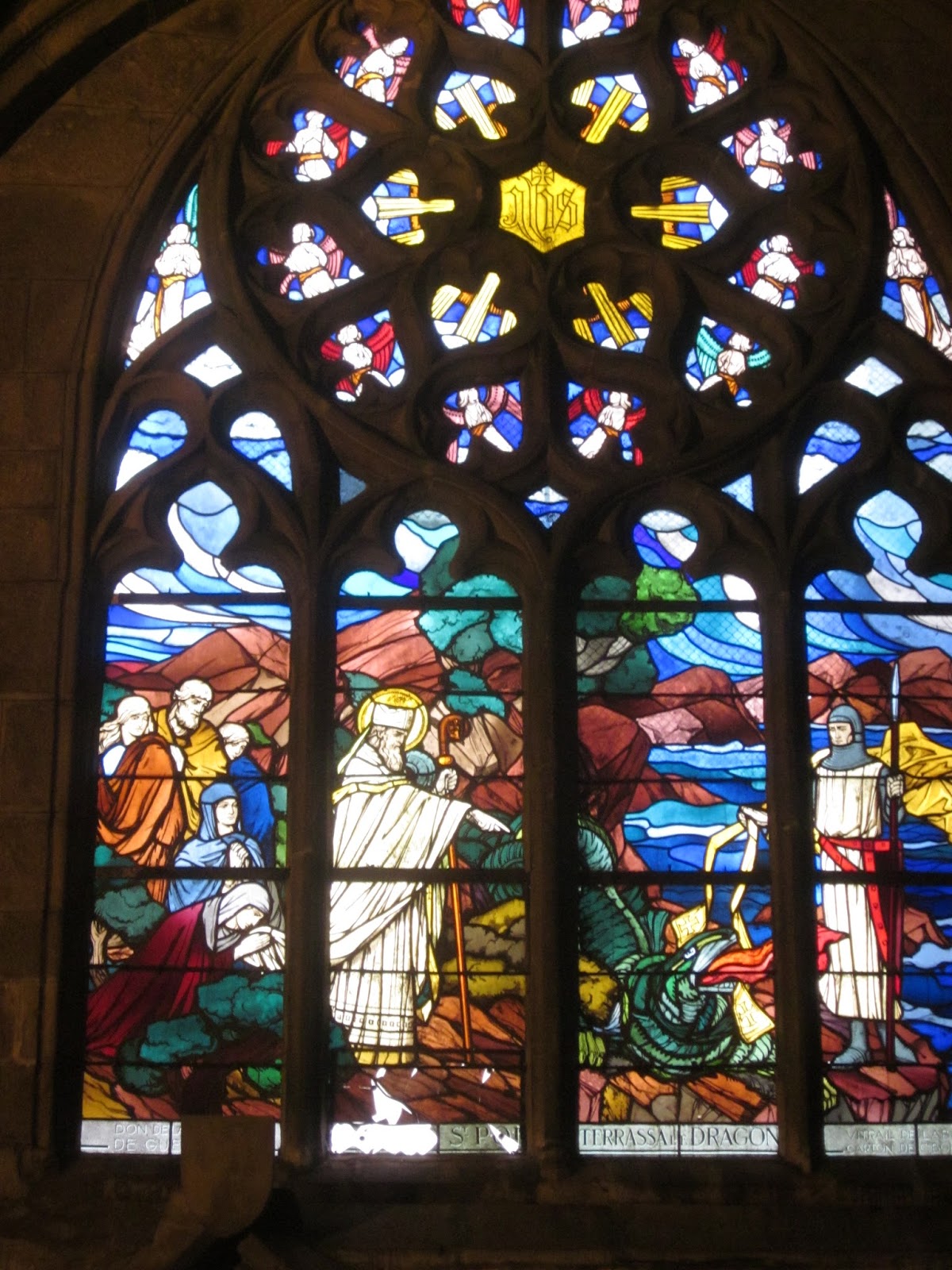
St Pol and the dragon

The iconography of St Pol (Sant Paol in Breton), one of the founding saints of Brittany, shows the saint with a dragon beneath his feet. The reference is to an event on the Ile de Batz, in the area where he came to settle permanently, witnessed today by the nearby mainland town of St-Pol-de-Léon with its cathedral commemorating St Pol as the first bishop in the early 6th century.

St Pol began his religious career in Wales, studying at the prestigious monastery of Llanwit Major. From a noble family, he was marked by his piety from an early age, although the evidence for his later life suggests the uneasy mixture of asceticism and missionary zeal not uncommon in the early Breton saints. After a sojourn with King Mark in Cornwall, where he was refused a bronze bell to take to his new land, St Pol sailed across the Channel to confront the pagan population of western Brittany with the steady truth of Christianity.

This focused purpose is suggested by his first landfall on Ouessant, a remote island in the Atlantic off the north-west shore of Brittany. Here there was a well-established pagan cult centre, a group of priestesses that St Pol is said to have forced from one end of the island to the other. A cross on the cliffs marked his first landfall, with a nearby stone bearing the imprint of his knees at prayer. The name of the only sizeable settlement on Ouessant today is Lampaul – the holy place of St Pol.

Further place-names reflect the saint’s traditional journey eastwards across what is now Léon, the northern part of Finistère: Lampaul-Plouarzel, Lampaul-Ploudalmezeau, the chapel of Prat-Paol, Lampaul-Guimiliau and finally St-Pol-de-Léon. Here St Pol is said to have had a positive interview with local count Withur (who may have been a relation), and received land on the Ile de Batz, just off Roscoff. Here he founded a monastery on the site of what later became a chapel to St-Anne, still visible in ruins on the island now.

The Ile de Batz was terrorised by a marauding dragon and the inhabitants approached St Pol for help. He is said to have called the beast out of its lair, placed his bishop’s stole around its neck, led it to the western edge of the island and commanded the dragon to hurl itself into the sea. It obeyed. The place today is called Toull ar Zarpant, Serpent’s Hole, and a striking rock formation marks the bay where this remarkable event took place.

In the village church, a medieval bishop’s stole is displayed in a glass case, echoing the most memorable feature of the story, a wild beast led like a tame dog to its death. The fabric has been tested and is very early, possibly 8th century, alas too late for St Pol himself who died near the end of the 6th century at the great age of 102.

He had wanted to continue a quiet monastic life on the Ile de Batz, but was tricked into becoming a bishop by Withur who sent him to Clovis in Paris with a note requesting his episcopal consecration. Thereafter he cleared more wild beasts from the Celtic site of Occismor and founded what later became the cathedral and town of St-Pol-de-Léon. Official life was not congenial to St Pol who made several thwarted attempts to retire to the Ile de Batz before he was finally allowed to live out the rest of his long life in peace there.

The dragon story overrides all other tales of St Pol’s miracle-working, such as healing the blind and commanding the sea to respect a boundary he had set, the powers that set him apart from other Christians in his group of settlers. It is surely the detail of that wild monster behaving like a family pet that sticks in the memory and makes the story curious. Another interesting detail, often overlooked, is that the saint took a companion with him for this feat, a certain knight from Cléder. The implication of a knight is of course a warrior with a sword, which sounds suspiciously like an insurance policy or back-up plan. Did St Pol want a witness? Or perhaps a muscle-man if things did not turn out to his advantage. Did the islanders turn out to watch a potentially thrilling contest or cower in their huts until the danger was past? An observed miracle and a reported one are markedly different things.

If the dragon, so vividly described in the Latin text of an early Vita of St Pol, written by Wrmonoc, a monk at Landévennec in 884, symbolized pagan religion, the worship of natural forces and elemental powers, it was perhaps apt that it met its end on the western shore, a direction associated with death and the Isles of the Blessed in Celtic mythology, here where the sea stretches emptily and endlessly into the far distance. The bay is crammed with rocks of all sizes today, dominated by the vaguely beast-shaped pile of giant stones at a point exposed fully at low tide. The sea of course has resurrective potential in pagan mythology, so the beast may not have been reluctant after all, and needed little bidding to opt not for destruction but regeneration, and a welcome release from the irritating goodness of Christian saints.

Tuesday, February 14, 2017

Dull and cold

Spent the weekend in St Brieuc and the environs. I fear I shall never like this dull town with its tortuous traffic arrangements, incohesive centre and claustrophobic streets, despite a scattering of handsome half-timbered houses. The cathedral, built with defence in mind, has a dour and forbidding exterior, hardly enlivened by the gloom inside, the unadorned walls punctuated by bishops' tombs. Certainly the building was badly used at the time of the Revolution, but the interior still seems inhabited by the miasma of an unholy trinity: defeat, loss and martyrdom.
The Bay of St Brieuc is an open relief after many attempts to leave the town are thwarted by poor signage and roadworks further confusing an already baffling one-way system. The tourist office had provided me with maps for my visit to the bay area. Unfortunately, these did not include minor roads so finesse of direction was tricky. It's a long time since I explored this area for the Footprint Brittany guidebook, but I had various goals in mind, thinking about the new book and old pathways. I drove along a road based on the Roman route towards Corseul, capital of the Coriosolites in Celtic times, before branching off along a beautiful curvy split route with trees on both sides and between the carriageways, to the small bourg of Hillion with its appealing Romanesque church,
I then walked the coast path beyond the look-out point at the Maison de le Baie. It's a weekend of high tides and this bay is famous for one of the longest recoils in the world, when the sea retreats for up to 7km. It was out for me, so there was plenty of bird-life on the exposed bed, including a flock of Tadornes de Belon. I'm fond of this chunky bird whose peculiar markings make it look unfinished, a work in progress.
Moving inland and onto the high ground in the commune of Yffiniac, I found the Fontaine des Sept Saints beside the little chapel of St Laurent, tucked unobtrusively into the hilside beside a huge racecourse. In this case it is seven healing saints, not the founding saints of Brittany, nor the sleeping saints of Vieux-Marché. It just goes to show the insecurity of the historical evidence for the Tro Breiz pilgrimage. References to the the Seven Saints exist in  various documents, but which seven is far from clear. Here it is Guenolé, Jacut, Lubin, Tugdual (Tudwal), Méen, Cadoc and Armel, each patron of their own speciality disease, from rabies to eczema.
Last stop was Ploufragan to search for three ill-signed neolithic monuments. After two, the bitter wind got the better of me and I headed home. The highlight of my weekend was without doubt having the swimming pool at the beautiful appartments where I stayed (Domitys Le Griffon d'Or in St Brieuc) all to myself on two occasions.

Sunday, February 05, 2017

February

I wrote a long post at the end of January about what a frustrating month it had been and then could not get access to my blog to post it! February has begun with the same pattern of  set-backs and obstacles, although the weather has changed from the beautiful freezing sunny weather so perfect for walking to storms, hailstorms and persistent rain. I have spent a lot of time doing translation (Arthurian research by Christophe Deceneux) and waiting for translation pieces booked but never appearing and thus storing up further frustration for this month. I have been let down in a most dishonourable way by a contractor who was to do major work at my house (and I've been waiting five months for his services already. Still, my father always told me never to trust an Englishman ;-)).
Two articles have been written, two interviews given and a very successful launch of my new book enjoyed, but all I really want to do now is have clear time to get on with the next. Finally the French translation of Spirit of Place is done and at the printer, well in time for the February 19th launch, but getting it done has been a very rough ride.
Both my lap-tops are malfunctioning, the elder through exhaustion and the baby, initally my pride and joy, for no reason capable of analysis. It has been nothing but trouble from the set-up and I tend to do no more than leave it alone in its smart new case and make notes on scruffy bits of paper. Things can only get better. This week I am teaching a course about the Tro Breiz to lovely people in a lovely place and having a session with my lovely personal trainer, and maybe an island trip, so nothing to complain about at all... I am also incredibly pleased by and grateful for all the really wonderful comments on the new book. The theme has clearly struck many a personal echo.

Wednesday, January 04, 2017

New book

My new book is out (in English) next week, with a launch at The Bookshop, Huelgoat, on the 14th and 15th January, 2.30-4pm. The French translation will have its first airing at the Salon du Livre, Le Cloitre St Thegonnec in February.


 This book looks at the character and personality of certain ‘little landscapes’ in western Brittany, considering what sets them apart from their surroundings. Some, like the extraordinary megalithic cairn at Barnenez are well-known, others like the Chaos de Mardoul are well off the beaten track. Emotional links with place are also explored, as well as general themes of relating to the environment and the possibility of seeing into nature beyond accepted notions of beauty and cultural filters. Topics include the nature of ruins, sacred geography and the sense of belonging to the land. ‘Place writing’ and personal connection combine to express some fundamentals of intimacy with landscape.


Eleven doorways, eleven passages and eleven burial chambers: a terrace of dead neighbours, a defunct community echoing the values and social continuity of its creators. It is also an abiding memorial, although those responsible could scarcely have anticipated the endurance of their project. The cairn of Barnenez changed the colour of the landscape.


Sunday, January 01, 2017

2017

HAPPY NEW YEAR from St Pol de Léon to all friends and followers. My new book Spirit of Place in Finistère is out in English on January 14th, with French edition following in February. Thanks for all the support over the last year. Concentrating now on the Tro Breiz and a new fiction project.

Friday, December 30, 2016

Being outside


Being outside. Those words have defined my life for good and ill. They reflect my preference for place over people and the resulting separateness. As a child it was a physical longing, more than that, a necessity to be out of doors, away from the cage that family life often formed. The sense of liberation and free choice is intimately connected for me with open space, with air and sky. I have come to see my definition and sense of identity in a connection with landscape. Place before people, expansion before confinement. I don’t function well within physical limits.

Looking back, my life is speckled with moments of profound identification with my environment, and the course of my own career and development has been an irresistible, if wavy, line drawing me along the pathway of freedom and belonging. The journey began in Gloucestershire, found meaning in leaving that manicured terrain far behind, was inspired by the Brecon Beacons, and matured in the south Wales of my parental roots. It floundered in the relentless urbanity of London and revived in the relenting rurality of Somerset. There I began to understand the nature of spiritual pilgrimage and the value of landscape in life. My wayfaring has been equally fired by the Tatra mountains of southern Poland and the misty sweep of Exmoor,before being finally fixed in the granite of Brittany, where the moment of arrival was an awakening.
Here's to being outside in 2017...

Monday, December 12, 2016

Walking


Walking is our most natural pace. The moderate speed allows us to gain the greatest appreciation of what we pass. Early man needed to assess signs and sounds of danger and to spy out sources of food and water, all of which required a level of examination of the terrain he passed through that can only be achieved by pacing or striding. Jogging and running, cycling and horseback riding separate us from the detail of landscape by speed or height. By those methods we notice less: screeds of bluebells but not the first violets; a beautiful old stone wall but not the little heads of stoats peeping out of the cracks; a fish jumping from the river but not the tracks of otters on the bank. The detail needs time and deliberate searching by eye, and it’s the detail that raises the level of experience and a sense of connection with the other inhabitants of the earth as well as nature’s manifests.
The same is true of walking in an urban environment. We need our senses to be alert but also our movement to be slow enough to separate a blur of buildings or a flash of green space. Driving through a town in a car or riding a bike requires attention to be focused on the travel itself for safety. Stopping and starting may provide moments of observation but these are hardly leisured and the flow of traffic usually dictates the pace of passage. It’s possible to admire a street of medieval half-timbered houses, to get a sense of historic atmosphere through glimpses of architecture, but you have to walk to access the minutiae of decorative art. You also have to walk to appreciate fully the development of settlement patterns, the relationship between older and newer elements, the changing demands of society in an urban environment.
The complexity of landscape we have created can only be appreciated through the simplest of movements.

Saturday, November 05, 2016

Association des Ecrivains bretons

Parish Close at St-Thegonnec
Today was the AGM of my writers' association in Brittany, held this year in Finistère and not too far from me at Luzec and St Thegonnec. The cultural centre at Luzec, founded and run by sociologist and writer Anne Guillou, was one of the first stimulating places I ever discovered in Brittany, offering historical lectures through the winter on Sunday afternoons, and outings in the summer. Anne herself has been something of an inspiration to me in following my own path, and given me good advice and help on various occasions over the years.
The AGM was run by our President, Michel Priziac, a tireless worker for the interests of writers and a prolific author himself, place-names and the historical associations of places being two of his specialities. He has done a great deal to promote the association and encourage writers to make the best of their talents in recent years. Other members of the committee also give their time freely to perform the many administrative and organizational tasks required to keep a large association not only ticking over, but constantly exploring new avenues of interest to members.
After lunch and more feedback on the year's events, prizes, awards, future plans, etc. we drove the short distance to St Thegonnec for a guided tour of the famous Parish Close. I bring many groups and individuals here myself, so it was rather enjoyable to visit without responsiblity and to benefit from Anne Guillou's exceptional local knowledge.
I could not stay for drinks with the mayor, kindly offered to the Association by the commune - or rather the new commune, as St Thegonnec has just amalgamated with Loc-Eguiner-St-Thegonnec. I came away once again with an invigorating sense of the extraordinary vitality of associations in Brittany and the passionate commitment to heritage and tradition so prevalent here, as well as the pleasure of meeting up once more with fellow-writer-friends.
Anne Guillou's guided tour

Sunday, October 16, 2016

TRO BREIZ – a last long walk


Dol-de-Bretagne

 I am thinking of walking the Tro Breiz next year. It would need to be in stages, as the entire route tops 600km and would definitely be my last long distance walk. Let’s see how my fitness stands at the end of 2016 before the big decision.
The Tro Breiz pilgrimage connects the seven cathedrals associated with the seven founding saints of Brittany: ‘founding' because they represented the initial wave of proselytising Christianity which took hold of Brittany in the 5th and 6th centuries. Indeed this was the time when Brittany itself came into being in an embryonic state, as migrants from the British Isles arrived to start new lives, mingling their language with that of the indigenous population.

The name Brittany of course means 'little Britain'. Five of the seven saints were probably of Welsh origin, only two being natives of the Armorican peninsula (Amorica was the Roman name for NW France), perhaps sons of immigrant parents. The cathedrals later associated with the seven – and in order of the route I’ll maybe take - are St-Pol-de-Léon (St Pol), Tréguier (St Tugdual), St Brieuc (St Brieuc), St Malo (St Malo), Dol-de-Bretagne (St Samson), Vannes (St Patern) and Quimper (St Corentin).

Quimper
There is evidence that this ‘Breton journey’ was a genuine medieval pilgrimage route, an undertaking of serious commitment to be achieved once in a lifetime to be that much more secure of a heavenly future. Although the actual paths are mostly lost, old Roman roads, still major highways in later periods, certainly formed important links: for example, we know that a pilgrim from Morlaix took the 'Roman road nearest the shore' on his way to Dol. Another Roman road connecting Vannes and Quimper must also have been part of the chain. There are many place-names containing references to pilgrims (although these may just as likely refer to those on the Compostela trail), such as Le Champ du Pèlerins and La Fontaine-aux-Pèlerins. Some see an allusion to the 'Green route of Hope'(= salvation, by completing this journey) in names like Le Chemin-Vert and Les-Croix-Vertes. The study of toponyms is so often not a conclusive investigation. Another approach to establishing the ancient ways involves looking at where pilgrims would have stayed along their route. Abbeys and establishments of the Knights of St-John, such as that at La Feuillée, made natural stopping-places for travellers anxious about security. And certain chapels and fontaines along routes between the great cathedrals are known to have been focal points for spiritual travellers on the Tro Breiz: for example, La Trinité near Melgven.
Tréguier
I have often written and publicly spoken about these saints, I know the seven cathedrals well and have walked many miles of the paths used for the contemporary version of the Tro Breiz, recreated by the hard work and dedication of an association based in St-Pol-de-Léon. But the idea of one last great big walk with ancient connections, full of modern logistics, drenched in beautiful Breton coast and country, doubtless spiritually uplifting even to an old animist like me is almost irresistible, despite the inevitable physical trial it will also provide. 


Sunday, September 25, 2016

Away and home

Coming home
I've been away in London for much of September, an enjoyably rich and emotionally satisying time which is already reduced in my mind to its essentials:  great food (in great amounts) and even greater friends. Nevertheless, the sight of the Breton coast in a glorious dawn over St Malo always raises the heartbeat as home grows closer and by the time the train rattles westward out of Rennes, I am mentally salivating in anticipation. Within an hour of reaching the longed-for destination, I am out in the forest, feeling a familiar blanket of peace and calm settle on my shoulders, smoothing out the last London frazzles, and bringing me back to the fulfilment of here and now.
Since then I have been working, and having fun, as a guide to American tour operator, Mindie Burgoyne, (www.thinplacestour.com) and her husband Dan. We have packed the last two days with visiting natural wonders in the forest, megaliths on the moors and elsewhere, and churches demonstrating the complexity of religion in Brittany, where paganism is never far from Christianity.
Enclos at Guimiiliau
Now I must get back work and finish my book on the Little Landscapes of Finistere before returning, after a ten year break, to fiction.

Sunday, September 04, 2016

The Chaos of Mardoul


Water’s words to stone here are alternately loving and savage, caresses turn violent, stroking becomes a slap. In wild weather it is a seething insistence of water. All that rock can do is hold to itself, edges rounded to ease the onslaught and survive the longest time under a constant assault that is both smooth and brutal. It’s an unequal contest in the end. The river can spread to mount its challenge: the rocks have no more movement in them. In dancing steps the water constantly changes direction, twisting, turning, preening round its static partner, forming shapes and ritual traces, like little tripping thoughts of happy times. As water tires of obstacle, there’s the trumpet of torrent and torment, a surge of force. Under an angry wind, white-topped waves rage down the valley. In gentler times, with little explosions of foam like a series of sneezes, it glides as clear as glass down a shelf of rock. The old war between rock and water is a lost cause for the remnants of another earth. The river will have its way, hard or easy.

Friday, August 19, 2016

Out and about, getting somewhere

I've been on two trips recently to spend more time in places that will figure in the new book. Firstly down south, among the black rocks of St Guenolé, initially given cultural reference by Chaucer in The Franklin's Tale, when Dorigen paces the coast at Penmarc'h, fearful for her husband's safe return to such a treacherous shore. It's a dangerous spot, with many fatalities to this day as foolish spectators of the high tides edge out to risk their lives for more dramatic photos. In fact the flat shelving of dark rock, completely hidden when the tide is up, is somehow more frightening and sinister than the gigantic stone pinnacles with iron railings to cling onto in the hope of avoiding being swept away by a freak wave. This was, in fact, the fate of the Prefect of Finistere's family as they enjoyed a leisurely picnic in 1870. Several of the bodies were never recovered.

This week I was in north-west Finistère, watching the estuary tides on the Aber Wrac'h for my chapter on Pont Krac'h, the Devil's Bridge. There was also time to hop over to Landunvez for some coastal reflections around the chapel of St-Samson, the scene that figured on the cover of my cultural history of Brittany, and one which will also appear in the new book.
At last I feel I'm getting somewhere in terms of completing this work. Delighted to say that Lynette Hardwick, an illustrious illustrator, will provide line drawings for my text, so we have also been working on those, and the page lay-outs - and the French version is also underway. Now all I have to do is finish the text....