Tuesday, June 04, 2019

Ile St Gildas

Ile St Gildas
I spent the weekend on the north coast in Cotes d'Armor for the pardon on the little private island of Saint Gildas, who is one of several Breton saint patrons of horses. The unusual aspect of this event is that the island is only accessible on foot at the lowest tide and that it is only open for public access on this one day a year. A procession of people and horses make their way out from Coz Castel in Bugélès, following the curving line of an old causeway constructed in the days when the islands in this chain were all exploited and regularly inhabited. In places there is no more than a vague track and care is needed all along the slippy sliding path over sand, mud, rocks and seaweed.
I set off before the official start time, leaving crowds gathered on the shore to await tractor transport or to walk along with the horses on their way to a bishop's blessing on the island. Even so there was already a long line of men, women and children picking a precarious route across the strand. Footwear varied from wellingtons and walking boots to open sandals and bare feet. Many old hands carried a shoe-bag with a change for arrival. It was certainly a dirty business and required a degree of concentration that left little time for observing the off-shore scenery. Fortunately the intense heat of Saturday had evaporated and the breeze was fresh once away from the shore and walking where there would normally be sea. One wide channel remained and I waded across up to my knees through the gentle current.
Behind in the distance I could make out the main body of participants on the move. The first horses, a fine pair of chestnut mares, passed me shortly before I reached the causeway up onto the island. Paddocks and paths had been newly mown for the occasion, scenting the air with the summery smell of cut grass. There were already many there but I had the chance to visit the tiny chapel of St Gildas and even smaller oratory of St Roch in their stone enclosure before the crowds arrived. A makeshift altar was set in the open air under a white canopy and lines of chairs awaited the pilgrims for mass.

While they filled up, I wandered about watching the horses, now lining a large fenced area beside the food and drink stalls, and locating the eccentric toilets in a former bread-oven.
After mass the bishop of St Brieuc and Tréguier and his acolytes processed the short distance to the paddock, mounted a special platform and blessed baskets of bread which he then fed to each horse to ensure its good health and good behaviour during the coming year.
There were 75 animals,so I decided to set off back whilst the route was fairly clear and enjoy the journey which was my (work) purpose in coming, able to take it slower on return. There was about an hour left before the tide began to fill the channel, but I met an elderly Breton woman with bright blue eyes and bright yellow wellingtons, making her slow way to the island. She said she was afraid of slipping, but clearly determined to reach the site even though the ceremonies were almost over and tractors lining up to bring the faithful home. Gradually fading snatches of canticles accompanied me on my return.

Monday, May 20, 2019

The Pardon of St Yves

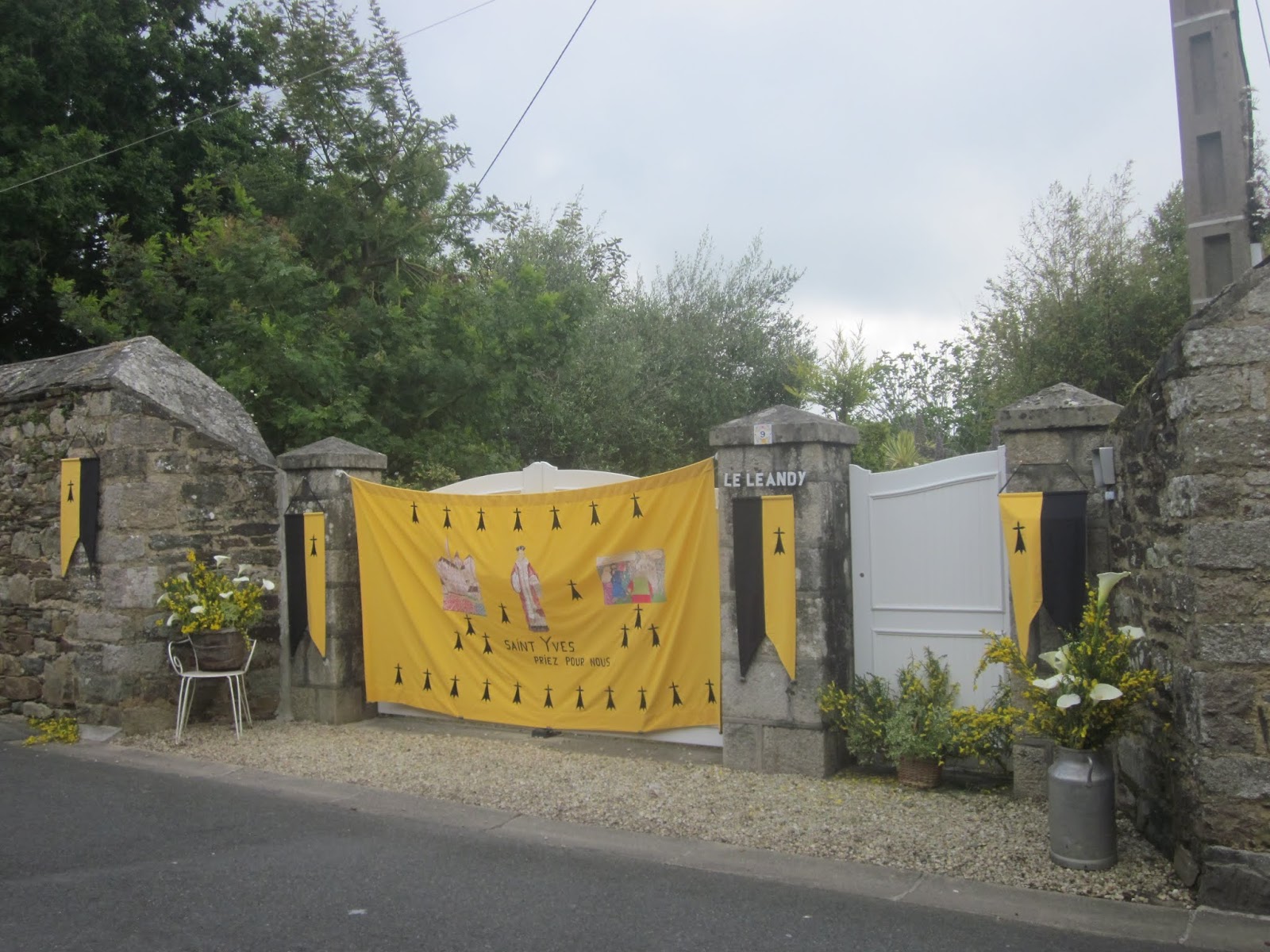
I spent the weekend in Tréguier, a favourite haunt, but for the first time to attend the great Pardon of St Yves. Yves Hélory (1253-1303) was an ecclesiastical advocate and extraordinary defender of the poor, well-known all over the Trégor in his day and considerably further afield following his canonisation in 1347. He is the patron saint of Brittany and his special day attracts thousands for a procession between the cathedral in Tréguier and the chapel in Minihy-Tréguier, his birthplace and home. The relic of his skull is carried by lawyer and priests along the 1.5km route and back.
The town is all dressed up for the event with his family's yellow and black flag (thanks to a crusader grandfather) displayed everywhere together with sheaves of yellow broom and hundreds of lily flowers studded into hedges along the way.
I attend the mass in Breton at Minihy, for a while in the back of the chapel and then outside in the cemetery, still singing along from the hymn sheet (Breton is easy to follow and generally pronounced as it looks), and watching pilgrims turn up now and then to crawl under the 'tomb' of the saint, an ornate stone table. The best sensations of the occasion - in the simple and emotional faith of St Yves - are most felt here without the great numbers thronging around the cathedral in Tréguier, where the service in French is also taking place.
Walking into the town along the processional way in reverse - Chemin de St Yves, rue de St Yves - I have time for a leisurely coffee while crowds gather to witness the spectacle. Suddenly I realise that just seeing a bunch of lawyers coming out of the south door with their proud burden is not what I want to see most, and it will be hard to do so or to take photos in the scrum of curious onlookers and the faithful following the parade.
I retrace my steps all the way back to Minihy, where a few are waiting at the point by a wayside stone cross where the main ritual of the procession occurs, on a ninety-degree turn down to the chapel.
After a short wait I hear singing floating up from the village - canticles of St Yves are repeated over and over during all the ceremonies - and the procession from Minihy with its three ancient banners arrives to await the cortege coming from Tréguier. The priests take up a position facing along the road towards the cathedral.
The crowd grows and seeking a place with a good view and the sun behind me, I'm forced to get up on a very narrow bank where three older people are sitting with their legs dangling. It requires considerable muscle and foot strain to keep perched up there for more than half an hour of anticipation. Finally the first figures appear and a Breton pipe band leads the way, passing in front of the cross and down into Minihy. Behind it an astonishing spectacle, wave on wave of banners and ceremonial crosses stretching as far as I can see.
The ritual of encounter begins as Minihy's tall metal cross is lowered and raised in a nod to various passing crosses from other parishes, which also dip so that the two metal faces almost kiss as they skim by one another. It is nearly forty minutes before the skull appears in the distance, a priest in front flanked by lawyers bearing the weight of the reliquary on their shoulders. They stop a little way away. The rest of procession has passed. We all wait. Finally the Minihy banner-carriers move forward and the skull is brought to face them. Up and down the banners go - what body strength it must take - high in the air then dropping towards the ground, saluting their saint as he arrives home in his own parish. This is the climax of the Pardon, the relic visiting its most profound site of connection. After passing through the village, the procession will return to Tréguier.
This is an old ritual, and of more significance that touches me than is usually the case in official ceremonies. The depth of relationship with place is something I understand. Indeed I am currently writing about St Yves and his paths in the Trégor. Almost every day, despite travelling far and wide in his duties as a priest elsewhere and preacher everywhere, Yves Hélory walked back home to the little family manor house where he tended the old and sick and saw that all their needs were provided for. Thirty or forty kilometres was nothing to him in search of home and belonging. The Pardon, despite all the trappings and pompous lawyers, both of which the saint himself would have deplored, still manages to symbolise this simple truth.

Sunday, May 12, 2019

Text 7: Musings of a Patron Saint


I am the saint. This is my church.

I stand over the porch, I stand next to the altar,
Sometimes a place on the calvary.
You can see me on my stag, with my wolf,
Beside my dog, along with a horse or cow.
I prefer animals. They obey me.

I am honoured with altarpieces, telling my story,
Through offerings and prayers, a relic, a tomb.
Honoured by banners and processions:
On my holy day, the Pardon winds its way.

Not always so easy being a saint.
All those demands and quarrels and envy:
I would prefer the quiet peace of a lonely spot,
But destiny says otherwise.

I have a mission: it is quite an exalted position.
Special powers make me a magician,
Using my staff for a wand.

I could strike a spring from the earth
Drive dragons to suicide,
I could cure shingles, blindness and burns.
Make children walk or form in the womb,
Bring rain to crops,
Call up the wind or pat it down
To save ships in a storm.
At my best, I was most effective.

People spoke fervently to me once,
A saint who was here and did stuff of note,
Rather than God, too busy or remote.

Now not so much.
No longer the draw, the object of hope,
I live in the past, and to be honest I’m bored,
It’s an unsettling slope,
From adored to ignored.


2019 ©Wendy Mewes

Thursday, April 18, 2019

Exhibition of texts on Parish Closes

Guimiliau

EXHIBITION April 29- May 17 at SUR LA ROUTE, Huelgoat
Opening event: May 4, 3pm

I am exhibiting creative texts - together with photos by Candy Blackham - on the theme of the Parish Closes in northern Finistere. These extraordinary religious ensembles renowned for their architecture and art deserve to be better known. They are also revealing of the particular social and economic history of the region.
There are 12 texts, with French translations, including a visual display of a close in words. The following are short extracts from what are much longer texts that obviously need to be read in entirety for best effect and all the intricacies of sound and structure.

Extract from Text 4: Ossuary - Bone House

end flakes
darling dust
not so
continuous

stone speaks
the dead words
memento mori

talking of bones

Extract from Text 5: Calvary – a tiered response

And those women: Mary sweetly holds her baby’s foot as they flee. Magdalena grieves at the base of the cross. Mary Stuart’s hat is there. Veronica and the hologram handkerchief. Those are the good roles, mothers and mourners. Not like Katell Gollet, dragged down to hell for liking a drink and a dance. Watch out, girls.
 
Bodilis
Extract from Text 10: Bits about Bits

Enclosure: determining wall, shaping the truth. Keeps faith in and the ungodly out, likewise dogs, chickens and pigs.  Pagans manage to squeeze through. Defining space and temptation, ritual containment. Descendant of cairns and alignments.

Extract from Text 12: Faith is

FAITH is glue, sticking together.
FAITH is an almost forever.

FAITH is illusion, but one bright and gilded.
FAITH is for the weak and deluded.

FAITH is trust in bones and blood.
FAITH is no protection from flood.
Sizun
Look forward to seeing friends and followers at some point during the course of the exhibition.


Sunday, March 24, 2019

St Yves de Verité - hexing by saint

St Yves in judge's garb
St Yves, the patron saint of Brittany and of lawyers worldwide, has enjoyed a tremendously strong and lasting cult centred on the cathedral of Tréguier (which holds the relic of his skull) and nearby chapel in Minihy-Tréguier, the hamlet where he was born. But just across the Jaudy estuary near the shore at Trédarzec, once stood a chapel dedicated to the saint with more sinister practices.
Unusually for a Breton saint, Yves was both a real person (in the late 13th century), and an actual official saint, canonised by the pope in 1347. Renown for his passion for helping the poor which led to giving away most of what he had and favouring them in decisions he made as an ecclesiastical judge, he was a synonym for justice and truth. At some point by the early 17th century this reputation had developed a very particular application in the form of St Yves de Verité (Erwan ar Gwirinez or Santik (little saint) ar Wirione in Breton), with a case attested in 1620 when a woman sought vengeance on the landlord who had accused her son of arson. This was indeed the purpose of the cult: a petitioner who felt himself wronged would make a bargain with the saint, calling down vengeance on the guilty party. If his accusation was false, he would suffer the same punishment - death within a year.
The ritual consisted of pilgrimage (in a state of fasting) to the chapel at Trédarzec on three consecutive Mondays as night fell. The petitioner then grasped the shoulder of the statue of St Yves and shook it sharply. This could be because the place was ill-frequented and Yves might have dozed off a bit, but in fact violent treatment of saints' statues by worshippers was widespread in Brittany. Whilst doing this, the petitioner would say the portentous words 'You are the little saint of truth. I make this vow to you. If he is right condemn me. But if I am right let him die within the appointed time.' A coin marked with a cross would then be placed at the foot of the statue, before the customary prayer of a vow would be said BACKWARDS, a clear echo of pagan magic ritual where curses often employed this method. Three ritual circuits of the chapel then followed. Another account says a cobblers' awl was left handy in the chapel for piercing the statue three times, to make a little dust, so anticipating the fate of the guilty party.
Skull of St Yves - Tréguier cathedral
It was once thought this strange cult began just after the Revolution, a time of excess and the suppression of conventional religious practice. In 1792 a document records that the chapel was one of several in the area closed and without petition to reopen it. The building itself began to decay but remains and two statues were still seen in 1881. The poet Brizeux called it 'cette chapelle horrible' in 1845 and this 'cult of hatred' was well-known (and presumably well-used). The chapel was destroyed by order in the 1880s to put an end to what the church saw as barbarous practices, but when the statue was removed to the priest's courtyard it remained a focus for petitioners. He finally hid it in the attic of the presbytery.
The matter was somewhat blurred by the great folklorist Anatole le Braz, who wrote in 1893 that the cult had originally been of St Sul and the chapel destroyed after a notorious murder case in which an old woman claimed to have been asked to carry out a vow of vengeance. In fact the chapel had already been destroyed by then, but a nearby oratory, which still exists, may have caused some confusion. There is also reference to Notre-Dame de la Haine by Emile Souvestre in 1836, but perhaps this was a casual deduction from the standard 'Ave Maria' to be said three times in the course of the ritual.
The attempted destruction of superstition was always an act of folly by the Church - it is the very strength of Breton faith whose tenets are set by the people and their will. God himself would be hard pressed to make impositions on a Breton. Let's not forget we live in a world where recently made statues of unknown saints are said to be working miracles. Today there is apparently a freemasons' lodge at Tréguier with the title Erwan ar Gwirionez. Good luck with that.

Wednesday, March 06, 2019

Christophe Deceneux

Christophe and I at Combourg with 'our' book
So very sad to hear of the sudden death of my dear friend Christophe. He was a lovely man and an exemplary writer, devoting much of his time to research and managing to turn that into a prolific output. I was delighted to translate one of his booklets 'The Holy Grail and Brocèliande in Dol-Combourg' to bring his work to the attention of anglophones, and this investigation did indeed make its mark in the world of Arthurian studies, through the interest of Geoffrey Ashe.
I first got to know the work of Christophe's late brother Marc Deceneux, an historian of repute, who wrote extensively on the area around Dol and Combourg. During a month's stay for research of my own in Combourg years ago I was introduced to Christophe and his charming wife Jacqueline, and through them became friends with the La Tour du Pin family, owners of the famous chateau. These connections have been of immense importance to me, and my attachment to Combourg remains profound.
Christophe's interests were wide, but recently focused on the curious, alchemic and esoteric. He published Finis Gloriae Mundi de Fulcanelli, La Révélation in 2016. More recently he was working on a novel in conjunction with another writer. The research that brought us together, on the 'location' of the literary forest of Brocéliande in the tales of Arthurian knights, made a big impression on me, going against received notions here in Brittany that the forest of Paimpont was the original inspiration - not at all likely, as Christophe demonstrated convincingly. Exploring the Dol/Combourg area to follow up his leads was an adventure and a revelation.
I will never forget his kindness and enthusiasm for history and imagination. I shall sorely miss sitting in his garden talking over the latest research and going on a little trip of exploration with both Christophe and Jacqueline, as we did one happy day not so long ago. It seems long ago now, the separation of death harsh and decisive. But I was very lucky to know him.

Sunday, February 10, 2019

Mr Patch

My primary school reports
I've often been asked about why I write but never about the origins of the impulse, about what made me a writer from a very early age. The most obvious influence was my father, a teacher of English and Latin with an equal interest in history, a phenomenal reader and throughout his adult life a maker of notes and diaries. After retirement he devoted a lot of time to writing, including an account of his experiences during WWII which he called with habitual irony 'A good war'. I read very widely from his suggestions from the age of 4, having an excellent library of books to draw on.

The first book I wrote was at the age of 8/9. It was about, of all things, the Greek islands. I still have it. Of course I'd never been there or anywhere outside of Gloucestershire and Wales. The Homeric tales and Greek mythology had generated the interest, and islands were an excitingly stimulating whilst unknown phenomenon. My method was organised and surprisingly good: books collected from home and the local library, extensive notes made, a process of selection and then a text in my own words. Not that far from what I do now, except today I have the luxury of airing original thought as well as words. But I did pretty well then without the element of personal experience or widely acquired knowledge.

But here I want to honour someone who had an enormous influence on my writing career. When I was 10 years old, he arrived as a student teacher at the primary school I attended in Stonehouse. His name was Mr Patch. Not only did he teach my class daily English lessons, but we also had extra individual lessons together as my mother had quarreled violently (her speciality) with the RE teacher and withdrawn me from all religious teaching. As I had consistently avowed my desire to be a writer, it was deemed fitting that I concentrated on this in these spare lessons. What lovely and sensible people there were in that school!

Mr Patch set me a series of imaginative and demanding exercises, to write in different styles, to develop character studies, to describe places, to produce dialogue and most of all to stimulate my already maturing imagination. I remember now a newspaper article about an imaginary accident and the physical description of a Red Indian chief and desert setting. I realise now that he must have been an avid writer himself. He praised, corrected, encouraged and challenged me throughout. He gave me scope with discipline. He made me feel like a writer, with a serious purpose and a process of development to follow. He wanted me to be my best self in a context that has mattered to me more than other as my life has progressed.

What gifts for a solitary, serious, hyper-sensitive and hyper-imaginative 10 year old child! Recently finding my primary school reports stimulated this memory of a man who had an enormous influence on my writing, although I have never forgotten him. I'd thank Mr Patch from the bottom of my heart, if he wouldn't gently respond with a word or two about cliché.

Sunday, January 27, 2019

St Efflam

He's a strange one, this Irish saint of royal blood, who ran away on his wedding night to avoid intimacy with his new wife Enora and pursue his devotion to God across the sea. He landed at Lieu de Grève in the bay of Plestin-les-Grèves where his chapel and sacred spring stand near to the shore. Stories later associated with him illustrate the exceptional powers and single-minded courage that form almost a badge of office for many Breton saints.
The substantial fontaine, dating from the late 16th century, is a prophetic one. The rituals vary but pieces of bread are of the essence, If you have been robbed and have your suspicions about the culprit, take three pieces of bread, name each one and throw them into the water. The one that sinks will be the guilty person. This tradition has muddled itself with another concerning engaged couples, who are also to throw in three pieces of bread. If two come together without the 'saint' (or third bit) intervening, they will be happy. Obvious you might think, but rumour has it that the bread used should be stolen... In fact, the same ritual with the magic number three is used to answer any question there - will I marry, will my husband survive a sea voyage, will my child live - but in this case the answer is yes if two of the pieces float towards the third saintly morsel. Ah, the finesse of ritual.
St Efflam has another curious legend to his name. He came across King Arthur engaged in combat with a dragon on the towering rocky pinnacle of Grand Rocher overlooking the bay. When the hero failed to make headway and both combatants retired for a half-time break, St Efflam stepped in and called the beast out of his lair. The sight of the raised cross was enough to daze the poor dragon, who meekly submitted to a command to throw himself off the precipice. The moral is clear: faith is stronger than brawn (and dragons should always look away quickly when faced by saints).
Enora, the deserted wife, showed admirable spirit in following the virginal Efflam and landed a little way off near Le Yaudet where she was picked up in a fisherman's net. She was soon running from the local tyrant, who chased her lustfully back towards Efflam's haunt of Lieu de Grève. There a miraculous paralysis overcame the pursuer: he swiftly repented and was released from his plight by Efflam himelf. Enora established her own oratory near that of her husband and remained close but chastely separated from him until her death.

Saturday, January 12, 2019

Hello 2019

Temple complex Fanum Martis
Good start to the New Year, with lots of calm weather for tentative walking and lots of new writing getting itself down on the page. I've been working on the Roman chapter of Wayfaring in Little Britain with a trip to Corseul this week, considering the notion of procession in the short journey from the town to the hill-top site of the Temple of Mars. I'm also thinking of reviving my idea for a short Walking Meditation book if I can find the right artist for a collaboration.
Some solid work on the parish close exhibition has been achieved in the first days of January and I can now see the whole thing 'in the round' and connnections between the different pieces are clearer. There have also been new poems, so something in my head is still working - an encouraging and surprising discovery.
Temple remains

Monday, December 31, 2018

Goodbye 2018

This has been a sad and painful year on many levels: generally poor health, debilitating illness in recent months, deaths, the demise of relationships, practical problems, erratic work patterns. But somewhere out of all the torment have come good things like new friends and different ways of moving forward into a new year.
2018 has been my first year without a book being published for quite a while as Wayfaring in Little Britain proved too big a task physically in the last two years of serious illness. I agreed to write a more sedentary book on the Breton Saints and spent two months on this before stopping for a whole raft of complex reasons. Bottom line is that such a book would not serve my own essential interests nor honour the direction my writing has taken since 2015, and I feel strongly that I should no longer spend time writing or translating work outside those criteria.
Thankfully agreed that instead of an in-depth study, the saints will appear in short version later in 2019 in the very successful series of mini-guides like Huelgoat and the Monts d'Arrée, which have been my bread and butter over some years. Ironically this may also be more commercially satisying for the publisher. I cannot let go of the idea of WILB, so I resolve to try again with this tricky, demanding book and see if somehow I can find a scale and scope that is within my physical capacities. This is the book I want to write.
Otherwise I have come back to poetry in a concentrated fashion this year, and worked extensively on the parish closes through translation, talks and guided visits. A more creative approach will come in 2019 when I have an exhibition on this subject - Seeing is Believing - with a photographer friend at the new café/bookshop Sur la Route. I am working on those texts at the moment, contrasting individual experience with the collective identity enshrined in the closes.
So I am happy to move on into a New Year with new energy and ideas. I wish all my kind and valued readers and followers the very best for 2019 and thank them as ever for their continued support, without which these housebound months would have been much harder to bear. Good luck, my friends.

Saturday, December 15, 2018

Place and positive solitude

Putting aside the brief lapse of that last post, I return to my main theme: the power of place and its role in positive solitude. It took a large part of my life to learn this, but a naturally solitary person has to replace the mechanisms by which the socially active reinforce their own sense of identity and well-being. For them, this comes mainly from feedback from others and the operation of family networks. Outside such structures an individual generates self-assessment and works through the evaluation of experience in different ways.
It is perfectly possible for an internal 'conversation' to satisfy both these processes; a constructive, friendly dialogue with myself establishes what I got or failed to get from a film, an art exhibition, a concert, for example. I don't need another or other perspectives - mine own are usually diverse - delivered in the moment, verbally by a companion. I absolutely prefer to look and think and reflect quietly. Sometimes if puzzled by my reactions or curious about some actual facet of the production, I might later go on online to reviews or personal opinions on review sites. Certainly the experience of culture is different with a companion: I have rarely felt it to be better, assuming I am not looking for a learning experience from someone with specific knowledge.

In what one might call the larger issues of existence, I have come to realise over many years of getting to know the landscape of Brittany, that place can also take the role of companion and provide the feedback and stimulus essential for quality of life for those who prefer to live in positive solitude. Being alone in nature can act as a veritable celebration of the solitary. It provides me with replenishment and fulfilment. Why?

Because outside in the forest, on the moor, beside the sea, under the night sky, I am connnected with a much older, wider network than any social group I have ever reluctantly joined. There is something deeply freeing about a relationship that is spiritually profound, but without demands, on-going, without the pressing urgency - whether something is urgent or not - that characterises much human communication.
 You get to know a place much as a person: the first encounter is tramelled by self-consciousness, but losing that through the familiarity of shared time and space, you go beyond the curtain, to a powerful sense of the minutiae of connection in every aspect of the natural world. It is also the framework in which I can best see myself as a functioning living thing, with a place, a context, a layered existence of my own. This is my feedback, my family, my network. It is strong and subtle, liberating and binding. It is always there, in this place or that, here or there, now or tomorrow.

Thursday, December 13, 2018

Finding our natural place

Recent events have taken their toll on the equilibrium of many people on both sides of the Channel. My own is further threatened by separation from the natural world, as illness continues to prevent me from spending sufficient time in places that have always acted as harmonising forces. I am like the child on a first bike without stablisers, wobbling and fearful. My spirit is heavy, full of big emotions that rest crammed into small enclosed spaces. The coast is too far away, the moors too difficult, the constant rain no longer liberating, just sadly wet. Everything is narrower and I make a virtue of wasting time, idly rolling in the muck of news, the offensive slough of politics. Helpless in the face of endless greed and cowardice beyond comprehension.
I am no longer staunch or bright or quick myself. But I do love winter. Maybe that's the lesson, to remember why.
 

Tuesday, October 30, 2018

RUIN

Thinking about ruin(s) came out of my last book on the Spirit of Place. This also emerged.

RUIN                                                                                                           
We played in that old ruin,
Mark, Sylvie, Dev and I,
Threading childhood dreams
Through something broken:                                        
Truncated walls, a single arch,
Lost purpose, masquerading as romance.

I led because I talked the best.
The others took direction,
Indifferent or desiring, 
Through laughter cracked by cruelty
Wrapped in nature’s greening stance.
                                                                
We grew up and unfurled.
Mark dreamt, Dev dared,
I wound up in my words,
Flirting with truth and Sylvie
More fragile than her beauty.
Nothing was settled, we only
Played for time, revolving  
In that other ruined structure    
Called the world.

Our hopes were vague,
All focused on survival,
Far too hung up to grieve
The missed stop of arrival.

Fast forward on to now -
Mark lost, Dev dead
On London streets and Afghan sand,
Sylvie, adrift in drunken dactyls,
Twice deserted (only once by me).
I still have my stories, my dissolving dream.

Thread end, dead end, back
To that eternal present
Beneath the mouldering arch,
For failure not my own,
Where grey and green rewind:
I am still living in the left behind.
Nature at least does not discriminate
Between what is and some more pristine state.
The ruin carries on, the teller tells,
Each prospering their shadow-selves.


© Wendy Mewes

Saturday, October 13, 2018

Hell and healing

After three weeks of hell - total incapacity, insufferable pain, hospital in Rennes - I decided to turn to more traditional methods of healing yesterday. One of the chapters in my new book on the Breton saints is on this very theme, so some pratical research combined with the personal search for relief from pain that is preventing me from working, even reading or spending more than a few minutes on the computer, seemed a pragmatic idea. A kind friend took me to the place.
St Maudez is a specialist in skin diseases, eczema especially, but this fontaine is also associated with the cure of shingles. It sits beside a large, plain chapel in the countryside near Plouyé, with plenty of outside covered space indicating continued use for festivals and a pardon. There are two statues, one unusually incorporated in the steep-curved roof, and three basins, one shaped liked a four-leaved clover.
I made an offering and said my piece, then scooped water onto my burning face. Strangely after a couple of minutes there was a complete lull in the pain and a sudden flow of relief went through my whole body, so worn down after weeks of intense suffering. Then it was back, throbbing and stabbing around my eye and cheek-bone. For the moment, I have nothing more to say to St Maudez.

Friday, August 31, 2018

Saints preserve us

Making cow"s eyes - St Herbot
Summer has been slow, sad and full of difficulties, but I have to say that working on the new book about Breton saints has revived my tenderness for this bunch of introverted loners and misogynistic misfits. The tension between what they mostly wanted - isolated contemplation and spiritual struggle in the throes of landscape - and what became expected of them in terms of community leadership, man management and political nous (or maybe nowse) was nothing if not challenging. Some - St Pol, for example - rose above it all and maintained a lofty saintliness that was proof against the worst excesses of wordliness: others, like St Ronan, fought every battle with asperity and, one is tempted to think, the relish of a waspish personality. His namesake, the philosopher Ernest Renan, says he was more a spirit of the earth than a saint: 'son caractère était violent  et un peu bizarre'. St Herbot just gave it all up and settled down in a quiet spot away from people to commune more comfortably with cattle.
But their legacy is immense, and the particular nature of Breton faith that cherished them so is equally endearing. I am currently reading Anatole Le Braz's Au pays des pardons in which he describes (or rather tells how it was described to him) the pardon of St Servais when the faithful of Cornouaille and the faithful of Vannes turned up ready for a brawl, comported themselves as teams and fought for the privilege of hoisting the sacred banner of the saint, whilst the little statue of Servais was smashed to smithereens under the blows of staves and had to be replaced each year. The wounded were taken home on carts, bleeding and groaning.
Pardon of St Eloi - a more orderly affair

Monday, July 23, 2018

Huelgoat: as real as legendary

The lake
The town tour I am offering this summer is something of an oddity. Huelgoat (= high forest in Breton) is famous for its glorious forest, massive granite boulders and the associated legends. The town itself is not distinguished by impressive architecture - far from it - and away from the lake, rocks and sylvan streams there is little a romantic could find to celebrate. But I've been taking people round the forest and telling the same old stories since 2004, so more than time for a change, and surely reality can be just as compelling if presented in a coherent way.
The reality of Huelgoat is a distinct economic and social history that has fashioned the town differently from its neighbours. The key to history is often geology, and here the exceptional granite flowerings (product of volcanic magma) and considerable silver-bearing lead deposits have both played their parts in development and prosperity. Mining was practised by the Celts and Romans here, and this underground wealth attracted the attention of the dukes of Brittany in the late 12th century when they bought large tracts of land from the spendthrift lords of Léon. The oldest building in Huelgoat is the central mill (now called Moulin du Chaos), built in 1339 on the orders of Jean III (and sadly recently turned into a shop). The forest also provided extensive hunting grounds for ducal sport, a medieval equivalent of 'leisure activity' for the wealthy, an issue that was to assume renewed significance much later in Huelgoat.
Moulin du Chaos
German engineers constructed the lake - much smaller in form than today - in the late 16th century to serve as a reserve for the mines which were situated several miles away in what is now the commune of Locmaria-Berrien. No lake road existed until the early 20th century: a simple track gave cattle, horses and washer-women access to the water's edge. In the 1770s, at the height of exploitation, the size was enlarged and a canal cut from it to travel all the way through the forest to the mine, taking water to drop onto a hydraulic wheel and drive the underground pumps that forced water out of the galleries and shafts. An earlier canal, taken directly from the river Argent (Silver River) near the Gouffre had not proved adequate for the mine's requirements.
Little but long, canal heading out to the mine
Unskilled labour at the mines was mostly local, although peasants also had to work their farms, with many foreign professionals (Germans, English) and French (after the Revolution). This great influx of outsiders led French to achieve a dominance over Breton here which was not the case in the surrounding areas. There was also much inter-marrying as some local family names indicate, deriving from other parts of France. There were some tensions, some early strikes, plenty of environmental damage and pollution and finally decline of supply as it became more and more dangerous to access deeper deposits even with more sopisticated machinery in the mid 19th century.
Once the mines declined, quarrying became the main local industry with Huelgoat granite in great demand as building material. Where the creperie in the forest now stands beside the world-famous Chaos was once the manager's house and centre of activities. It explains why there are expanses here without boulders and why lone stones like the Trembling Rock (which bears a line of chisel marks, ready to be spilt) and the Champignon (Mushroom) stand out in what was once a sea of shapes like the surviving Chaos. The wide tracks so handy for roaming tourists today were then necessary for bringing out the cut stone in carts.
Roche tremblante with line of chisel holes
But the latter part of the 19th century saw changes of attitude towards nature and the development of leisure interests for ordinary people. Writers and artists (like Sérusier, one of the Nabis) flocked to the picturesque forest, and hotels blossomed to satisfy new tourist demands. One advertised the town as the 'Fontainbleau breton' and even had a dark room for budding photographers. Flyers in English reflect the early attachment of the British for this lakeside town, already referred to as an 'English colony' in the 1880s. Walking and cycling became serious leisure pursuits throughout the social scale and the beauty of natural scenery began to be valued for its own sake.
As quarrying caused more and more destruction of the great rocks that were attracting visitors from far and wide, a campaign to save them was mounted by the Touring Club of France and supported by many famous figures from the world of culture. In 1903 the town finally bought up the forest area of Saoulec to preserve what is now the main lure for tourists, an astonishing valley crammed with boulders of every size and evocative shape.
I throw in a single legend (the sort I like with social and economic significance) to show willing. It is a pleasing irony that the origin of this Chaos is attributed to the giant Hok Bras or Gargantua who rained down these rocks on the town as retribution for being offered nothing but thin gruel by the inhabitants once he tasted the creamy porridge available further north in wealthy Léon. The rocks thus began as symbols of poverty and are now the basis of the town's wealth, such as it, almost entirely derived from tourism.
The Chaos
Finally, one unprepossessing building can be used to illustrate this shifting economic balance between tourism and industry. The Hotel de France, situated in the town centre, put up this annexe close to the Chaos in 1904, a block of small appartments to accommodate the hordes of visitors that descended on the town in the first quarter of the 20th century.
Not pretty, but telling: early tourist accommodation


Thursday, June 14, 2018

Dol-de-Bretagne: crowded glory


Dol-de-Bretagne is a small place with a dense, chewy history. Situated in a curve of the river Guyoult, as its name (dol = meander) indicates, the town occupies a rise above the marais de Dol, the so-called ‘black marshes’ stretching across to the Bay of Mont St-Michel.
Saint Samson, of Welsh origin and one of the seven founding saints of Brittany, arrived in the 6th century, following the course of the river inland, and made an initial settlement at Carfantin, still marked by his sacred fontaine. He was then said to be responsible for the earliest ‘cathedral’ on the current site in the high town.

This was replaced in the 9th century, at a time when the see of Dol became a cause-celébre of religious and political history in Brittany, but this version was destroyed by Viking raids in 1014. The Romanesque cathedral that followed was burnt down by King John’s troops in 1203. John was surprisingly remorseful and contributed to the reconstruction, but the second tower of the Gothic version was never completed.
The cathedral has a unique feature in its double well, with shafts inside and outside the walls, connected way below ground level by a passage which can be flooded or pumped empty. Another unusual point of interest is the Renaissance tomb of Bishop Thomas James, a surprisingly grandiose feature in the fairly sombre interior. This monument is exquisite in decorative quality, but worth visiting above all on the summer solstice when a shaft of sunlight spotlights the Holy Grail at midday.

A sense of the medieval fortified town once solidly defended and aligned east/west between two entrance points can be derived from a walk along the restored northern ramparts with views out across the marshes to the mysterious Mont Dol, but walls to the south and east were destroyed as industrial quarters developed. The arrival of the train in 1864 led to the creation of new roads, including a wide tree-lined avenue connecting the station to the centre.
The most ostensible glory of Dol lies in the bright parade of ancient houses along Grand rue des Stuarts and Rue Lejamptel, including the oldest house in Brittany, Les petits palets, a Romanesque stone beauty from the 11th century, and numerous half-timbered medieval façades, including porch houses.
The Stuart connection stems from a local nobleman Walter Fitzalan, made overall steward of Scotland by King David in the 12th century. His descendants eventually held the Scottish throne.

Dol’s size belies its significance in the history of Brittany, symbol of an embryonic Breton state in the 9th century, and focus of a resulting religious wrangle with Rome that lasted three centuries. Nominoë was the first leader to attempt a serious grouping of Bretons to counter the weighty threat of the Franks, repelling them in a skirmish near Ballon in 845. His political vision for a unified Breton identity was backed by religious moves to replace the Metropolitan episcopal authority of Tours, in Frankish control, with an archbishop at Dol-de-Bretagne, the latter to hold sway over the other Breton  bishops. A whole succession of popes sought to undo this unilateral decision, but the machinations rumbled on with claims and counter-claims on both sides until 1199 when a definitive decision was made against Dol, and the Breton church returned to the papal fold.

Dol is still determined to secure special status, with the assertion that Nominoë himself was crowned first king of Brittany in the cathedral. It is certain that his son Erispoe took this title but little evidence for his father’s regal rank. It is perhaps surprising that those perversely determined to draw clear and specific conclusions from the complex and shadowy history of the 9th century should be so keen for the political founder of Brittany, a description that could reasonably be assigned to Nominoë, to bear the tainted title ‘rex’in a land where submission to authority has rarely been considered a virtue.