Tuesday, July 19, 2016

Short extract, work in progress


I have been busy with non-work related stuff lately, including a very pleasant interlude manning an art gallery in Goarec last week for a friend's exhibition. Now we have a heatwave and I struggle as ever to achieve much in such atmosphere, but I'm determined to finish with the landscape book in the next few months and move on to completely different writing projects. So, getting back into the mood...

 The landscape is a sponge for emotions, the great soakaway of human experience. We bring our woes and stresses to nature and lay them down at the feet of the sea or on a lonely mountain top or beside a quiet forest pool. Often we seek nature’s company simply because it demands and expects nothing from us, giving temporary release from inner burdens or the opportunity to ponder issues in the comfortable airy freedom of the outdoors. The search for peace and quiet is a strong factor in our need for landscape, balm for the human individual who is so rarely physically alone and in silence in modern life. We also respond deeply to the expansion of our vitality into open space and the basic practice of walking, man’s most natural pace, which puts us back into a lost rhythmic relationship with the detail of landscape. 

Monday, June 06, 2016

Mindlessness inflicted on rocks

The defacing of stones by mindless graffiti is not a recent phenomenon but I have become mightily aware of it since living in an area famous for its granite boulders of remarkable size and shape. Apart from a few minor examples which are fairly unobtrusive unless up close to the rock-face, there has been surprisingly little of this most brash kind of damage up until now.
Two recent glaring instances, however, have made me re-evaluate my own reactions. The first appeared a while ago, high up on a steep hillside above one of the main roads out of town. The tree cover has been felled, leaving an open expanse of boulders, dead wood, scrubby growth and churned earth. One of the stones, a pleasingly rounded mass of grey granite has been given two eyes and a smile, courtesy of black paint. And it made me smile the first time I passed, like a sudden revelation of a grinning entity long hidden by forest growth. This anthropomorphism of rock did not make me think of defacement and hooliganism at all, but initially as something rather amusing, the sort of landmark that people driving in and out of the town would enjoy. It is after all the rocks that give this place its life and identity. And people relate more easily to the sort of facile humanization shown here than the apparent in-animation of a mass of stone. I regret this reaction on reflection and attribute it to the fact that the rock is simple and ordinary, un-moulded by dramatic erosion.
The second example has made me angry. A famous rock, mid-stream in the river and hollowed out by natural erosion of granite to resemble a mini-cave or seating-place, has acquired the incised initials DD, writ large above the opening. The main tourist path passes here and the rock itself is easily accessible from the far bank across other stones, so it has become an obvious spot for photos of children or adults sitting inside the rock or filming of atmospheric sequences. I once saw a korrigan (local gnome of spirited character) seated inside the stone as the camera rolled for a Breton themed short or perhaps a tourist trailer. That is harmless fun and in its way does honour to the natural qualities of this environment. The ensemble of river and rock under a canopy of trees pierced by shafts of light is a conjunction of elementals that speaks powerfully to something inside us and defines the spirit of this particular place.
The rock will long outlast the cretin and the letters will weather away, but the imposition of humankind – the engraving of initials is a statement of facile human power over nature – degrades this landmark, as well as the perpetrator him or herself. It is not the work of a child but an ‘adult’. It is not the work a moment but considerable effort.
The fact that I care more about this than the other reflects the important of context in our relationship to particular landscapes. The smiley face is in essence no more acceptable to lovers of natural landscape than the initials, but it reveals at least benign intention rather than an egotistical assertion. The latter instance seems so much more intrusive by its deliberate spoiling of a significant spot for locals and visitors alike, a rock whose whole incredibly long history is mapped in its unique shape, its situation where the combination of elements stands together to create a powerfully numinous experience for those who are open to it.


Monday, May 09, 2016

The art of landscape


In the May Greenwood
I have a television for the first time in nearly two years. The first thing I watched was on a subject close to my heart and the object of my own current work: landscape. James Fox’s Forest, Field & Sky: Art out of Nature examined the work of contemporary artists who create their work within the living context of landscape – Andy Goldsworthy being the best known example featured. He was attempting to build a vertical wall within a hollow tree-trunk. There were also David Nash’s extraordinary Ash Dome and Julie Brook’s inexplicably emotional fire stacks. I was less taken with the careful construction of artistic frameworks shown in the latter part of the programme, not because they were not memorable, but somehow far further removed from the nature they were openly manipulating.
It all made me reflect as bitterly as usual on the totally unnatural walkers’ cairns that now so often spoil wild and rural landscape. These are glaringly intrusive features, making statements about the self, vaunting the vertical as mankind is so fond of doing. Are people not capable of containing their homage to place within? Are spiritual and emotional reactions too demanding compared with piling Pelion on Ossa? Do we still need to say so physically ‘I was here’? These clumpy lumps are not art, just empty self-expression.
Contrast them with the sinuous partnership of man and nature in the work of Nash, Brook and Goldsworthy, whose challenge is to enter into landscape rather than impose themselves on it, to understand its workings and to learn the strengths and limitations of its materials. Their work is not immediately outstanding from the surrounding landscape, so close is the harmony between nature’s creation and their own. They reflect that edge of us that can soften into landscape and blur – often fleetingly, for such is nature - the separation between man and his environment. Picking up a stone and placing it on top of another, distorting the lie of the land and showing community with other people rather than natural landscape is not an art. Unfortunately it is rapidly laying claim to being a tradition.

Sunday, April 24, 2016

The island of Ouessant

It's been a busy time with various guided visits/tours and translation work, whilst moving house, with all that brings. I recently enjoyed a great visit to the island of Ouessant, taking a small group to see the dramatic landscape of this westernmost outpost of Breton territory, 25km out into the Atlantic from the coast of the Pays d'Iroise. We left from Brest for a three hour voyage out, stopping at mainland Le Conquet, then the tiny island of Molène before crossing the turbulent waters of the Fromveur towards Ouessant. It's odd to arrive in an isolated port without houses, commerce or bars, but only stark cliffs and the towering radar tower that protects the Rail d'Ouessant, keeping large freighters at bay. Le Stiff, the oldest lighthouse in Europe (Vauban's idea in 1695) peeps out above the headland.
We were staying on the edge of Lampaul, the only village, at the other end of the island. Its name reflects the tradition that Welsh saint Pol Aurelien made land here and initiated a spirited confrontation with pagan practices, determined to break up a sizeable cult centre. Decades of archaeological investigation at Mez Notariou have offered some insights into the nature of island worship from the Bronze Age onwards. The results can be seen in an exhibition in the Museum of Lighthouses and Signalling, located in the iconic black-and-white Phare du Creac'h.
In the bourg, we visited the church and cemetry to see evidence for the proella, a sad ritual made necessary by so many lives lost at sea as the menfolk from the island habitually served in the French navy. A small wax cross was treated as a symbol of the dead, with a vigil at the family house, a procession to the church, the placing of the cross in an urn until a bishop's visit for a formal blessing, and then the 'resting-place' of the cross in a special tomb in the cemetry, the only structure aligned north-south in contrast to the graves which all lie east/west.

Mostly we walked the coastal path, surrounded by lighthouses and the sites of countless shipwrecks, whose origins indicate the location of Ouessant at the epi-centre of international trade over centuries. In 1937 the Greek ship Mykonos went down off the northern shore (remains can be seen at low tide at the Baie de Calgrac'h), releasing a cargo of fat white sheep which some enterprising local took advantage of, with the result that traditional scraggy, hardy black Ouessant sheep are a rare sight in their home territory.
Ouessant is an exceptional place for walkers. My new book Walks in Finistère contains a feature with full maps, suggested routes and places of interest along the way. The island offers nearly 50km of coastline and plenty of inland paths through hamlets, marshes and moors, mostly with views of the sea on the horizon.

Monday, March 28, 2016

New book

Advance copies arrived - out shortly. My new collection of walks in Finistère including town, coast, country, island, circular and linear routes, features on places of special interest to walkers. Published by Red Dog Books (www.reddogbooks.com) who produced the excellent maps. Practical spiral binding. Enjoy.


Wednesday, March 16, 2016

Combourg and environs

Chateau de Combourg
I've been staying in Combourg, revisiting the wonderful chateau and its English-style park which are so evocative of Chateaubriand's formative years here, intensely described in Memoirs from Beyond the Grave, published soon after the great writer's death in 1848. And what a remarkable man he was - explorer in North America, soldier, author, politicial figure, opponent of Napoléon, royalist, journalist and diplomat (ambassador to London in 1822) - all roles examined in the powerfully emotional prose and beautiful language of the Memoirs. For all his far-flung careers and final resting-place on a little island off St-Malo, I can't help feeling that his spirit lingers strongest here, where he felt the first stirrings of the all-possessing exhiliration and hopelessness of a passionate nature that was to earn him the title of Father of Romanticism.
There was also time to seek out a little known menhir of great size and presence, rather unusually placed on a high ridge not far from Broualan.

Tuesday, February 16, 2016

Barnenez


The funerary monument at Barnenez is probably the oldest structure in Europe. It is a powerfully impressive place to visit. This enormous cairn (now 75x28m), orientated east/west, was constructed in two phases: five tombs built from local dolerite date to about 4600BC, and another six made from granite taken from nearby Ile Stérec were added perhaps a thousand years later. The dry-stone work of the overall structure, a huge carapace of smaller stones protecting the graves, is remarkable for its time, and the actual tombs show a range of techniques from chambers shaped by megaliths to tholos-style circular roofs. The architectural abilities and degree of organization demonstrated rather give the lie to the concept of a primitive prehistoric society.
The land was acquired in the 1950s by a developer involved in public works construction. He used another nearby cairn as a quarry, destroying it in the process, and had begun breaking into the existing monument in 1955 when protests led to a halt in the demolition and the first prosecution in Finistère for deliberately damaging an important historical site. Four tombs in the westernmost later section had already been slashed through by the diggers, leaving an unexpected cross-section view for visitors today, demonstrating the variety of design and execution by the Neolithic builders.

Careful excavations were carried out in the following twelve years, as well as conservation and restoration work. André Malraux, the minister of culture in the 1960s, famously and fittingly, called Barnenez the ‘neolithic Parthenon’. Finds were not prolific, but they included pottery fragments, polished axes, arrow-heads, flints and a later copper dagger, attesting the continued or renewed use of the site. Some equivocal carvings include an idol’s head with spiky head (or is it a shield), cup-shapes and wavy lines (like those seen at Carnac). Recently, traces of red and black colouring have been identified, suggesting artwork.

The landscape has changed considerably since the construction of the monument. Now the sea of the Bay of Morlaix laps at the foot of the prominence where the cairn was situated. This gives quite a different impression from the original setting, where the bay was grassland with a river running through it. Rather than being sited to astonish passing travellers or signal a ritual rendezvous to those arriving by boat, perhaps its size and solidity are more a weighty reminder to those on the low hills across the water – this is our territory, marked by the graves of our significant ancestors.


A great degree of confidence and security led to the foundation of this cairn, and ensured its re-use by later generations. As the balance between men and the earth began to shift for the first time with settlement and incipient farming, control of the environment became an issue. Construction of monuments that carry a sense of permanence and anchor a people to their land is one manifestation. The pride and satisfaction of extending their practical knowledge and skills to complete such a memorial must have been enormous. It is an expression of living community as much as reverence for the dead. Smiles and laughter, mixed with grief.

Monday, February 15, 2016

Holding on

MOOR
It was the moor that opened us 
To freedoms of the horizontal plane,
So hard, so soft, a world of
Pluvious air, wrapped every nuance
In pale folds of brume.
 
The moor-grass changed each season:
Young, verdant, later bleached of life,
We saw beyond all reason,
Leaning locked against the rock, with                                     
Sun-gleamed quartz a white sheet
For our backs.
 
Lulled by a rare ease like the buzzard’s soar,
We lived a rainbow on that moor.
 
Our footsteps fell on stony tracks
Where what might be was stretched out
Vastly, over tracts of gorse and broom,
Hemmed only by the distance of the view.
You talked and talked, the words like litter
Scattered on a breeze that rippled
Brownly over bracken seas.
 
Moor-covered hills with mountains
In their DNA, hold on to every memory:
A little piece of you, a part of me,
Still strewn like jewels across the heather
A lasting spawn
Of days we spent inside that weather.
 
It nailed our colours from the very start,
Your green eyes and my grey heart.

Wednesday, January 20, 2016

Yet more moor


From Tuchenn Gador
I've been looking back at my life to trace the history of my profound attachment to landscape. This background may or may not figure finally in the new book I'm working on, but here's an extract anyway:

There were early travels over the Brecon Beacons, as my poor exiled Welsh parents, miserable in manicured and over-managed Gloucestershire countryside, often made the return to their homelands - Swansea, Mumbles, Gower - with four children in tow. It was part of my father's sad, hopeless quest for a reassuring identity and a crucial building block in my own first passionate attachment to landscape.

The sight of those moors we passed made me happy, and when I walk now on the heaths of the Monts d’Arrée in Brittany I am connected each time with that childhood self in the rekindling of a deeply stirring feeling of boundless freedom. I know better now that the apparent simplicity of the moors is an illusion, but it seemed of high value then. Other landscapes were psychologically more complex to me even as a small child: the sea with its tides, the changing shape of a river, the uncertainties of woodland, hills lost to the unsettling exploitation of farming. But those long, high rounded slopes, empty of life and difficulty, solid and unchanging, gave me both a powerful sense of permanence and an invitation to limitless possibilities, to the open heart and mind that seemed so perplexingly elusive in the constraints and compromises of the everyday world. I came to learn that there was far less isolation and considerably more connection for me in the wilderness of moor than in family life.

Friday, January 01, 2016

Prepositions of place


I’m really looking forward to this new year. My work will concentrate on local landscape – natural and built - and how it comes to shape and absorb us, offering a relatively stable network of emotional connection in an uncertain world. This is forged by the heightened experience of being inside and within one’s environment, a participant rather an objective observer. I’m also increasingly interested in why certain places exert a hold whilst others with similar elements do not, and how somewhere with no specific historical significance or enhancement through legend can still generate a remarkable atmosphere and make its mark on all who pass by or through it.

Prepositions of place may well turn out to be the title of the book.

Wednesday, December 23, 2015

Happy Yuletide

Good wishes for the festive season to all my kind readers and followers, with thanks for all the great support and lovely messages during 2015, even though I've had no new book out in the last year. I'm still getting letters about Moon Garden (from 2004)! There will be two new books in 2016, Walks in Finistère and 'the landscape one'. Happy holidays, one and all.

Sunday, December 13, 2015

Connection

One response to stomping globalization and recent atrocities of all kinds could be a return to close acquaintance with local environment, a pulling back into the beautiful diversity of small-scale observation and appreciation. Less talking and watching, more seeing and noticing. Getting to know the world in our immediate vicinity does more than enhance real as opposed to superficial knowledge and understanding: it offers a sense of purposeful belonging. It gives a multi-layered quality to everyday life that can satisfy restless yearning for 'meaning' or the transient excitement of novelty. And it's an infinite exercise, an exploration that will occupy even a long lifetime. Connection with our own land is connection with our own lost selves.

Tuesday, December 01, 2015

End of a very long walk

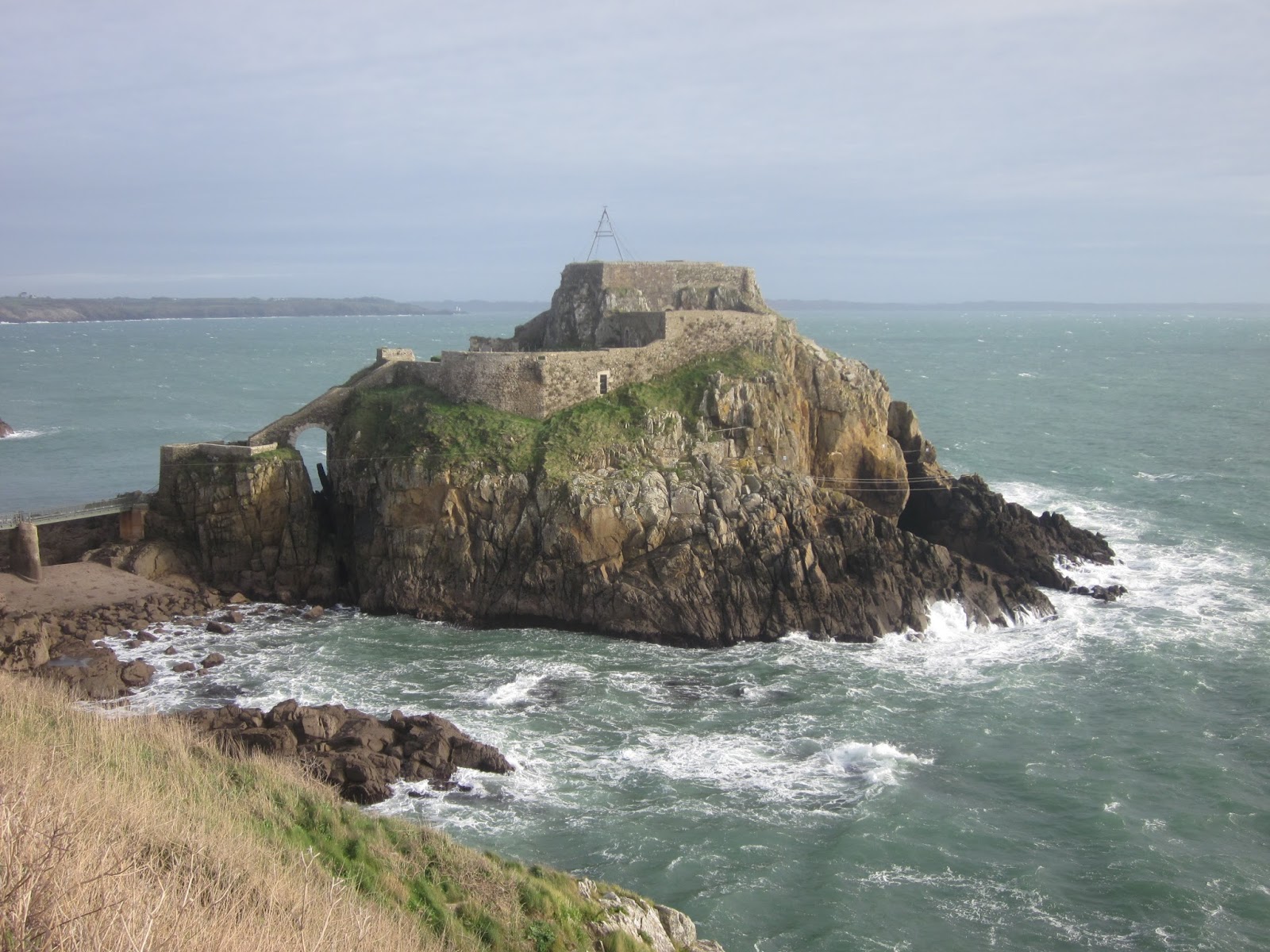
Fort de Berthaume
Finishing up the walking book routes, only just behind schedule. Now it will be a relief to sit down at my desk and finish all the texts. I ended up covering more ground than intended and more routes than will probably fit in the designated number of pages, but better too many than not enough at this stage. Very pleased to rewalk this last section, a linear route from Le Conquet to Plougonvelin. It's one of my favourites and a piece of coast I'll never tire of, even though high gusting winds on the cliffs this time made me cautious. Ended up at this magnificent fort in bright weather. Glad that my back-up was waiting with a car, but for those less fortunate and not on expenses, there's a bus back to the starting point if retracing all those kilometres is just too much to contemplate.

Tuesday, November 24, 2015

My heart lies in the forest

After recent events in Paris, one of the few memorable reactions on my Twitter feed was from a woman bewildered and feeling the cold shock of a secure hold on daily life slipping away. I cling to my land, she said. I don't know if she meant it literally or metphorically but it brings up once again the question of landscape as comfort and stability. It is the familiarity of 'one's own' physical territory that offers a sense of consistency that can be relied upon in a world that is changing alarmingly before our aging eyes. Those of us who believed our generation would at least never see another world war begin to doubt that flimsy hope, as layer upon layer of hatred, intolerance and misconception flattens and stunts the potential of  humanity.
The rate of change in landscape can be as rapid as a fallen building, or as gradual as the creeping threat of floods with climate change, but we like to feel it remote in our immediate surroundings, at the millenia speed of eroding granite.We have been startled in Brittany to discover last week that the state is to sell off some of our forests, those symbols of life before human settlement, of the longevity that spawns legends. Forests that were once noisy places of human abode and economic activity are now mostly silent and dressed in recreational attire of finger-posts and picnic tables. Is this an identity to be perpetuated for the sake of our need to believe nature is all around us and that we are still alive in some meaningful way? Do we need forests? Of course we do. I clung to my land this week with gratitude.

Tuesday, November 10, 2015

Finishing and getting started

Currently writing about this ancient bridge - Pont Krac'h
It's a strange time. My exhibition is now over, although the month flew by and I was too busy to be there often or even to think much about the outcome of all that work. Certainly my texts were well-received, and perceptively so from the messages and comments I've had from very diverse places and people. I'm grateful to everyone who bought a booklet and took the time to give me feedback.
Turning my attention (at last) to the new landscape book, I finally realised the degree of concentration it is going to need and a huge investment of time. So I made the big decision to finish with Brittany Walks, after 11 years of offering a monthly (until recently twice monthly!) programme of guided walks. I'm sure it's the right thing at the right time, but it represents a great change in my working schedule, and I'll miss the many lovely people who have supported the walks, some of them since the very beginning.
I am also coming to the end of the walking for the new Finistère walking guide which will be out next spring. Of course there remains masses of work to do on the background information, maps and page lay-out, but psychologically finishing the field work feels as if the project is almost over in terms of mental (and very physical) commitment. My mind will soon be much clearer and able to focus on the landscape essays. Whether this new book will be only in French is a big decision to be made over the winter. It will rather depend on publishers in the end and whether separate editions in the UK and France is really a viable option. I almost feel that there are two different books there. This long winter will tell.

Saturday, October 31, 2015

Best west coast walk

Chateau de Dinan
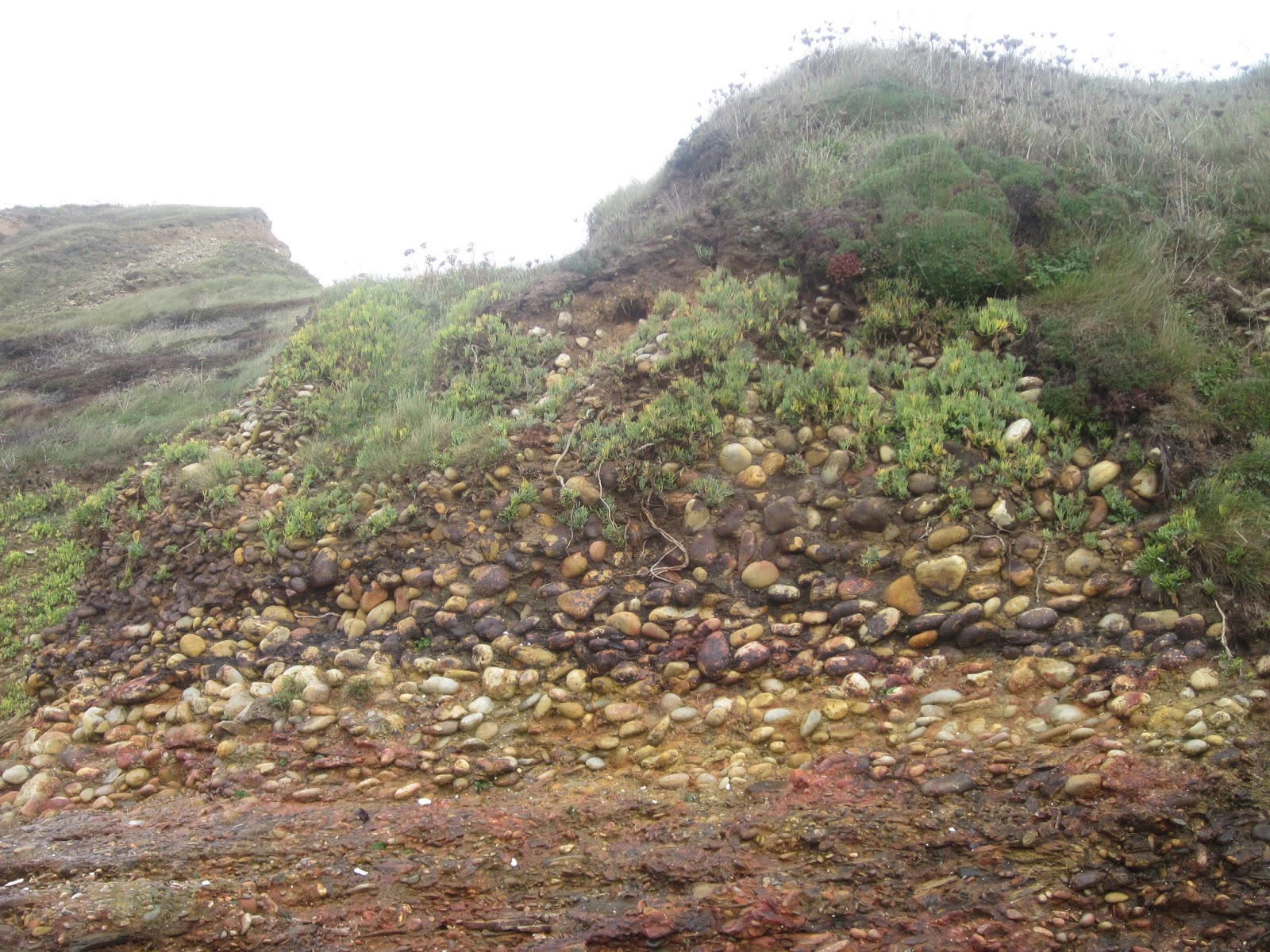
Revisited my favourite coastal route in Brittany this week. The stretch between Camaret and the Cap de la Chèvre has everything a walker could possibly want - and then some. Natural features like the so-called Chateau de Dinan, the extraordinary raised beach at Porz Koubou and other geological wonders like pillow-lavas, historical sites such as the Iron Age éperon barré at Lostmarc'h, a memorable sight below you after breasting a high ridge, looking down on the lines of defensive ditches and ramparts that once protected a small community from their enemies.
Raised beach
Other works of defence are remnants of the Mur d'Atlantique, German protection of this wild west coast, where only the most foolhardy would ever have considered any sort of landing. Surfers haunt the vast beaches here but it is too dangerous for swimming.
Lostmarc'h
The coastal path streaks through moorland - gorse, heather and low spiky thorn - down to beaches, up to yet more cliffs, the gradient sometimes decidedly steep, the proximity to the edge precarious. It's all the very best of coastal walking, seeing the paths rippling ahead across the contours, looking back on headlands conquered one by one. At the end is the reward of the Cap de la Chèvre itself, with a WII memorial to the naval air arm, granite plane-wing rising against the blue sky - for I felt not a drop of rain that day, despite black clouds menacing from time to time.

Thursday, October 22, 2015

Seeing the sea

I'm concentrating now on coastal walking for the new book. This section will include some linear suggestions for Finistère's sensational littoral, so a route of about 10km becomes a day long out and back excursion (or a lift, taxi or even bus can make it a one way walk if so desired). The point is to highlight the best bits so walkers who only have a limited time can be sure of getting a memorable journey - and best bits usually means avoiding the obvious (i.e. places easily reached by car, like the Pointe du Raz).
So today I was on Cap Sizun, revisiting some favourite sections of the coastal path and enjoying the mild sea air, softened by occasional misty rain drifting across the high cliffs, as below at Kastell Koz.
 A good day's work, even if my knees would have preferred to stay at home and watch TV.

Saturday, October 17, 2015

Village in a sacred space


I had a wonderful walk in Locronan in beautiful sunshine on Thursday. The route concentrated on the wooded countryside around this unusual village, which has a strange dual nature, the sense of artificiality spread unconvincingly over something profound. The name means the holy place of Ronan, the Breton saint of Irish origin who came to Brittany and like many others, faced opposition and antipathy. He moved around, settling finally in this sylvan paradise said to have been the location of a well-defined Celtic nemeton or ritual space, with specific points linked to movements of the heavens.
Each day he walked the boundary of this area, an action commemorated today in the annual Tromenie walk (extended to the full 12km every six years). The chapel of Penity attached to his imposing church in the village centre has the saint's tomb. Locronan sits between the Bois du Duc and the Bois du Nevet, remnants of ancient forest. Anyone following the walk (to feature in my new book) will have the sense of the numinous landscape that is the source of these legends and religious affiliations.
But the other more obvious face of the village, which has brought many film-crews (including Roman Polanski who filmed some scenes for Tess of the d'Urbervilles here) and attracts hordes of tourists throughout the year, is made up of handsome 17-18th century façades around the centre square before the church. Remarkably unspoilt, these reflect the wealth derived from sail-cloth making in the heyday of the Breton cloth trade.
Today many artists and craftsmen have their workshops here and there are plenty of bars and restaurants, making it doubly desirable for a day's outing. Not always to be relied on though: a couple of years ago I decided to come here on my birthday just before Christmas, to buy a few presents, have lunch and a walk, as the weather was unseasonably sunny and mild. Everything was closed, even the bakery, so with no possibility of food, I paid my respects to St Ronan and drove home for a cheese sandwich.