I have been around the Gulf of Morbihan on the trail of St Gildas. It's the first time of seeing the wonderful 11th century abbey church at St-Gildas-de-Rhuys since a large-scale restoration project. (You could say the original was a bit of a renovation job after the earliest abbey was destroyed by the Vikings in the early 10th century.) It certainly looks cleaner, positively glowing under the autumn sunshine.
Inside, the Romanesque apse and ambulatory are remarkable survivals, although the so-called tomb of the saint is just an unmarked lump of stone with a bland modern statue. The tombstones of Breton nobility around the walls of the nave are more substantial. This part of the church was restored after the bell-tower fell onto it in the mid 17th century.
From the coast just below the village there are views across to the islands of Houat and Hoedic. Gildas initially made landfall on Houat when arriving in Armorica, and returned there for his final years after running the new abbey on the mainland. After another day around Quiberon I was all set to get out there and see the valley setting of his former chapel, but some serious weather intervened and all boats were cancelled. Another trip then....
Saturday, October 19, 2019
Sunday, September 29, 2019
Taking stock
| Menhir de Champ Dolent, Dol-de-Bretagne |
As to the main purpose of my year, the completion of Wayfaring in Little Britain, the journey is far from finished, although I have made significant progress lately. This is the third year of trying: thwarted by serous illness for the last two, I am finding the physical demands of travel, walking and research extremely hard to cope with, but am determined to finish the manuscript by the end of the year, even though the last bit of route coverage is not scheduled until December 26th! With the encouragement of the few readers who have glimpsed the content of this elusive book, this theme of hard-won achievement has crept into the text - quite a change for me to write personally, but it perhaps it is time to be honest about the demands of walking and searching against a backdrop of pain and difficulty. Most people writing about history in the context of landscape are serious walkers covering 30-odd kilometres a day without too much trouble. That has never been the case for me, but I hope there is equal merit in a book constructed around hardship, where a day's walking for a healthier person may turn into two or even three for me on occasion and where considerably more logistical planning is needed.
| St Samson's mitre, Mont Dol |
| Start of the Devil's trajectory on Mont Dol |
Monday, September 09, 2019
Megaliths
| Alignements du Moulin |
| Le Tribunal |
What is so extraordinary about this site is the constant unfolding of remains, the accumulation of death, here, there and everywhere around the main path which forges across the open centre of the plateau. The loftiness of the location was obviously significant, and its dramatic end, abruptly above the valley of the river Canut and the Etang du Val.
| Chateau Bu |
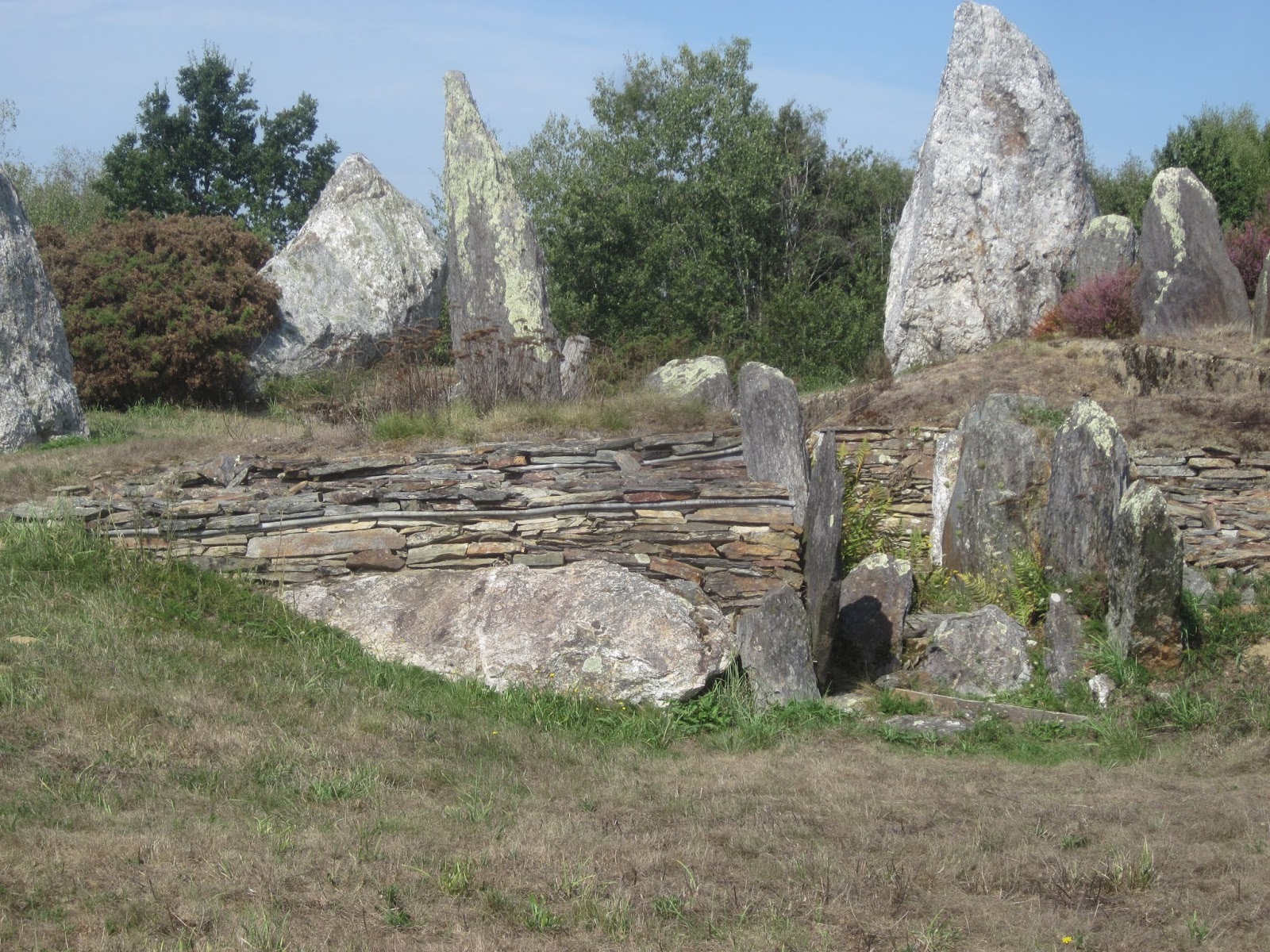
After a few days away, I made a slow journey back, stopping off to see if the megalithic site at Monteneuf in Morbihan had changed much over the years. It has, whether for the better or not is hard to say.
| Monteneuf |
Saturday, August 17, 2019
A Roman site
Yesterday I was in Locuon, looking at the Roman (and probably earlier) quarry which provided stone not only for the locality, but for the new town established at Carhaix, 27km away, in the 1st century AD. A Roman road from Vannes passed near the site, facilitating transport of stone blocks, and excavations of this track found parts had been paved in the same material. The sheer rock faces are like living walls, ferns burgeoning in the damp green light of the pits. The whole site has a subterranean feel as the trees close in overhead creating a sensation of being underneath a porous layer. Soft and crumbly to the touch, Locuon granite is a light grey/white in hue and smooth in texture, giving it almost the appearance of marble.
The approach is down a monumental staircase, thanks to the sacralisation of the site, with a chapel, Madonna in a niche on the quarry wall, fontaine and lavoir on a lower level. The current chapel is 17th century and shows off the potential of the building stone, but there were certainly earlier versions, as a line of probable roof support holes in the cliff behind indicates. This granite wall also includes a carved face and cross motif. Facing the statue of the Virgin Mary is the headless statue of a pagan goddess, fixed to the bottom of the staircase parapet.
Descending to a lower level of the quarry, a spring pours out of a sculpted surround in the rock and the water is carried via a slate enclosed channel to the washing basin. Here is the first of a group of contemporary art pieces, a rather dog-like curled wolf on a platform raised above the water. Pushing further into the dells of the quarry, there are rocks incised with criss-cross pattern and, more impressively, a 'boulder' held in the thin branches of a tree. This was actually made in situ by Yuhsin U Chang, from wool over a wooden frame.
After a lengthy site inspection, I set off for a few kilometres on the former Roman road.
Descending to a lower level of the quarry, a spring pours out of a sculpted surround in the rock and the water is carried via a slate enclosed channel to the washing basin. Here is the first of a group of contemporary art pieces, a rather dog-like curled wolf on a platform raised above the water. Pushing further into the dells of the quarry, there are rocks incised with criss-cross pattern and, more impressively, a 'boulder' held in the thin branches of a tree. This was actually made in situ by Yuhsin U Chang, from wool over a wooden frame.
After a lengthy site inspection, I set off for a few kilometres on the former Roman road.
Wednesday, August 14, 2019
Saints
| St Thélo |
A few walking trips coming up for Roman and megalithic chapters of WILB. Time to get out of my writing hut and onto the road...
Monday, July 22, 2019
Worth its weight in gold
![]() |
| Artichoke harvest |
The legend of Saint Goulven is at the heart of this idea of fecundity and its concomitant prosperity. His mother was about to give birth to him as soon as they arrived on the coast of Armorica, near where the bourg of Goulven is today. His father went on a desperate search for water, finally falling to his knees and praying for God's help. On returning to his wife, he found a newly born son and a newly flowing spring of freshwater. The land in Brittany provides. The elaborate Renaissance fontaine of St Goulven now marks the spot. Pilgrims later came for healing, particularly of fever. A stone sarcophagus in the wall by the statue is called the bed or tomb of the saint. Here sufferers immersed themselves and prayed for cures.
| Sarcophagus in lefthand wall |
Although much later a bishop of Léon, Goulven was a quiet and serious young man, who soon dedicated himself to prayer and preaching. He lived apart from society with a single follower. One day he had the impulse to send his friend Maden to a neighbour asking for a gift. After a short reflection, the neighbour hefted a clod of earth into the fold of Maden's tunic and sent him back. Maden found his load heavier and heavier as he struggled to return. Goulven came out of his hut to meet him and discovered that the earth had turned into a lump of gold. So we learn that the riches of Léon lie in its soil, and that Goulven was worthy of a miracle and destined for sainthood.
| Earth turned to gold |
Labels:
Breton saints,
brittany,
Finistere,
Goulven,
Léon,
Saint Goulven
Thursday, July 11, 2019
Sacred walking - the Grande Tromenie
![]() |
| Tomb of Saint Ronan |
| Countryside around Locronan, context of the trail |
![]() |
| Keben uses a washing paddle to de-horn the ox |
One notable feature is Gazeg vaen, a rock also known as the Chair of Ronan, where the saint is said to have sat and looked out over the waters of the bay (no longer visible from the spot). The stone is the survivor of a megalithic group, and has been (for how long?) the focus of a fertility ritual for women, who lay full length or rubbed their belly against the surface to increase their chances of conceiving a child.
| Postcard of woman sitting on the "chaise de Ronan" |
| The rock today |
Sunday, June 23, 2019
Morlaix's unique style
![]() |
| 9 Grand'Rue |
Most interesting of all is the raison d'etre of these exceptional buildings. They were the fine residences of nobles turned merchants, officially surrendering the swords that symbolised their status in order to cash in on the highly lucrative cloth trade with England. The quality fabric créées was purchased in the shop-fronts of these Morlaix houses (with a fold-down counter on ground level) and shipped from the river port 200m away. Often younger sons of the Breton petite noblesse had few prospects in terms of family inheritance and stood to make fortunes in commerce, but they still wanted the trappings of the manor houses in the narrow confines of a medieval town - hence the narrow frontage and great height of these splendid residences, and the quality of craftsmanship in their construction and decoration.
Two of these houses can be visited today. The so-called House of the Duchess Anne in the market square Place Allende and 9 Grand'Rue. The latter would be my choice as more atmospheric and clearly presented. Just the thing for getting in the spirit of the town and imagining that attack in 1522. A maid in this very street had the measure of the English: she opened a trap-door in the hall and the first few pillagers fell into the cellar and drowned. Their less stupid comrades chased the maid up and up the stairs until she was forced to throw herself from the top window. That piece of anecdotal history takes on quite another dimension when mounting the levels of this maison pondalez.
![]() |
| So-called Maison de la Duchesse Anne |
Thursday, June 06, 2019
'New' website
| Combourg - chateau and park |
My website www.wendymewes.com has had a complete overhaul and now features recent and other work. It will be updated regularly with new writing. Please have a look - non-spam flavoured feedback is welcome.
Tuesday, June 04, 2019
Ile St Gildas
| Ile St Gildas |
I set off before the official start time, leaving crowds gathered on the shore to await tractor transport or to walk along with the horses on their way to a bishop's blessing on the island. Even so there was already a long line of men, women and children picking a precarious route across the strand. Footwear varied from wellingtons and walking boots to open sandals and bare feet. Many old hands carried a shoe-bag with a change for arrival. It was certainly a dirty business and required a degree of concentration that left little time for observing the off-shore scenery. Fortunately the intense heat of Saturday had evaporated and the breeze was fresh once away from the shore and walking where there would normally be sea. One wide channel remained and I waded across up to my knees through the gentle current.
Behind in the distance I could make out the main body of participants on the move. The first horses, a fine pair of chestnut mares, passed me shortly before I reached the causeway up onto the island. Paddocks and paths had been newly mown for the occasion, scenting the air with the summery smell of cut grass. There were already many there but I had the chance to visit the tiny chapel of St Gildas and even smaller oratory of St Roch in their stone enclosure before the crowds arrived. A makeshift altar was set in the open air under a white canopy and lines of chairs awaited the pilgrims for mass.
While they filled up, I wandered about watching the horses, now lining a large fenced area beside the food and drink stalls, and locating the eccentric toilets in a former bread-oven.
After mass the bishop of St Brieuc and Tréguier and his acolytes processed the short distance to the paddock, mounted a special platform and blessed baskets of bread which he then fed to each horse to ensure its good health and good behaviour during the coming year.
There were 75 animals,so I decided to set off back whilst the route was fairly clear and enjoy the journey which was my (work) purpose in coming, able to take it slower on return. There was about an hour left before the tide began to fill the channel, but I met an elderly Breton woman with bright blue eyes and bright yellow wellingtons, making her slow way to the island. She said she was afraid of slipping, but clearly determined to reach the site even though the ceremonies were almost over and tractors lining up to bring the faithful home. Gradually fading snatches of canticles accompanied me on my return.
Monday, May 20, 2019
The Pardon of St Yves
I spent the weekend in Tréguier, a favourite haunt, but for the first time to attend the great Pardon of St Yves. Yves Hélory (1253-1303) was an ecclesiastical advocate and extraordinary defender of the poor, well-known all over the Trégor in his day and considerably further afield following his canonisation in 1347. He is the patron saint of Brittany and his special day attracts thousands for a procession between the cathedral in Tréguier and the chapel in Minihy-Tréguier, his birthplace and home. The relic of his skull is carried by lawyer and priests along the 1.5km route and back.
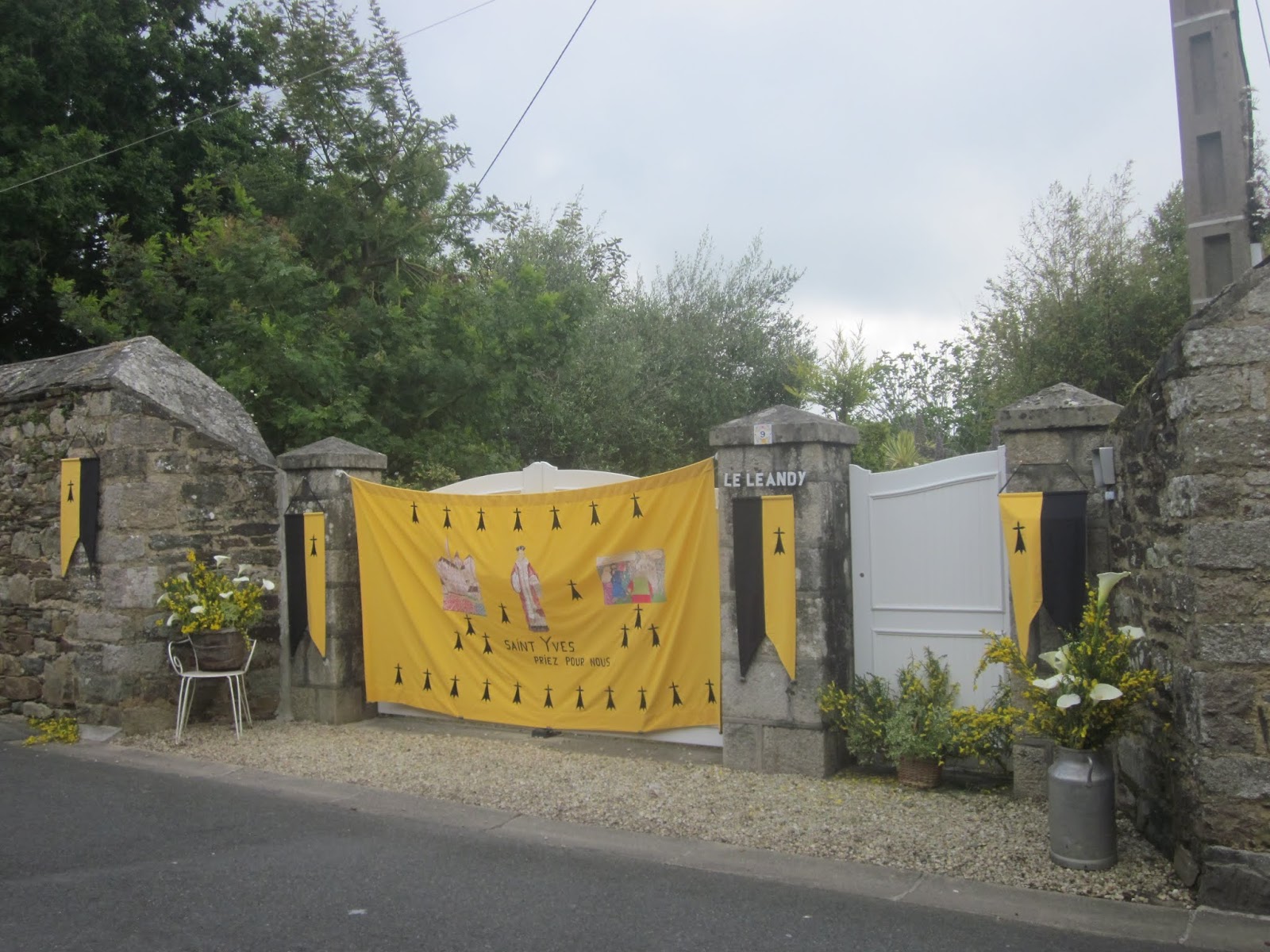
The town is all dressed up for the event with his family's yellow and black flag (thanks to a crusader grandfather) displayed everywhere together with sheaves of yellow broom and hundreds of lily flowers studded into hedges along the way.
I attend the mass in Breton at Minihy, for a while in the back of the chapel and then outside in the cemetery, still singing along from the hymn sheet (Breton is easy to follow and generally pronounced as it looks), and watching pilgrims turn up now and then to crawl under the 'tomb' of the saint, an ornate stone table. The best sensations of the occasion - in the simple and emotional faith of St Yves - are most felt here without the great numbers thronging around the cathedral in Tréguier, where the service in French is also taking place.
Walking into the town along the processional way in reverse - Chemin de St Yves, rue de St Yves - I have time for a leisurely coffee while crowds gather to witness the spectacle. Suddenly I realise that just seeing a bunch of lawyers coming out of the south door with their proud burden is not what I want to see most, and it will be hard to do so or to take photos in the scrum of curious onlookers and the faithful following the parade.
I retrace my steps all the way back to Minihy, where a few are waiting at the point by a wayside stone cross where the main ritual of the procession occurs, on a ninety-degree turn down to the chapel.
After a short wait I hear singing floating up from the village - canticles of St Yves are repeated over and over during all the ceremonies - and the procession from Minihy with its three ancient banners arrives to await the cortege coming from Tréguier. The priests take up a position facing along the road towards the cathedral.
The crowd grows and seeking a place with a good view and the sun behind me, I'm forced to get up on a very narrow bank where three older people are sitting with their legs dangling. It requires considerable muscle and foot strain to keep perched up there for more than half an hour of anticipation. Finally the first figures appear and a Breton pipe band leads the way, passing in front of the cross and down into Minihy. Behind it an astonishing spectacle, wave on wave of banners and ceremonial crosses stretching as far as I can see.
The ritual of encounter begins as Minihy's tall metal cross is lowered and raised in a nod to various passing crosses from other parishes, which also dip so that the two metal faces almost kiss as they skim by one another. It is nearly forty minutes before the skull appears in the distance, a priest in front flanked by lawyers bearing the weight of the reliquary on their shoulders. They stop a little way away. The rest of procession has passed. We all wait. Finally the Minihy banner-carriers move forward and the skull is brought to face them. Up and down the banners go - what body strength it must take - high in the air then dropping towards the ground, saluting their saint as he arrives home in his own parish. This is the climax of the Pardon, the relic visiting its most profound site of connection. After passing through the village, the procession will return to Tréguier.
This is an old ritual, and of more significance that touches me than is usually the case in official ceremonies. The depth of relationship with place is something I understand. Indeed I am currently writing about St Yves and his paths in the Trégor. Almost every day, despite travelling far and wide in his duties as a priest elsewhere and preacher everywhere, Yves Hélory walked back home to the little family manor house where he tended the old and sick and saw that all their needs were provided for. Thirty or forty kilometres was nothing to him in search of home and belonging. The Pardon, despite all the trappings and pompous lawyers, both of which the saint himself would have deplored, still manages to symbolise this simple truth.
The town is all dressed up for the event with his family's yellow and black flag (thanks to a crusader grandfather) displayed everywhere together with sheaves of yellow broom and hundreds of lily flowers studded into hedges along the way.
I attend the mass in Breton at Minihy, for a while in the back of the chapel and then outside in the cemetery, still singing along from the hymn sheet (Breton is easy to follow and generally pronounced as it looks), and watching pilgrims turn up now and then to crawl under the 'tomb' of the saint, an ornate stone table. The best sensations of the occasion - in the simple and emotional faith of St Yves - are most felt here without the great numbers thronging around the cathedral in Tréguier, where the service in French is also taking place.
Walking into the town along the processional way in reverse - Chemin de St Yves, rue de St Yves - I have time for a leisurely coffee while crowds gather to witness the spectacle. Suddenly I realise that just seeing a bunch of lawyers coming out of the south door with their proud burden is not what I want to see most, and it will be hard to do so or to take photos in the scrum of curious onlookers and the faithful following the parade.
I retrace my steps all the way back to Minihy, where a few are waiting at the point by a wayside stone cross where the main ritual of the procession occurs, on a ninety-degree turn down to the chapel.
The crowd grows and seeking a place with a good view and the sun behind me, I'm forced to get up on a very narrow bank where three older people are sitting with their legs dangling. It requires considerable muscle and foot strain to keep perched up there for more than half an hour of anticipation. Finally the first figures appear and a Breton pipe band leads the way, passing in front of the cross and down into Minihy. Behind it an astonishing spectacle, wave on wave of banners and ceremonial crosses stretching as far as I can see.
This is an old ritual, and of more significance that touches me than is usually the case in official ceremonies. The depth of relationship with place is something I understand. Indeed I am currently writing about St Yves and his paths in the Trégor. Almost every day, despite travelling far and wide in his duties as a priest elsewhere and preacher everywhere, Yves Hélory walked back home to the little family manor house where he tended the old and sick and saw that all their needs were provided for. Thirty or forty kilometres was nothing to him in search of home and belonging. The Pardon, despite all the trappings and pompous lawyers, both of which the saint himself would have deplored, still manages to symbolise this simple truth.
Sunday, May 12, 2019
Text 7: Musings of a Patron Saint
I am the saint. This is my
church.
I stand over the porch, I
stand next to the altar,
Sometimes a place on the
calvary.
You can see me on my stag,
with my wolf,
Beside my dog, along with
a horse or cow.
I prefer animals. They
obey me.
I am honoured with
altarpieces, telling my story,
Through offerings and
prayers, a relic, a tomb.
Honoured by banners and
processions:
On my holy day, the Pardon
winds its way.
Not always so easy being a
saint.
All those demands and quarrels
and envy:
I would prefer the quiet
peace of a lonely spot,
But destiny says otherwise.
I have a mission: it is
quite an exalted position.
Special powers make me a
magician,
Using my staff for a wand.
I could strike a spring
from the earth
Drive dragons to suicide,
I could cure shingles,
blindness and burns.
Make children walk or form
in the womb,
Bring rain to crops,
Call up the wind or pat it
down
To save ships in a storm.
At my best, I was most
effective.
People spoke fervently to
me once,
A saint who was here and did
stuff of note,
Rather than God, too busy
or remote.
Now not so much.
No longer the draw, the
object of hope,
I live in the past, and to
be honest I’m bored,
It’s an unsettling slope,
From adored to ignored.
2019 ©Wendy Mewes
Thursday, April 18, 2019
Exhibition of texts on Parish Closes
| Guimiliau |
EXHIBITION April 29- May 17 at SUR LA ROUTE, Huelgoat
Opening event: May 4, 3pm
I am exhibiting creative texts - together with photos by Candy Blackham
- on the theme of the Parish Closes in northern Finistere. These extraordinary
religious ensembles renowned for their architecture and art deserve to be
better known. They are also revealing of the particular social and economic
history of the region.
Extract from Text 4: Ossuary - Bone House
end flakes
darling dust
not so
continuous
stone speaks
the dead words
memento mori
talking of bones
Extract from Text 5: Calvary – a tiered response
And
those women: Mary sweetly holds her baby’s foot as they flee. Magdalena grieves
at the base of the cross. Mary Stuart’s hat is there. Veronica and the hologram
handkerchief. Those are the good roles, mothers and mourners. Not like Katell
Gollet, dragged down to hell for liking a drink and a dance. Watch out, girls.
Extract from Text 10: Bits
about Bits
Enclosure: determining wall, shaping
the truth. Keeps faith in and the ungodly out, likewise dogs, chickens and
pigs. Pagans manage to squeeze through.
Defining space and temptation, ritual containment. Descendant of cairns and
alignments.
Extract from Text 12: Faith
is
FAITH is glue, sticking together.
FAITH is an almost forever.
FAITH is illusion, but one bright and gilded.
FAITH is for the weak and deluded.
FAITH is trust in bones and blood.
FAITH is no protection from flood.
| Sizun |
Look forward to seeing friends and followers at some point during the course of the exhibition.
Subscribe to:
Posts (Atom)