Monday, May 11, 2020

Coming very soon...

There have been some delays, not surprisingly with current working conditions, at the printing stage, but the book should soon be ready. News about launch also in the pipeline. Thanks to all those who've enquired about this. I know that the many lovely British and French fans of Spirit of Place kind enough to want to continue following my work have had a long three year wait, but it's nearly over now. At the very least I hope people will enjoy the 'triumph over adversity' aspect that accounts for the long delay in finishing this book. I can still hardly believe I made it to the end.

Tuesday, April 28, 2020

Nantes-Brest Canal guide - 4th edition

Very pleased to announce that the 4th edition of my Nantes-Brest Canal guide is available now. There will also be a new French edition for the first time on release shortly. The enduring popularity of this guide shows how important the canal is as a leisure resource, although the balance between walking and cycling has definitely swung towards the latter. It always saddens me to see cyclists whizzing along to make their daily kilometre target and not noticing all kinds of wildlife and natural treats along the way. The guide includes all the accommodation information needed to plan a trip, as well as showing restaurants and cafés or where provisions can be purchased within easy reach of the towpath. All this has been checked and updated for this new version and the route itself verified on the ground.
Every inch of the towpath is carefully mapped, with detail of locks and crossing points, direction of flow and distances. Places of interest on and around the canal are given on the relevant pages and there is a long introduction describing the origins and development of this extraordinary engineering feat. We have Napoleon to thank for the go-head for this incredibly expensive and labour-intensive project, with work carried out in fits and starts over twenty-odd years from 1806. The heyday of the canal was in the last years of the 19th century and first decade of the 20th. Burgeoning railways and, after WWI, lorry transport were invincible rivals for this slow form of transport and decline was long and sad, although a few barges operated right up until 1977 when the last load of sand was deposited at Saint-Congard in Morbihan.
Many people do not realise that that the vast majority of the 365km length of the canal consists of beautiful, wide, windy, free-flowing river with few locks, and it is only the connecting sections between river valleys that are the straight narrower channels often associated with the word 'canal'. There is nothing monotonous about a walk or ride across the very diverse territory from Loire-Atlantique to Finistere. The introduction to this guide gives an idea of the changing landscape and atmosphere right across historic Brittany. Better note before planning a trip that the canal actually starts just over 20km north of Nantes and ends nowhere near Brest....

Thursday, April 16, 2020

Simple things will save us


A walking meditation: this little route gives me hope

I start at the bridge, watching the water, thinking of now and all it is. Yellow is the colour, the colour of sickliness and fear, but here bright in granitic sand lining the stream bed, the gleam of mallows in the April sun. First thought: clarity and flow. Quick movements of nature while we slow down, a reminder of true rhythm.
The first path is through a small wood. I move into green. How this colour flows differently into the leaves of spring, the freshness of new beech spurts, the acid of moss, the deep vibrance of new grasses. Still the darkness of winter in holly and ivy. I have lost my closest person to the coronavirus, my grief is still green and new. It can only grow.

At the top of the path, I choose the right fork into the tiniest of valleys, down steeply in shade to a minute trickle of water, up steeply into dappled light. My knees feel the gradient, adding to the stiff joints of mourning. This small interlude is of everyday and the mundane, a beaten earth path, the basic ups and downs of life moving us between beauty and disappoinment, between heartache and love, these necessary intervals of heightened emotion and extra demands. My heart beats faster on the up. Breath is another sort of up and down. We are forced to relook our now.
Now the way is very narrow between banks. I think of confinement, a negative connotation, and then of boundaries, not so bad. Here the path divides a field just ploughed and a tangle of wild scrub. The tame and untamed, the contrasts of lockdown where we long for mad outstepping, and the needs of growing food through disciplined work and management of time. Both are essentials in their way. The making of land calls it. I long for the uncontrolled, but my need for rage is gently diminished, as I tread through.
At the end, I stop. A beautiful oak is getting ready to bloom, on a gilded spread of celandines. The next throw of the path is obscured around a sharp bend. This is a pause before new knowledge. My grief is soft and settling in the stillness. Things are happening quietly around and within. A bird reminds me of melody. An encouragement of song, that stirs my tired heart. Half life is on fire, the other half is burnt and gone.
Around the corner, the sense of more up is daunting. We imagine sunken ways downwards. I have the sensation that I have shrunken within these banks. Trees are huge sometimes. But I feel escorted, a ribbon of bluebells at my ankles. There is always path as long as we can walk. Here I am just the little brown thing waiting to green.
Second pause. Everything so far has been immediate. From this point suddenly I can glimpse across the valley the houses at the top of town, and my mind surges out. What is yellow and green in the world right now, what are the boundaries to be faced, the vistas cut off, the friendly access denied? If compassion were contagious. Any path can lead anywhere because our minds are beyond restriction.
Back to now and here. Ahead is a tunnel of foliage stretching uphill to where it will end at a little road, and just before that the rock that is my marker, my goal. I am feeling the rock from a distance through a fug of horse smell and the wasted effort of recently severed tree trunks. The rock is still, waiting for me. I can finish with the touch of a friend.
Meditation is over. I turn back, and at once the dog runs up for his treat, part of it all again.

Sunday, March 29, 2020

Two weeks in lockdown

Day 9
Here in rural Brittany people are calm and daily life is orderly, with no shortages or panic buying, and most people observing a distance from others. The lake path and waterside parks have been forbidden to all of us trying to exercise and walk our dogs. There has been no edict issued about the forest, and as I live on the edge, I have made short excursions out and back, keeping to the regulations of remaining within one kilometre of home. A few days ago I was stopped by the police a few metres from my house and asked to produce the form of attestation. I only had the old one and with the wrong date, but was let off with a warning to print out a new form every day. Honestly and surprisingly, I don't enjoy the dog-walk, feeling it a daily pressure and stress without solidly clear guidance of where one can go.
Mentally I am starting to struggle a little. Unable to concentrate well and lacking any urgent current project, it is hard to structure the day and I fritter away time, unsettled and frustrated with myself. So far I have baked a lot and watched the 1967 version of the Forsyte Saga. I do some basic stretching exercises and a short Tai Chi routine every day but my body feels torpid and full of aching joints. My arthritic hand is much worse and gives constant pain, making writing difficult, even if I could muster the concentration. The easy flow of creativity has completely departed from my life under these conditions.
Day 13
I have made a cogent effort to use my time better, at least to complete a few basic tasks every day and then not worry if nothing else is achieved. I've expanded Tai Chi and bodywork meditations to an hour and devoted the same amount of time to my new novel, so it grows at least by a few paragraphs a day. My spiritual practice remains strong since my retreat last month, which was in fact good training for the current situation. This moderate level of activity is enough for me, but the steady routine has actually made me much less anxious and more able to get things done generally. I need medication soon and am hesitating between asking someone younger and fitter than me to get it or go myself. I have not set foot in the town or any shop since this started and feel reluctant to cross that line and take the risk. My immunity is low and keeping away from people seems an imperative. On the other hand, I obviously don't want anyone else to suffer on my account. On dog walks I rarely see another person and no-one at close quarters. The healing hush of the forest is powerful at a time like this, when atmosphere is heightened by our fears and sensitivity to the unusual flow of energy that prevails in this strange suspended framework of changed life.

Wednesday, March 18, 2020

Bretons: Vefa de Saint-Pierre

This extraordinary woman was born in 1872 in the Goëlo region of Brittany, although she is most closely associated with Spezet and the Montagnes Noires in Finistère for her later activities.
As a child she wanted to dress like a boy and harboured ambitions of running away to sea. Hunting was a real passion from an early age and throughout her life, guns were never far away.
At 18 she joined a nunnery, perhaps a surprising choice for one of such decidedly strong and individual character, but it did mean she got to go on her first significant journey, a mission to the Equator in 1899. This fuelled the thirst for long-distance travel which was to be another theme of her life, with a visit to America and Canada in 1906. By this time she had left the religious order definitively without taking orders or being thought suitable to take them by her superiors. She met President Roosevelt and spent a lot of time delightedly hunting caribou.
Back in Brittany in 1908 she bought the Manoir de Menez Kamm near Spézet which was to be her beloved home for many years. It was situated in prime hunting territory and she was soon well-known for fearless pursuit of the local wild boar. She learnt Breton and became an ardent (and militant) advocate of Breton history and culture, hoping for the kind of revolution in Brittany that Ireland had seen. She gave money and moral support to many Breton nationalist projects and local organisations, and was closely involved with Gorsedd bardic community. In 1930 she was given the bardic name Brug ar Menez Du (Heather of the Black Mountain).
She had a very lively intelligence, bent on constant learning throughout her life, whether languages, geography, natural sciences or theology, remaining a devout and committed Catholic. She also wrote poetry, although always very modest about her talents. A round-the-world trip in the 1920s gave her the chance to write about her travels and encounters for magazines and papers, as she visited Australia for an international Christian conference.
After the war, her beloved home was used as a centre of Breton culture, as she provided free bed and board for many writers and musicians. As old age loomed, she herself was increasingly based in Saint-Brieuc, until her death there in 1967. Claire Arlaux's engrossing biography tells the whole story of an exceptional and remarkable figure in 20th century Breton history, giving a new perspective on pre-war nationalism and subsequent cultural development.


Saturday, February 29, 2020

On the other side of silence

I have just finished a five-day silent 'retreat', staying at home and only walking where I knew I'd see no-one. Neighbours were primed to ignore me if necessary, but in fact I saw no-one for the duration. My purpose was to explore the thing itself, to think through a few issues, to renew my spiritual practice with meditation and study, and to relax deeply. The only concern was my very loving dog who is used to constant verbal communication with me and who is highly vocal himself. On a few occasions when he seemed really perturbed or frustrated by the silence, I whispered in his ear. Otherwise he soon responded swiftly to a single hand-clap or whistle. In the house I maintained silence - no radio, TV, internet or music. There was plenty of weather to listen to as it turned out, and I walked through storms on the moors and in the forests, finishing yesterday with a meditation in the pouring rain at my favourite personal outdoor space, on the rocks beside a turbulent river.
On the first day, my energies and thoughts were a bit scattered as I broke customary patterns of computer use, using the time to make notes on the first question on my list for consideration, about one aspect of my life that needs decisions. I also revisited my personal values list and thought carefully about their relevance to the choices I must make. On my two walks I kept very much in the moment - no emails to think about or anticipate - and struck up acquaintance with two trees of powerful character that I have passed a hundred times before without looking or listening attentively. This was something precious in the way of connection that repeated as the week went on.
I also read a lot - Greek myths, a book on extending paganism beyond the superficial - meditated and used various methods of divination on the question of the day. I was very tired at the end of this first day, but had concentrated throughout almost effortlessly, as all distraction was off the table.
Too much happened to detail each day of the 'retreat' and some of it was far too intimate and extraordinary to write on a public blog, but moments of spiritual intensity and meaningful communication were not lacking. I read a powerful book about ritual and an academic history of paganism. I wrote the preface of my new novel and conceived an ambitious new writing project that would change the whole focus of my work if it turns out well. I made a couple of decisions that have been difficult to resolve in recent months and felt all my thinking clear and sharp from the second day. Some personal issues simply resolved themselves in the course of the week without special attention.
There was no problem whatsoever with the silence, no desire to break it or to communicate with any of my human connections. I slept long hours and by the last day my body was just about catching up with everything and relaxing in the space and silence that filled the house in a resounding way. I recommend the practice to anyone seeking clarity or peaceful development and would love to hear the experiences of others.

Saturday, February 08, 2020

Bretons: Theophile-Malo Corret de la Tour d'Auvergne

Starting this series of articles on interesting and not so well-known figures in Breton history with a soldier and scholar, who has left at least one important legacy in assigning the names dolmen and menhir to megalithic structures. Along with his friend Jacques Le Brigant, he was one of the first to be called a  'celtomane', reflecting passionate zeal for all things Celtic, a phenomenon which grew from the late 18th century until a peak a hundred years later. Amateur archaeologists and researchers of this persuasion were especially concerned with the excavation of neolithic monuments, which were thought - by almost all - to be the products of the Celts and Druidic religion.
His life (1743-1800) is celebrated in Carhaix, his birth-place (unless it was nearby St Hernin), with a statue in his eponymous square. The tribute portrays scenes from his astonishing military career, where he was highly respected by his men and regarded as having a charmed life. But he was also an accomplished scholar, and rarely seen even on campaign without a book.
Théophile-Malo Corret grew up in the Chateau de Kergoat and was educated at the college of Quimper before joining the Mousquetaires du Roi. Later serving the Régiment d'Angoumois, he went on to fight in Spain against the English. In 1777 he added De la Tour d'Auvergne to his name after discovering a link with this famous noble family. He was unusual in refusing promotions and honours, such as the rank of colonel, and only accepting to be a captain in the grenadiers in 1792, when he fought in the Republican army after the French revolution.
His only surviving major work is the Origines Gauloises, published in 1792, which sets the Celts and the Breton language at the beginning of European civilisation. He formalised the use of menhir (or long stone in Breton) for a standing-stone (although peulven or upright stone is equally known in Brittany) and dolmen or stone table for a tomb. This refers to the basic structure of two uprights and a capstone of the simplest form, resembling a table in outline.
Musée de la Révolution française

After seeing service in the Savoy region and the Pyrenées, he intended spending his retirement in Carhaix but was captured by the English navy off Brest in 1794 and forced to spend several years in a pontoon prison ship on the south coast of England. During this period of captivity and subsequent residence in Paris, he worked on the ambitious project of producing a dictionary comparing 42 languages. This was never completed.
In 1797, after failing to use his influence to save Le Brigant's only son from military call-up, La Tour d'Auvergne  decided to volunteer in his place, and at the age of 54 was back in arms. In April 1800 Napoleon gave him the title Premier Grenadier de la République for acts of great bravery, but he was to die only two months later on the battlefield at Oberhausen in Bavaria. He is buried in the Pantheon.


Wednesday, January 22, 2020

Ile de Houat

Port St Gildas and the ferry
Finally made it to this little island today on my fourth attempt, after three boats cancelled because of bad weather. I was beginning to think it would never happen - at least in time to finish my book for deadline. This was the first landing place of St Gildas in the 6th century and later his retirement home after an illustrious foundation of the abbey which exists in more recent form at what is now St-Gildas-du-Rhuys on the mainland opposite. I needed this trip to complete my writing on the saint's wayfaring in my new book, a chapter also covering another island off the north coast of Brittany.
Today was beautifully clear and sunny, but the wind was cruel and made what should have been a great day's walking into a bit of an ordeal.
St Gildas on his death-bed
Direct reference to St Gildas is in the name of the port itself, a sacred spring on one of the many wonderful beaches and the church. This contains a large 19th century painting of the death of the saint, showing the devotions of his monks. There are also two statues of the saint, a ceremonial banner and the words of his canticles. I am a week too early for his special day. The fontaine has no statue and looks sadly neglected, with a dribble of water from the cliff finding its way out through supporting platform. It is also completely unsigned and not particularly easy to find without effort.
Sacred spring of St Gildas
That said, the tiny bourg is attractive, despite everything being firmly shut on this January day and no-one about. I was the only outsider on the boat over from Quiberon, the other fifteen or so being welcomed by family on arrival or carrying large cool boxes for some kind of shell-fish activity. On the return journey huge whole fish were stacked in iced crates on the passenger deck.
The scenery of the island is magnificent, with a coastal path of 17 km in entirety and no constructions outside the one village - with the exception of three forts from the 19th century, one at each end and one on the highest point of the island.
Mairie
Fort, now offering accommodation
I shall explore some of the interesting history of the island in my book and definitely return for more of the wild beauty of the landscape on another trip outside the winter months. It is only a 40 minute run on the ferry from Quiberon - weather permitting.

Tuesday, December 31, 2019

Walking the wild coast

On Boxing Day I took my last trip for the new book, a walk down the wild coast of the Quiberon peninsula. Thin wintry sun alternated with grey skies, high winds lashed constantly, hard to stand against at times, and whipped the sea into a foaming, surging mass in the small bays. The cliffs are of modest height, which enhances a sense of engagement with the watery assault, as spume flies high over the rocks and little snowballs of foam splatter all around.
The pinchpoint of the promontory is only 22m wide, enough to carry the main road and a railway that joined Quiberon to Auray from the 1880s. Until the 11th century the Presqu'ile was a real island, but widespread deforestation led to the sanding up of a narrow spit or tombolo to join the mainland. The landmark Fort de Penthiévre was built in the mid 18th century after English raids on Quiberon, but it played a better known role in the disaster of 1795, when briefly held by royalist emigrées who had landed near Carnac but then been forced back onto the peninsula by the Republican army.
From the little fishing village of Portivy, I cross the Plage du Fozo and then fight the wind up onto Beg en Aod, an Iron Age eperon barré possibly attacked by Caesar before his naval victory over the Vénètes in 56BC. The next headland, Pointe de Percho is dominated by the ruins of a corps de garde. This coast is all about attack and defence, in both natural and human history. Contrasts are everywhere: the famous arch of Port Blanc, eroded by wind and water, stands near a pair of neolithic graves dramatically poised by the hand of man on the cliff-edge.
Further down the coast a stele commemorates the sad fate of two members of the rescue squad who tried to save a reckless photographer who had been swept into the sea. Michel Ponin and André Robet lost their lives, whilst the object of their sacrifice survived. This afternoon I see quite a few idiots posing for selfies on the very edge of the cliffs above turbulent waters. They probably go home exhilarated, whilst I stagger on down towards Quiberon through a succession of fine megaliths, weary and bleary eyed under the unhelpful slaps of that relentless wind...
But I've done it. What I set out to achieve in 2019 is accomplished. I've completed a demanding schedule of research trips. Held tight to desk work when my health prevented travel. Finished the first draft of the manuscript before the end of December 31st. All is well. Happy New Year everyone.


Sunday, December 29, 2019

Manoir des Indes

Manoir des Indes
The spirit of adventure and exploration is strong in Breton history, where the sea is an almost maternal element for so many. From Chateaubriand's North American adventures to the discovery of islands in the south Indian Ocean by Kerguelen, the global imprint of Breton individuality on the map of Imperial France is still a source of celebration in contemporary Brittany.
I spent a night to celebrate my birthday this Christmas at the 4* Manoir des Indes, set in a large park, beside Quimper's western ring-road. This manor house was built by René Madec, a son of Quimper from lowly origins, who joined the navy at the age of 11 and later arrived in India on a boat of the Compagnie des Indes. He fought the English under the command of Dupleix (who is also honoured in Quimper, giving his name to one of the quays). Through mercenary activity in the many wars in India, Madec rose to the status of nabob and a fabulous fortune in his own right. He was at the siege of Pondichery in 1778 with 6000 men.
Returning to Brittany the following year, Madec was ennobled by Louis XV. The town house where he settled in Quimper is marked today by a plaque from the local pottery showing him in full Indian dress, and he was a familiar sight on horseback along the banks of the Odet. He also bought up land on the outskirts of the town in Pluguffan and Penhars, building the lavish house now converted into a hotel on the site of a former manoir, whose chapel can still be seen.
rue René Madec, Quimper
At the hotel the theme of oriental luxury is pursued in furniture and decor, with the rooms given names evocative of maritime adventure. Mine (Kerguelen) had an enormous low wooden bed, a rugged A-frame and the sliding bathroom door echoed the screen partitions of warmer climes. The bedrooms are accessed off an open landing surrounding the glass-roofed atrium where breakfast - of exceptional quality - is served. In the basement a spa has been created, with treatment rooms, a sauna and, of most interest to me, the beautiful pool/jacuzzi, under the old stone arches of the original cellars.
Cellar pool
The story of René Madec's rise to greatness is told in a booklet in each room. On his final return to Quimper, he did not live long to enjoy all his acquired wealth with his young wife, dying in 1784 after injuries sustained by a fall from his horse. I cannot fault the hotel (except that I personally prefer a Relais du Silence to dispense with piped music), but the addition here of historical pedigree and local colour made it an exceptional stay; one I intend to repeat.

Sunday, December 22, 2019

Solstice

Solstice greetings to all my readers and best wishes for 2020. I was at Mardoul very early this morning to find the Elez in greater flood than I've ever seen: all paths and bridges inaccessible. I left home under the moon and stars, saw the light come up over the dashing water, stood through a rainstorm and drove home with the sun. It was wonderful, a time of real reflection on the turning of the year and great hopes for all the new things coming in the next one. I have achieved all I set out to do in the good but tough passage of 2019: now is the time for change, a call I feel strongly in mind, body and heart. Looking forward to it and sending positive thoughts and thanks to everyone.

Saturday, December 07, 2019

Wayfaring update

Really pushing myself to finish the draft of Wayfaring in Little Britain before the end of the year. I have one more field trip around Christmas and then a scramble to write up the final chapter in some coherent fashion. Otherwise all that's left, which I'm working on now, is text about imaginary and symbolic journeys, so important in Breton culture, and the idea of the landscape imbued with legend and metaphor should lead nicely into my actual journeys. It's a strange feeling to see this elusive book finally looking like a manuscript after three years of stop/start, illness and frustrations. I am grateful to all those who ask me rather nervously from time to time about progress. It's not quite as I envisaged at first, but the narrative shape that has developed organically seems a good one, true to experience and representative of all I have left to say on the history and landscape of Brittany. Next year, back to fiction!

Thursday, November 07, 2019

Citizen

About to cross the bridge and enter the round doorway of the Prefecture
Eighteen months after becoming a French citizen, I finally got to have a ceremony to celebrate the event. Last year I was not invited even though some of these ritual affairs were held and reported in the press. The Prefecture at Quimper failed to answer any of my messages. When I went there to ask directly why I had been overlooked, I was basically told to go and queue up with the foreigners awaiting visas, cartes de sejour, etc., which I declined to do on the grounds I was already a citizen. It seeemed like a matter of principle at the time, in the face of rude dismissiveness from the 'Welcome' staff.
After mulling for a long time over whether this really mattered and deciding it did, finally I wrote to Président Macron - this is easy to do through the Elysée Palace website - and asked for his help. His office replied to me within a week and soon after, lo and behold, I received a letter from Quimper assuring me I would be on the list for the next ceremony. It is a pity that it takes the Président of the Republic to make an administrator in Quimper do their job correctly and politely.
So it happened this week, a grand official occasion, admirably presided over by Aurelien Adam, the new Directeur de Cabinet du Préfet, who was excellent in every way. I was quite moved by his words and the sense of significance he managed to convey. I even had a few personal words with him later on as we both left the building at the same time. There were many people there, more than 150 including those receiving the official decree of citizenship and their family and friends. I really enjoyed seeing some of the palatial rooms of the Prefecture, and singing the Marseillais with a large group of many nationalities of all ages, united by our Frenchness. The only time I heard a language other than French was when two British people saw fit to speak loudly in English just before the ceremony began. I edged as far away from them as I could get.
Monsieur le maire me soutient
I was delighted that the mayor of my commune, Benoit Michel, took the trouble to come all the way to Quimper to support me and share a celebratory drink afterwards. It really added something to the day. At last I have my decree and various texts of edifying Republican values to ponder. Despite having had an ID card and a French passport for a long time, the process now feels complete and I really do feel French. And I say both Vive La France and Vive La Bretagne.

Friday, November 01, 2019

Twelve today


On the beach at Pentrez this birthday morning - Tex in good form.

Saturday, October 19, 2019

St Gildas

I have been around the Gulf of Morbihan on the trail of St Gildas. It's the first time of seeing the wonderful 11th century abbey church at St-Gildas-de-Rhuys since a large-scale restoration project. (You could say the original was a bit of a renovation job after the earliest abbey was destroyed by the Vikings in the early 10th century.) It certainly looks cleaner, positively glowing under the autumn sunshine.
Inside, the Romanesque apse and ambulatory are remarkable survivals, although the so-called tomb of the saint is just an unmarked lump of stone with a bland modern statue. The tombstones of Breton nobility around the walls of the nave are more substantial. This part of the church was restored after the bell-tower fell onto it in the mid 17th century.
From the coast just below the village there are views across to the islands of Houat and Hoedic. Gildas initially made landfall on Houat when arriving in Armorica, and returned there for his final years after running the new abbey on the mainland. After another day around Quiberon I was all set to get out there and see the valley setting of his former chapel, but some serious weather intervened and all boats were cancelled. Another trip then....

Sunday, September 29, 2019

Taking stock

Menhir de Champ Dolent, Dol-de-Bretagne
After my annual long visit to Combourg, where I have been based to complete a chapter called the Devil's trajectory around Dol-de-Bretagne, it's time to take stock of the year's work and my progress along a very decided path for 2019. I arrived home to find author's copies of my little saints' guide  waiting - one objective achieved and a pleasing result of a great deal of effort. Much of the research was done for another saints' project last year, but trying to sift a mass of material for meaningful synopsis is not easy, and to convey complex issues in compact form is a veritable skill. Introduction to the Breton Saints forms a third volume in the series that began with guides to Huelgoat and the Monts d'Arrée, a format that has been much appreciated by very many people. There may well be a fourth topic in 2020, given the success so far.
As to the main purpose of my year, the completion of Wayfaring in Little Britain, the journey is far from finished, although I have made significant progress lately. This is the third year of trying: thwarted by serous illness for the last two, I am finding the physical demands of travel, walking and research extremely hard to cope with, but am determined to finish the manuscript by the end of the year, even though the last bit of route coverage is not scheduled until December 26th! With the encouragement of the few readers who have glimpsed the content of this elusive book, this theme of hard-won achievement has crept into the text - quite a change for me to write personally, but it perhaps it is time to be honest about the demands of walking and searching against a backdrop of pain and difficulty. Most people writing about history in the context of landscape are serious walkers covering 30-odd kilometres a day without too much trouble. That has never been the case for me, but I hope there is equal merit in a book constructed around hardship, where a day's walking for a healthier person may turn into two or even three for me on occasion and where considerably more logistical planning is needed.
St Samson's mitre, Mont Dol
I hope it can be done. The themes of journeys and different types of walking from neolithic ritual through Roman roads to saints' stories and medieval pilgrimage are fundamental to the discovery of Brittany's landscape and history. It will be a final summary of all my painstaking work in this field over many years, as next year is to be devoted to something rather different...
Start of the Devil's trajectory on Mont Dol

Monday, September 09, 2019

Megaliths

Alignements du Moulin
I have been in Ille-et-Vilaine, revisting the exceptional megalithic site at St-Just, which will figure in my new book Wayfaring in Little Britain. Here a walking trail leads out along the Landes de Cojoux with alignments, standing-stones, tumuli and graves all around for more than two kilometres. The site has been tamed and organised since my last visit to a lonely open plateau which then had little restriction for movement among the stones. It was also a forlorn sight at that time, just days after a major moorland fire had left the scars of burning everywhere, vegetation reduced to ashes and acridity filling the air. Now in late summer there was plenty of plant colour and clean quartz to gleam in the hot sun.
Le Tribunal
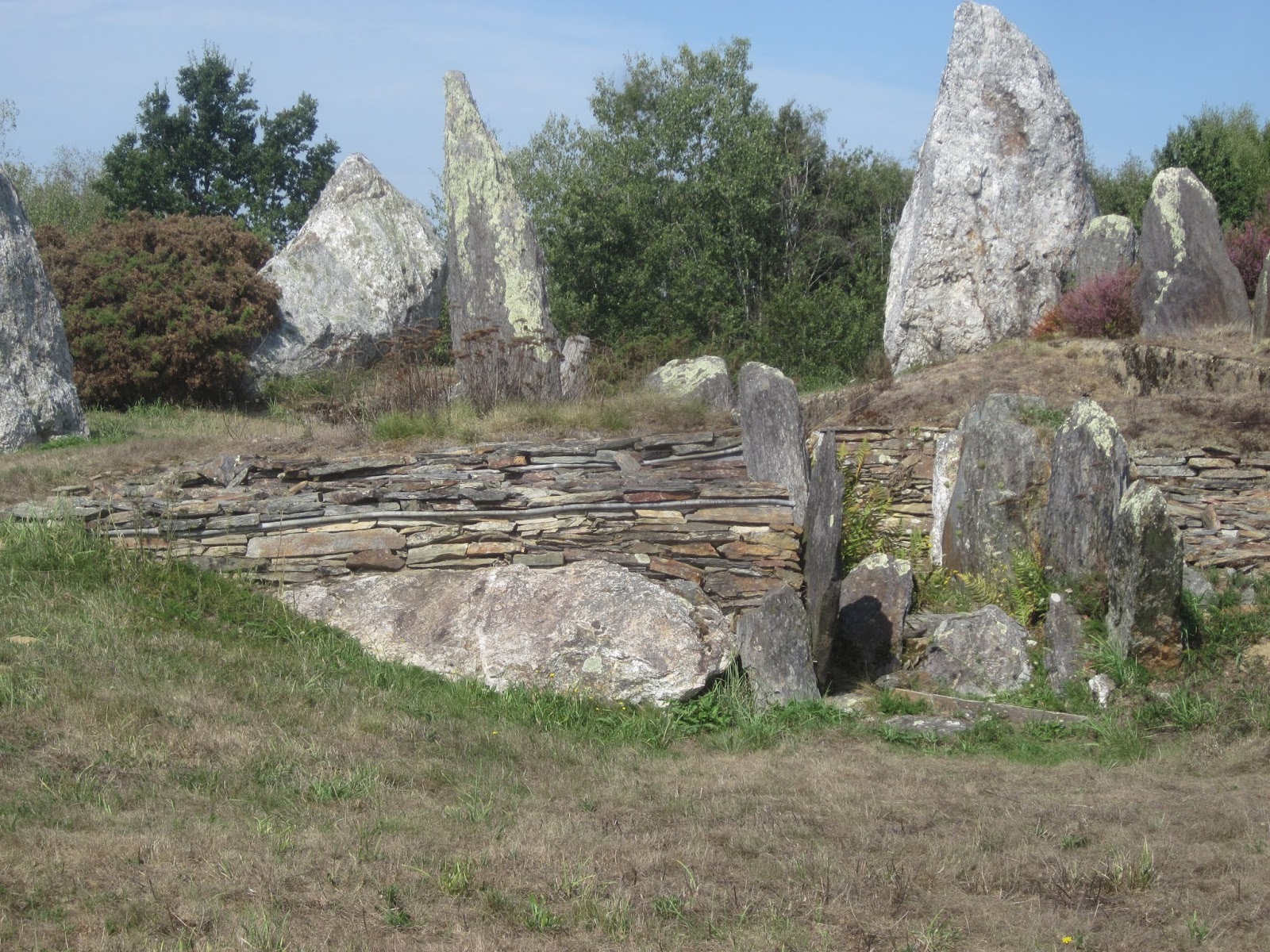
The monuments that I return to again and again are the Alignements du Moulin and the so-called Tribunal, the latter mooted as a stone age calendar, but named for its appearance of a row of judges and the accused. The 12 menhirs of the alignment, made of schist and organised east/west, are like people in their individual shapes, character and relative placings - a family photo covering the generations. Funerary remains found on excavation date to about 4700BC: the standing-stones came later. The function of the stones themselves or their role within the overall structuring of the whole complex is impossible to say. They appear to be on course to meet at a point with the line of chubbier quartz stones to the north. A further north/south line is suggested by a few remaining small stones.
What is so extraordinary about this site is the constant unfolding of remains, the accumulation of death, here, there and everywhere around the main path which forges across the open centre of the plateau. The loftiness of the location was obviously significant, and its dramatic end, abruptly above the valley of the river Canut and the Etang du Val.
Chateau Bu
On reaching the pinnacle at the Chateau Bu, with its neolithic burial in lateral chambers and later Bronze Age graves and guardian pillars, it is hard to imagine anything better, but huge complexes of inter-related monuments like the Croix St Pierre arrangements await. The place, even over its significant length, has a clearer sense of unity than Carnac, for example, and is to me much more compelling. The main practical advantage is that there are rarely other people to share the scene outside weekends and holidays. This sense of aloneness amidst serial funerary architecture from nearly seven thousand years ago offers a powerful experience and it was a strangely emotional one this time.
After a few days away, I made a slow journey back, stopping off to see if the megalithic site at Monteneuf in Morbihan had changed much over the years. It has, whether for the better or not is hard to say.
Monteneuf

Saturday, August 17, 2019

A Roman site

Yesterday I was in Locuon, looking at the Roman (and probably earlier) quarry which provided stone not only for the locality, but for the new town established at Carhaix, 27km away, in the 1st century AD. A Roman road from Vannes passed near the site, facilitating transport of stone blocks, and excavations of this track found parts had been paved in the same material. The sheer rock faces are like living walls, ferns burgeoning in the damp green light of the pits. The whole site has a subterranean feel as the trees close in overhead creating a sensation of being underneath a porous layer. Soft and crumbly to the touch, Locuon granite is a light grey/white in hue and smooth in texture, giving it almost the appearance of marble.

The approach is down a monumental staircase, thanks to the sacralisation of the site, with a chapel, Madonna in a niche on the quarry wall, fontaine and lavoir on a lower level. The current chapel is 17th century and shows off the potential of the building stone, but there were certainly earlier versions, as a line of probable roof support holes in the cliff behind indicates. This granite wall also includes a carved face and cross motif. Facing the statue of the Virgin Mary is the headless statue of a pagan goddess, fixed to the bottom of the staircase parapet.
Descending to a lower level of the quarry, a spring pours out of a sculpted surround in the rock and the water is carried via a slate enclosed channel to the washing basin. Here is the first of a group of contemporary art pieces, a rather dog-like curled wolf on a platform raised above the water. Pushing further into the dells of the quarry, there are rocks incised with criss-cross pattern and, more impressively, a 'boulder' held in the thin branches of a tree. This was actually made in situ by Yuhsin U Chang, from wool over a wooden frame.
After a lengthy site inspection, I set off for a few kilometres on the former Roman road.