
Sunday, July 12, 2020
Book-signing


Wednesday, July 08, 2020
Newsletter

Anyone who would like to be on the mailing list to receive about 10 issues a year of this emailed PDF document, can contact me at mewes@orange.fr or on Twitter @brittanyexpert Your details will only be used for this purpose.
Tuesday, June 30, 2020
Le Canal de Nantes à Brest - French guide now out
It's out! French version of my very popular Nantes-Brest canal guide, which is now in a fourth edition in English. Every inch of the 361 km mapped, accommodation, shops, refreshments, all updated this year. The introduction has a history of the canal and there is also much practical information about locks, nearby sights along the way and details of connected walking/cycling circuits along the entire length.
Le guide indispensable à vélo ou à pied! www.reddogbooks.com

Le guide indispensable à vélo ou à pied! www.reddogbooks.com

Thursday, June 25, 2020
Bretons: Mai Le Manac'h, Lady Mond

This is an
extraordinary ‘rags to riches’ story. Mai Le Manac’h, daughter of the miller at
Prat Guéguen in Belle-Ile-en-Terre, rose through an unconventional life to
become Lady Mond, wife of the ‘nickel king’ millionaire Robert Mond. From a simple
Breton childhood she came to enjoy enormous wealth and glamorous lifestyle, but
she remained inextricably linked with Brittany and her roots.
She was born in 1869,
leaving home as a teenager to seek her fortune first in St Brieuc and then in
Paris. Here she entered the bohemian world of Montmartre, and this part of her
life is little documented, but on record in 1893 is a charge of indecent exposure for showing herself naked in a restaurant.
She moved to London
after starting a relationship with fruit and vegetable merchant Simon
Gugenheim. They married in 1897 but the union was short-lived as he died of TB
three years later. Mai now moved freely in wealthy circles, and met her next
love at the Savoy Hotel. Becoming the mistress of the Infant of Spain, Antoine
d’Orleans, fixed her place in high society, although it could never lead to a
permanent tie. She returned to Brittany now and again, buying a house in Belle-Isle-en-terre.
 |
| Chateau de Coat-an-Noz |
In 1910 she met rich
industrialist Robert Mond, and this relationship was to last. They wed in 1922
and he was knighted by George V in 1932. As Lady Mond, Mai remained closely
bound to her Breton origins. The couple established their home at the international
resort of Dinard, at the mouth of the Rance, in the Chateau du Bec, which became known as 'Castel Mond'. They funded the first lifeboat for the town in 1924.
For Mai’s 60th
birthday, however, her husband bought her the chateau on the edge of the Wood of the Night (Coat-an-Noz)at
LocEnvel, near Belle-Isle. Many famous people
were entertained here before the war, as Lady Mond was a patron of Breton
culture. Contests of the gouren or
Breton wrestling were also held as this sport was always of great interest to
her. Until very recently this chateau could be seen in semi-ruined state, the palatial interior covered with graffiti. It is now being renovated and off-limits.
Widowed in 1938, Lady
Mond was imprisoned in Guingamp for a while during the occupation, and the chateau seized by the Germans. Afterwards she decided to build a smaller chateau on the site of her father’s
former mill in Belle-Isle-en-Terre. When this on completion was found to be too
near the road, she had it knocked down and rebuilt ten metres back... Her
generosity had already funded many public buildings there – the post office,
town hall, village hall and police station.
She died in 1949 and
was buried in a special mausoleum shared with her husband at Locmaria before
her remains were later removed to England.
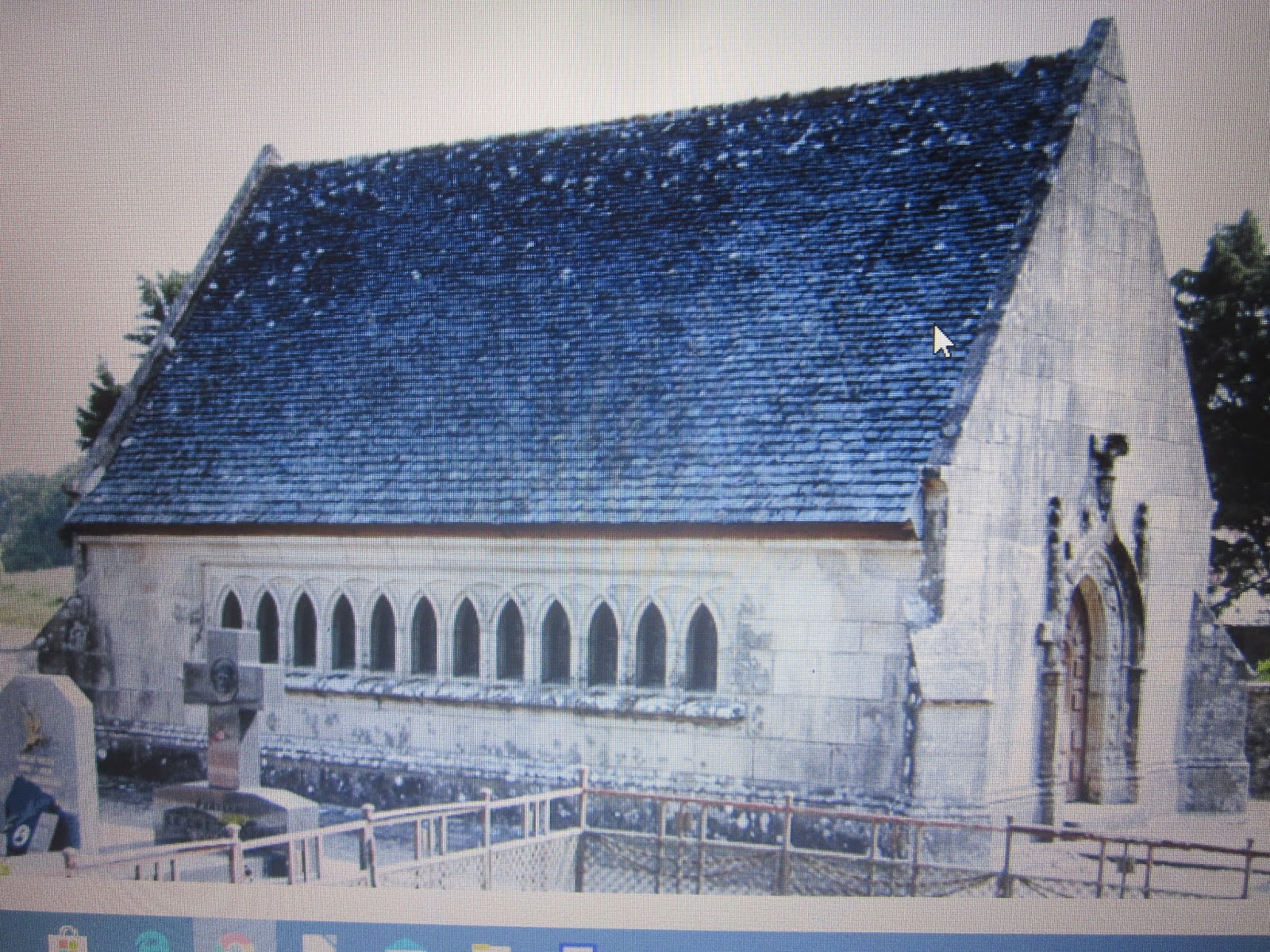 |
| Mond mausoleum |
Friday, June 12, 2020
The bridge that has lost its name.....
 |
| Pont Guern |
Later, in my time here, a wooden passerelle was built between the Pont Guern and the Mare aux sangliers, offering more opportunities for criss-crossing the little river. To reach the Pont Guern from this new feature, an additional wooden walkway ran along the left bank, inches from the water, which runs fast and strong in any rainy season, and the path then leads through woods just above the flow to reach a little boggy meadow by the old slab bridge.

The first sign of this historical corruption came quite a while ago with the appearance of a sign post on the main path above the passerelle, marking the Pont Guern at 150m down the linking path. This was obviously a mistake as the distance to the real bridge from that point is more like 400m. It would be by no means the first time that casual miscalculations of distance appeared in the name of tourism around here. But worse was to follow later. There has been a drive to put up information boards (mostly awful) and new signage in the forest, which is notoriously badly managed in that way. I spend a lot of time each year helping lost visitors. One of the characteristics of forest is that it is disorientating terrain - people unskilled in navigation and with no sense of direction need clear maps and clear signs, neither of which have been available (except in my own guidebook, mapped with GPS).
 |
| Modern footbridge with false name plaque |
POSTSCRIPT to this in the light of responses on Twitter today. Maps of the area made for this year's tourist season mark the new crossing Pont Guern and leave the old bridge off altogether, now denying its very existence.
UPDATE 30/06/20 My meeting with mayor of Huelgoat to ask for some answers cancelled without explanation or apology.
Monday, June 01, 2020
Today's the day

Monday, May 11, 2020
Coming very soon...


Tuesday, April 28, 2020
Nantes-Brest Canal guide - 4th edition

Every inch of the towpath is carefully mapped, with detail of locks and crossing points, direction of flow and distances. Places of interest on and around the canal are given on the relevant pages and there is a long introduction describing the origins and development of this extraordinary engineering feat. We have Napoleon to thank for the go-head for this incredibly expensive and labour-intensive project, with work carried out in fits and starts over twenty-odd years from 1806. The heyday of the canal was in the last years of the 19th century and first decade of the 20th. Burgeoning railways and, after WWI, lorry transport were invincible rivals for this slow form of transport and decline was long and sad, although a few barges operated right up until 1977 when the last load of sand was deposited at Saint-Congard in Morbihan.

Many people do not realise that that the vast majority of the 365km length of the canal consists of beautiful, wide, windy, free-flowing river with few locks, and it is only the connecting sections between river valleys that are the straight narrower channels often associated with the word 'canal'. There is nothing monotonous about a walk or ride across the very diverse territory from Loire-Atlantique to Finistere. The introduction to this guide gives an idea of the changing landscape and atmosphere right across historic Brittany. Better note before planning a trip that the canal actually starts just over 20km north of Nantes and ends nowhere near Brest....
Thursday, April 16, 2020
Simple things will save us
A walking meditation: this little route gives me hope

I start at the bridge, watching the
water, thinking of now and all it is. Yellow is the colour, the colour of
sickliness and fear, but here bright in granitic sand lining the stream bed,
the gleam of mallows in the April sun. First thought: clarity and flow. Quick
movements of nature while we slow down, a reminder of true rhythm.
The first path is through a small
wood. I move into green. How this colour flows differently into the leaves of
spring, the freshness of new beech spurts, the acid of moss, the deep vibrance
of new grasses. Still the darkness of winter in holly and ivy. I have lost my
closest person to the coronavirus, my grief is still green and new. It can only
grow.

At the top of the path, I choose the
right fork into the tiniest of valleys, down steeply in shade to a minute
trickle of water, up steeply into dappled light. My knees feel the gradient,
adding to the stiff joints of mourning. This small interlude is of everyday and
the mundane, a beaten earth path, the basic ups and downs of life moving us
between beauty and disappoinment, between heartache and love, these necessary
intervals of heightened emotion and extra demands. My heart beats faster on the
up. Breath is another sort of up and down. We are forced to relook our now.
Now the way is very narrow between
banks. I think of confinement, a negative connotation, and then of boundaries,
not so bad. Here the path divides a field just ploughed and a tangle of wild
scrub. The tame and untamed, the contrasts of lockdown where we long for mad
outstepping, and the needs of growing food through disciplined work and
management of time. Both are essentials in their way. The making of land calls
it. I long for the uncontrolled, but my need for rage is gently diminished, as
I tread through.

At the end, I stop. A beautiful oak
is getting ready to bloom, on a gilded spread of celandines. The next throw of
the path is obscured around a sharp bend. This is a pause before new knowledge.
My grief is soft and settling in the stillness. Things are happening quietly
around and within. A bird reminds me of melody. An encouragement of song, that
stirs my tired heart. Half life is on fire, the other half is burnt and gone.
Around the corner, the sense of more
up is daunting. We imagine sunken ways downwards. I have the sensation that I
have shrunken within these banks. Trees are huge sometimes. But I feel
escorted, a ribbon of bluebells at my ankles. There is always path as long as
we can walk. Here I am just the little brown thing waiting to green.
Second pause. Everything so far has
been immediate. From this point suddenly I can glimpse across the valley the
houses at the top of town, and my mind surges out. What is yellow and green in
the world right now, what are the boundaries to be faced, the vistas cut off,
the friendly access denied? If compassion were contagious. Any path can lead
anywhere because our minds are beyond restriction.

Back to now and here. Ahead is a
tunnel of foliage stretching uphill to where it will end at a little road, and
just before that the rock that is my marker, my goal. I am feeling the rock
from a distance through a fug of horse smell and the wasted effort of recently
severed tree trunks. The rock is still, waiting for me. I can finish with the
touch of a friend.

Meditation is over. I turn back, and
at once the dog runs up for his treat, part of it all again.
Sunday, March 29, 2020
Two weeks in lockdown

Here in rural Brittany people are calm and daily life is orderly, with no shortages or panic buying, and most people observing a distance from others. The lake path and waterside parks have been forbidden to all of us trying to exercise and walk our dogs. There has been no edict issued about the forest, and as I live on the edge, I have made short excursions out and back, keeping to the regulations of remaining within one kilometre of home. A few days ago I was stopped by the police a few metres from my house and asked to produce the form of attestation. I only had the old one and with the wrong date, but was let off with a warning to print out a new form every day. Honestly and surprisingly, I don't enjoy the dog-walk, feeling it a daily pressure and stress without solidly clear guidance of where one can go.
Mentally I am starting to struggle a little. Unable to concentrate well and lacking any urgent current project, it is hard to structure the day and I fritter away time, unsettled and frustrated with myself. So far I have baked a lot and watched the 1967 version of the Forsyte Saga. I do some basic stretching exercises and a short Tai Chi routine every day but my body feels torpid and full of aching joints. My arthritic hand is much worse and gives constant pain, making writing difficult, even if I could muster the concentration. The easy flow of creativity has completely departed from my life under these conditions.
Day 13
I have made a cogent effort to use my time better, at least to complete a few basic tasks every day and then not worry if nothing else is achieved. I've expanded Tai Chi and bodywork meditations to an hour and devoted the same amount of time to my new novel, so it grows at least by a few paragraphs a day. My spiritual practice remains strong since my retreat last month, which was in fact good training for the current situation. This moderate level of activity is enough for me, but the steady routine has actually made me much less anxious and more able to get things done generally. I need medication soon and am hesitating between asking someone younger and fitter than me to get it or go myself. I have not set foot in the town or any shop since this started and feel reluctant to cross that line and take the risk. My immunity is low and keeping away from people seems an imperative. On the other hand, I obviously don't want anyone else to suffer on my account. On dog walks I rarely see another person and no-one at close quarters. The healing hush of the forest is powerful at a time like this, when atmosphere is heightened by our fears and sensitivity to the unusual flow of energy that prevails in this strange suspended framework of changed life.
Wednesday, March 18, 2020
Bretons: Vefa de Saint-Pierre

As a child she wanted to dress like a boy and harboured ambitions of running away to sea. Hunting was a real passion from an early age and throughout her life, guns were never far away.
At 18 she joined a nunnery, perhaps a surprising choice for one of such decidedly strong and individual character, but it did mean she got to go on her first significant journey, a mission to the Equator in 1899. This fuelled the thirst for long-distance travel which was to be another theme of her life, with a visit to America and Canada in 1906. By this time she had left the religious order definitively without taking orders or being thought suitable to take them by her superiors. She met President Roosevelt and spent a lot of time delightedly hunting caribou.
Back in Brittany in 1908 she bought the Manoir de Menez Kamm near Spézet which was to be her beloved home for many years. It was situated in prime hunting territory and she was soon well-known for fearless pursuit of the local wild boar. She learnt Breton and became an ardent (and militant) advocate of Breton history and culture, hoping for the kind of revolution in Brittany that Ireland had seen. She gave money and moral support to many Breton nationalist projects and local organisations, and was closely involved with Gorsedd bardic community. In 1930 she was given the bardic name Brug ar Menez Du (Heather of the Black Mountain).
She had a very lively intelligence, bent on constant learning throughout her life, whether languages, geography, natural sciences or theology, remaining a devout and committed Catholic. She also wrote poetry, although always very modest about her talents. A round-the-world trip in the 1920s gave her the chance to write about her travels and encounters for magazines and papers, as she visited Australia for an international Christian conference.
After the war, her beloved home was used as a centre of Breton culture, as she provided free bed and board for many writers and musicians. As old age loomed, she herself was increasingly based in Saint-Brieuc, until her death there in 1967. Claire Arlaux's engrossing biography tells the whole story of an exceptional and remarkable figure in 20th century Breton history, giving a new perspective on pre-war nationalism and subsequent cultural development.
Saturday, February 29, 2020
On the other side of silence

On the first day, my energies and thoughts were a bit scattered as I broke customary patterns of computer use, using the time to make notes on the first question on my list for consideration, about one aspect of my life that needs decisions. I also revisited my personal values list and thought carefully about their relevance to the choices I must make. On my two walks I kept very much in the moment - no emails to think about or anticipate - and struck up acquaintance with two trees of powerful character that I have passed a hundred times before without looking or listening attentively. This was something precious in the way of connection that repeated as the week went on.
I also read a lot - Greek myths, a book on extending paganism beyond the superficial - meditated and used various methods of divination on the question of the day. I was very tired at the end of this first day, but had concentrated throughout almost effortlessly, as all distraction was off the table.
Too much happened to detail each day of the 'retreat' and some of it was far too intimate and extraordinary to write on a public blog, but moments of spiritual intensity and meaningful communication were not lacking. I read a powerful book about ritual and an academic history of paganism. I wrote the preface of my new novel and conceived an ambitious new writing project that would change the whole focus of my work if it turns out well. I made a couple of decisions that have been difficult to resolve in recent months and felt all my thinking clear and sharp from the second day. Some personal issues simply resolved themselves in the course of the week without special attention.
There was no problem whatsoever with the silence, no desire to break it or to communicate with any of my human connections. I slept long hours and by the last day my body was just about catching up with everything and relaxing in the space and silence that filled the house in a resounding way. I recommend the practice to anyone seeking clarity or peaceful development and would love to hear the experiences of others.
Saturday, February 08, 2020
Bretons: Theophile-Malo Corret de la Tour d'Auvergne

His life (1743-1800) is celebrated in Carhaix, his birth-place (unless it was nearby St Hernin), with a statue in his eponymous square. The tribute portrays scenes from his astonishing military career, where he was highly respected by his men and regarded as having a charmed life. But he was also an accomplished scholar, and rarely seen even on campaign without a book.
Théophile-Malo Corret grew up in the Chateau de Kergoat and was educated at the college of Quimper before joining the Mousquetaires du Roi. Later serving the Régiment d'Angoumois, he went on to fight in Spain against the English. In 1777 he added De la Tour d'Auvergne to his name after discovering a link with this famous noble family. He was unusual in refusing promotions and honours, such as the rank of colonel, and only accepting to be a captain in the grenadiers in 1792, when he fought in the Republican army after the French revolution.

 |
| Musée de la Révolution française After seeing service in the Savoy region and the Pyrenées, he intended spending his retirement in Carhaix but was captured by the English navy off Brest in 1794 and forced to spend several years in a pontoon prison ship on the south coast of England. During this period of captivity and subsequent residence in Paris, he worked on the ambitious project of producing a dictionary comparing 42 languages. This was never completed. |

Wednesday, January 22, 2020
Ile de Houat
 |
| Port St Gildas and the ferry |
Today was beautifully clear and sunny, but the wind was cruel and made what should have been a great day's walking into a bit of an ordeal.
 |
| St Gildas on his death-bed |
 |
| Sacred spring of St Gildas |
That said, the tiny bourg is attractive, despite everything being firmly shut on this January day and no-one about. I was the only outsider on the boat over from Quiberon, the other fifteen or so being welcomed by family on arrival or carrying large cool boxes for some kind of shell-fish activity. On the return journey huge whole fish were stacked in iced crates on the passenger deck.
The scenery of the island is magnificent, with a coastal path of 17 km in entirety and no constructions outside the one village - with the exception of three forts from the 19th century, one at each end and one on the highest point of the island.
 |
| Mairie |
 |
| Fort, now offering accommodation |
I shall explore some of the interesting history of the island in my book and definitely return for more of the wild beauty of the landscape on another trip outside the winter months. It is only a 40 minute run on the ferry from Quiberon - weather permitting.

Tuesday, December 31, 2019
Walking the wild coast

The pinchpoint of the promontory is only 22m wide, enough to carry the main road and a railway that joined Quiberon to Auray from the 1880s. Until the 11th century the Presqu'ile was a real island, but widespread deforestation led to the sanding up of a narrow spit or tombolo to join the mainland. The landmark Fort de Penthiévre was built in the mid 18th century after English raids on Quiberon, but it played a better known role in the disaster of 1795, when briefly held by royalist emigrées who had landed near Carnac but then been forced back onto the peninsula by the Republican army.


Sunday, December 29, 2019
Manoir des Indes
 |
| Manoir des Indes |
I spent a night to celebrate my birthday this Christmas at the 4* Manoir des Indes, set in a large park, beside Quimper's western ring-road. This manor house was built by René Madec, a son of Quimper from lowly origins, who joined the navy at the age of 11 and later arrived in India on a boat of the Compagnie des Indes. He fought the English under the command of Dupleix (who is also honoured in Quimper, giving his name to one of the quays). Through mercenary activity in the many wars in India, Madec rose to the status of nabob and a fabulous fortune in his own right. He was at the siege of Pondichery in 1778 with 6000 men.
Returning to Brittany the following year, Madec was ennobled by Louis XV. The town house where he settled in Quimper is marked today by a plaque from the local pottery showing him in full Indian dress, and he was a familiar sight on horseback along the banks of the Odet. He also bought up land on the outskirts of the town in Pluguffan and Penhars, building the lavish house now converted into a hotel on the site of a former manoir, whose chapel can still be seen.
 |
| rue René Madec, Quimper |
 |
| Cellar pool |
Sunday, December 22, 2019
Solstice

Saturday, December 07, 2019
Wayfaring update

Thursday, November 07, 2019
Citizen
 |
| About to cross the bridge and enter the round doorway of the Prefecture |
After mulling for a long time over whether this really mattered and deciding it did, finally I wrote to Président Macron - this is easy to do through the Elysée Palace website - and asked for his help. His office replied to me within a week and soon after, lo and behold, I received a letter from Quimper assuring me I would be on the list for the next ceremony. It is a pity that it takes the Président of the Republic to make an administrator in Quimper do their job correctly and politely.
So it happened this week, a grand official occasion, admirably presided over by Aurelien Adam, the new Directeur de Cabinet du Préfet, who was excellent in every way. I was quite moved by his words and the sense of significance he managed to convey. I even had a few personal words with him later on as we both left the building at the same time. There were many people there, more than 150 including those receiving the official decree of citizenship and their family and friends. I really enjoyed seeing some of the palatial rooms of the Prefecture, and singing the Marseillais with a large group of many nationalities of all ages, united by our Frenchness. The only time I heard a language other than French was when two British people saw fit to speak loudly in English just before the ceremony began. I edged as far away from them as I could get.
 |
| Monsieur le maire me soutient |
Friday, November 01, 2019


Subscribe to:
Posts (Atom)
